Zooniverse blog from #ZooCon13
In case you missed it, there’s plenty of Galaxy Zoo in @chrislintott‘s blog from #zoocon13
ZooCon Oxford is Tomorrow!

After a very busy week, I’ve suddenly had the happy realization that ZooCon ’13 (in Oxford) is tomorrow.
Okay, it’s not like I had completely forgotten about it – I’ve been thinking about what I want to say in my talk and discussing the schedule with the other organizers for a while now – but what a lovely feeling to suddenly connect that the thing you’ve been looking forward to as an opportunity to meet some interesting people and talk about interesting stuff is less than 24 hours away!
There’s still time to register: just go to the Eventbrite page and sign up (it’s free!) and we’ll see you tomorrow.
I’m planning to talk mostly about the future of Galaxy Zoo, including CANDELS and other projects as well as interesting new tools to enable different kinds of collaborative science, including volunteer-led science. But I’m most looking forward to the other talks, which will include updates from Old Weather, Space Warps and Planet Four.
What are you most looking forward to?
(Besides the pub afterwards, of course!)
Clicking 10 Billion Years Into The Past
Astronomers use funny units. We have the light-year, which sounds like a time but is actually a distance. There’s the parsec, a historical (but still used) unit of distance that was famously mis-used as a time in Star Wars. And then there’s redshift, which is actually a velocity — distance divided by time — but which, because of the expansion of the universe, astronomers get to use as a proxy for distance.
While it may be convenient for us to use distance units where we set a mind-blowingly large number equal to 1, it doesn’t really help us communicate our work to the public. If I note that the galaxy images from CANDELS look a little different from the galaxies in the SDSS because the CANDELS galaxies are typically at a redshift of 2, that’s pretty meaningless. But it’s a little different to think of the fact that, when you classify a galaxy from CANDELS, you may be looking three-quarters of the way to the edge of the visible universe, and seeing the galaxy as it was 10 billion years ago.

Okay, that’s kinda cool.
During this hangout, we announced that your clicks and classifications of the CANDELS galaxies have been moving at such an impressive rate that the first round is finished. Every galaxy has enough classifications for us to get a very good sense of what its morphology is. It may be that, for some of the galaxies where there are clearly more details to flush out, we will ask for a few more classifications per galaxy. And there will probably be future CANDELS images from survey fields that are still being completed. So, don’t worry, there will still be plenty of opportunities to classify galaxies as they were 10 billion years ago!
In the meantime, though, we’re getting ready not just to do the scientific analysis, but to share Galaxy Zoo results with our colleagues around the world. The summer conference season is upon us, and many of us have given and are giving talks and posters at various meetings in various cities. This includes not just the recent meeting highlighting the importance of galaxy morphology in the era of large surveys at the Royal Astronomical Society and the upcoming ZooCon in Oxford and Galaxy Zoo meeting in Sydney, but also several more general conferences, including the 222nd American Astronomical Society meeting and the upcoming UK National Astronomy Meeting. Spreading the word about the scientific results we’re finding with Galaxy Zoo is one of the most important parts of our job — and it doesn’t hurt that in order to do that we have to visit some very interesting places. During the hangout we chatted a bit about that and also took some of your questions:
Note: although it was a beautiful sunny day in Oxford, the variable audio quality is not because I was occasionally distracted looking out the window. I don’t think it was the new microphone, either. We’ll look into it, but in the meantime I’ve tried to equalize the podcast version with some after-editing, so hopefully that is slightly better.
A Galaxy Zoo science team dinner
Almost a month ago now, Galaxy Zoo hosted a Specialist Discussion at the Royal Astronomical Society in London, on the topic of Morphology in the Era of Large Surveys. It was actually a wonderful day full of interesting talks and discussion, and we will be sharing more of the science content from the discussion as soon as we find time to put that together.
One of the other fun things about this meeting was that as well as the fantastic invited speakers, mostly from outside Galaxy Zoo collaboration, many members of the Galaxy Zoo science team were able to attend and contribute talks. We had representatives of team members from Minnesota, Oxford, Nottingham, Portsmouth, Hertfordshire and Zurich in attendance. It was a great chance for us to catch up both scientifically and socially. Below is a set of round table pictures we took during our “team dinner” that Friday night in London’s Chinatown. The captions always list names from left to right. The poor photography is entirely my fault!
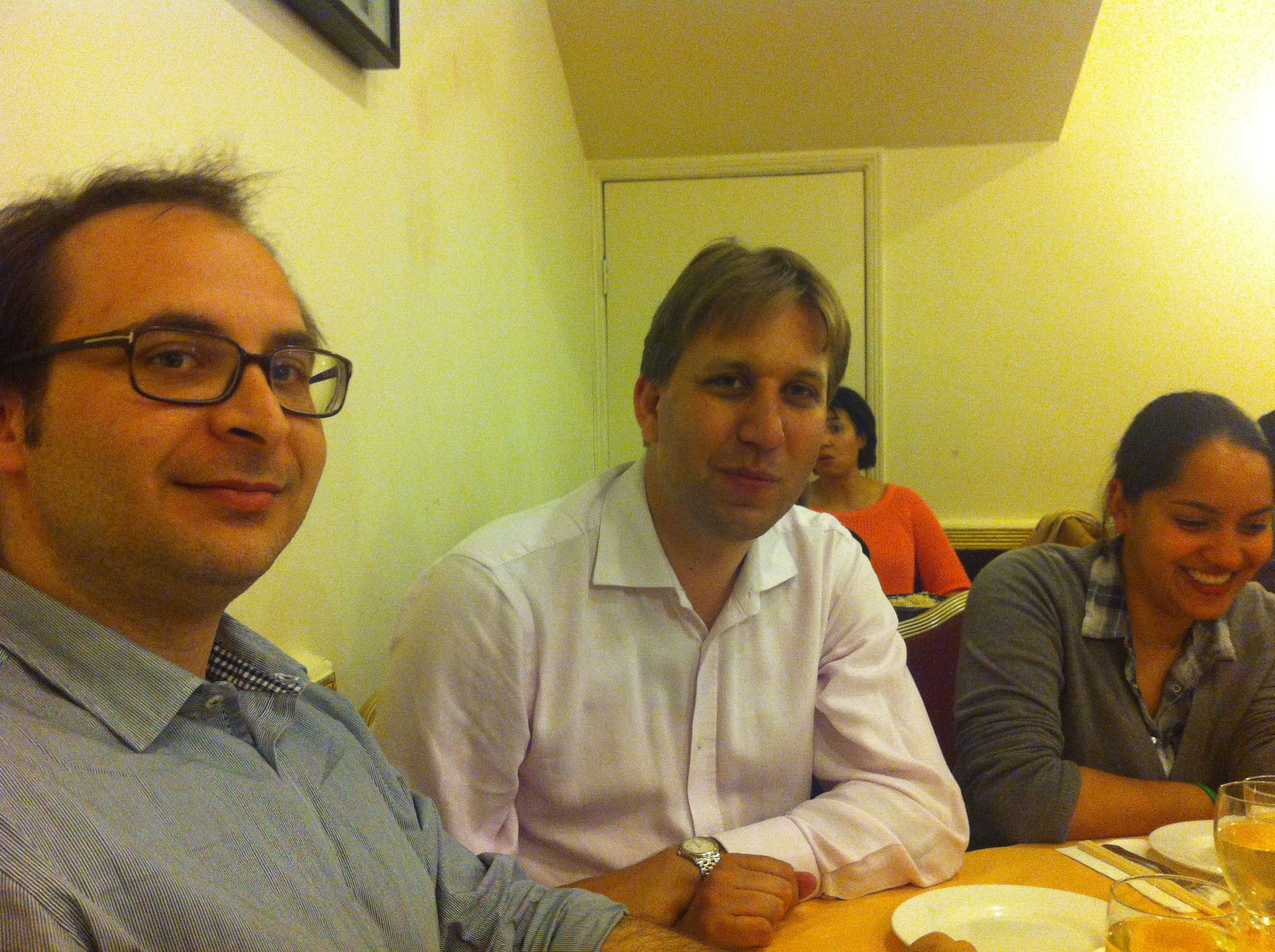
Kevin Schawinski (Zurich, Galaxy Zoo Co-founder); Chris Lintott (Oxford; Galaxy Zoo Co-founder and “PI of the Universe” – or maybe just the Zooniverse is enough); Jen Gupta (Portsmouth – Zooteach/Education)

Sugata Kaviraj (Oxford -> Hertfordshire, Dust lanes in early types and more); Tom Melvin (Portsmouth PhD student on redshift evolution of bars); Steven Bamford (Nottingham, GZ1 Data Guru, Colour-morphology and environment and more)

Kyle Willet (Minnesota; GZ2 Data Guru), Brooke Simmons (Oxford, Black Holes in Bulgeless Galaxies, Google+ Hangouts and much more), Boris Haussleur (Nottingham->Oxford; CANDELS team member)

Karen Masters (that’s me – Portsmouth, Galaxy Zoo Project Scientist), and back round to Kevin.
Next GZ Hangout: Thursday, June 6th, 15:00 GMT
It’s been a while since we’ve had a hangout — how about this Thursday?
8:00 PDT, 11:00 EDT, 15:00 GMT, 16:00 BST, 17:00 CET, 18:00 CAT. Have questions? Post them here or tweet at us (@galaxyzoo). Just before the hangout starts, we’ll embed the video here so you can watch from the blog.
The best way to send us a comment during the live hangout is to tweet at us, but you can also leave a comment on this blog post, or on Google Plus, Facebook or YouTube, which we’ll also try to keep an eye on. See you soon!
 Galaxy Zoo