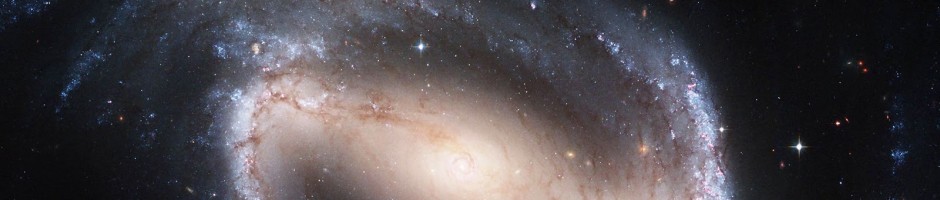
Astronomy & Geophysics Article on Arxiv
Just a quick note to say that the Astronomy & Geophysics article some of us wrote to review the Specialist Discussion we ran at the Royal Astronomical Society in May is now posted on the arxiv. A&G is the magazine of the RAS (so I get a copy, like all RAS members), but also makes some articles free to read for all (Free editors choice articles) – and in this case the entire magazine was made open access.
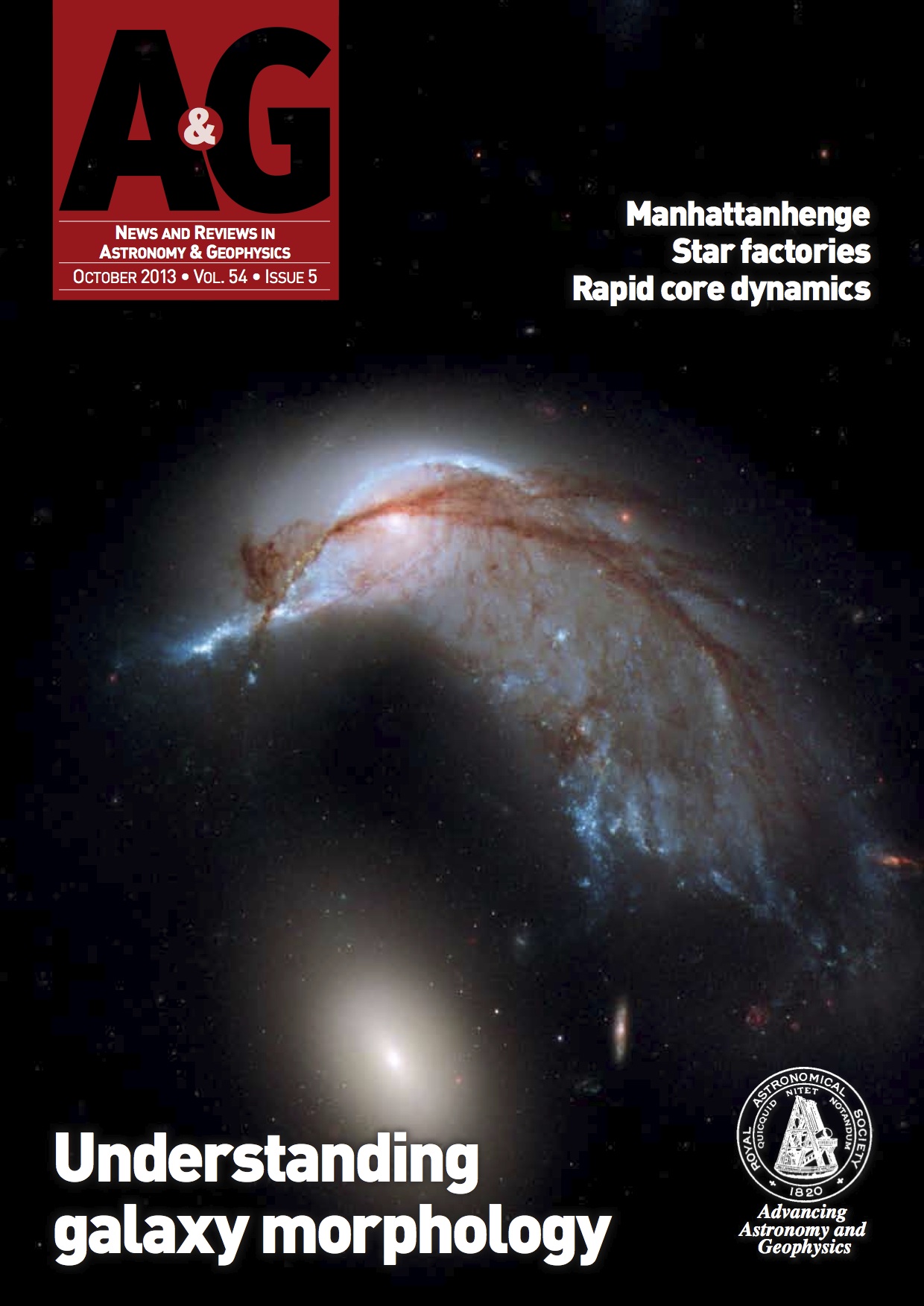
You might remember this article and the offer of a cover spot for a Galaxy Zoo related image sparked a vote for your favourite image, which was won by “The Penguin Galaxy”.
Here’s the lovely cover art to finish off the post.
And the winner is….. Arp 142 (The Penguin Galaxy)
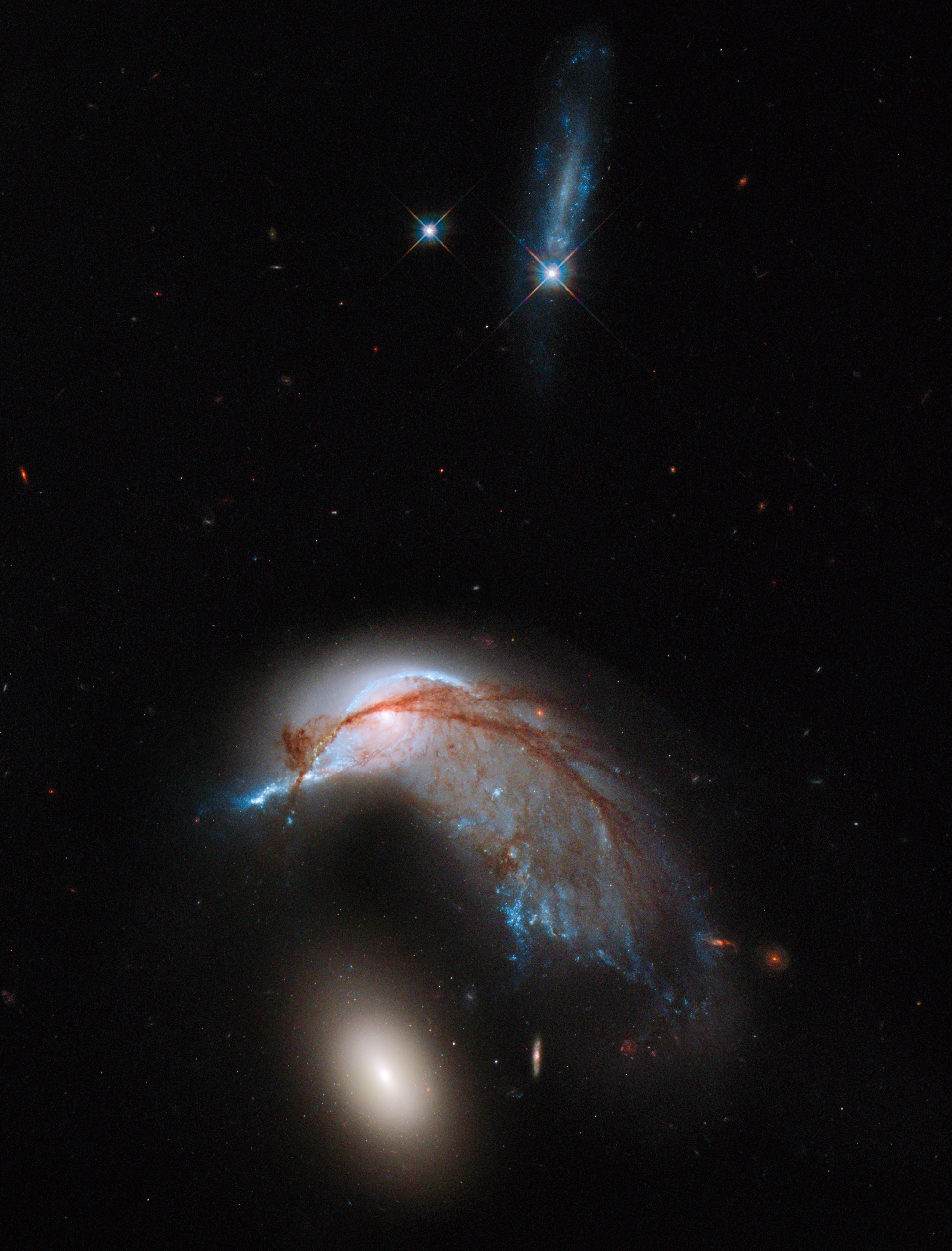
Well it was a very close fought battle, but the winner of our fun vote to pick the cover image for the October A&G was:
Apr 142 (aka The Penguin Galaxy):
I include below a screen shot of the poll from today, which confirms that choice. We have now sent this choice to the cover editor, so we won’t count any more votes.

Using Galaxy Zoo Classifications – a Casjobs Example
As Kyle posted yesterday, you can now download detailed classifications from Galaxy Zoo 2 for more than 300,000 galaxies via the Sloan Digital Sky Survey’s “CasJobs” – which is a flexible SQL-based interface to the databases. I thought it might be helpful to provide some example queries to the data base for selecting various samples from Galaxy Zoo.
This example will download what we call a volume limited sample of Galaxy Zoo 2. Basically what this means is that we attempt to select all galaxies down to a fixed brightness in a fixed volume of space. This avoids biases which can be introduced because we can see brighter galaxies at larger distances in a apparent brightness limited sample like Galaxy Zoo (which is complete to an r-band magnitude of 17 mag if anyone wants the gory details).
So here it is. To use this you need to go to CasJobs (make sure it’s the SDSS-III CasJobs and not the one for SDSS-I and SDSS-II which is a separate page and only includes SDSS data up to Data Release 7), sign up for a (free) account, and paste these code bits into the “Query” tab. I’ve included comments in the code which explain what each bit does.
 -- Select a volume limited sample from the Galaxy Zoo 2 data set (which is complete to r=17 mag).
 -- Also calculates an estimate of the stellar mass based on the g-r colours.
 -- Uses DR7 photometry for easier cross matching with the GZ2 sample which was selected from DR7.
 -- This bit of code tells casjobs what columns to download from what tables.
 -- It also renames the columns to be more user friendly and does some maths
 -- to calculate absolute magnitudes and stellar masses.
 -- For absolute magnitudes we use M = m - 5logcz - 15 + 5logh, with h=0.7.
 -- For stellar masses we use the Zibetti et al. (2009) estimate of
 -- M/L = -0.963+1.032*(g-i) for L in the i-band,
 -- and then convert to magnitude using a solar absolute magnitude of 4.52.
 select g.dr7objid, g.ra, g.dec,
 g.total_classifications as Nclass,
 g.t01_smooth_or_features_a01_smooth_debiased as psmooth,
 g.t01_smooth_or_features_a02_features_or_disk_debiased as pfeatures,
 g.t01_smooth_or_features_a03_star_or_artifact_debiased as pstar,
 s.z as redshift,
 s.dered_u as u, s.dered_g as g, s.dered_r as r, s.dered_i as i, s.dered_z as z, s.petromag_r,
 s.petromag_r - 5*log10(3e5*s.z) - 15.0 - 0.7745 as rAbs,
 s.dered_u-s.dered_r as ur, s.dered_g-s.dered_r as gr,
 (4.52-(s.petromag_i- 5*log10(3e5*s.z) - 15.0 - 0.7745))/2.5 + (-0.963 +1.032*(s.dered_g-s.dered_i)) as Mstar
-- This tells casjobs which tables to select from.
 from DR10.zoo2MainSpecz g, DR7.SpecPhotoAll s
-- This tells casjobs how to match the entries in the two tables
 where
 g.dr7objid = s.objid
 and
 -- This is the volume limit selection of 0.01<z<0.06 and Mr < -20.15
 s.z < 0.06 and s.z > 0.01
 and (s.petromag_r - 5*log10(3e5*s.z) - 15 - 0.7745) < -20.15
--This tells casjobs to put the output into a file in your MyDB called gz2volumelimit
 into MyDB.gz2volumelimit
Once you have this file in your MyDB, you can go into it and make plots right in the browser. Click on the file name, then the “plot” tab, and then pick what to plot. Colour-magnitude diagrams are interesting – to make one, you would plot “rabs” on the X-axis and “ur” (or “gr”) on the yaxis. There will be some extreme outliers in the colour, so put in limits (for u-r a range of 1-3 will work well). The resulting plot (which you will have to wait a couple of minutes to be able to download) should look something like this:

Or if you want to explore the GZ classifications, how about plotting “psmooth” (which is approximately the fraction of people viewing a galaxy who thought it was smooth) against the colour.
That plot would look something like this:
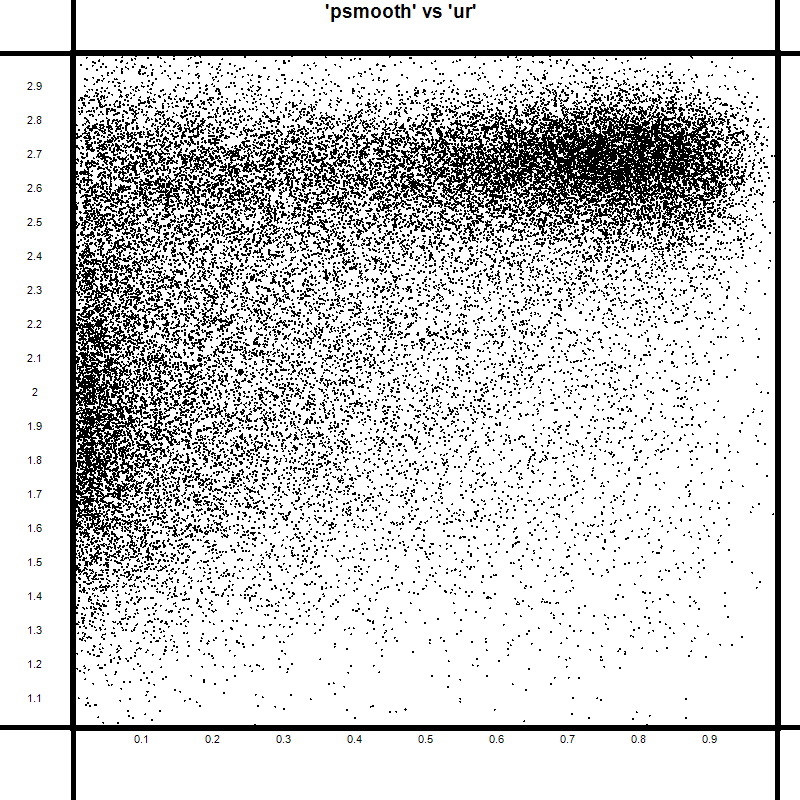
Which reveals the well known relationship between colour and morphology – that redder galaxies are much more likely to be ellipticals (or “smooth” in the GZ2 language) than blue ones.
You can learn more about SQL and the many things you could do with CasJobs at the Help Page (and then come back and tell me how simple my query example was!).
This example only downloads the very first answer from the GZ2 classification tree – there’s obviously a lot more in there to explore.
(Note that at the time of posting the DR10 server seemed to be struggling – perhaps over demand. I’m sure it will be fixed soon and this will then work.)
Vote for the Cover Image of October “Astronomy and Geophysics”

Jun 2013 Edition of A&G
We are pleased to announce an open vote for the cover image of the October 2013 issue of “Astronomy and Geophysics” (the magazine of the Royal Astronomical Society).
A write-up of the Specialist Discussion the science team ran at the Royal Astronomical Society in May on “Morphology in the Era of Large Surveys” is going to appear in the October issue of A&G , so we were asked to nominate a cover image for this issue.
Rather than just have the science team pick our favourite image, we thought it would be nice to open up the choice to our volunteers. After all it’s you that make Galaxy Zoo special, and a unique way of dealing with morphology in the era of large surveys.
So we have put together five images for you to vote on. These are images which would make good covers for the magazine, and which the science team think either have a special connection to the Galaxy Zoo project, or illustrate something special about Galaxy Zoo and its contributions to the understanding of galaxy evolution. Subject to final approval by the editors, the image that wins this vote will appear on the cover of A&G for October 2013.
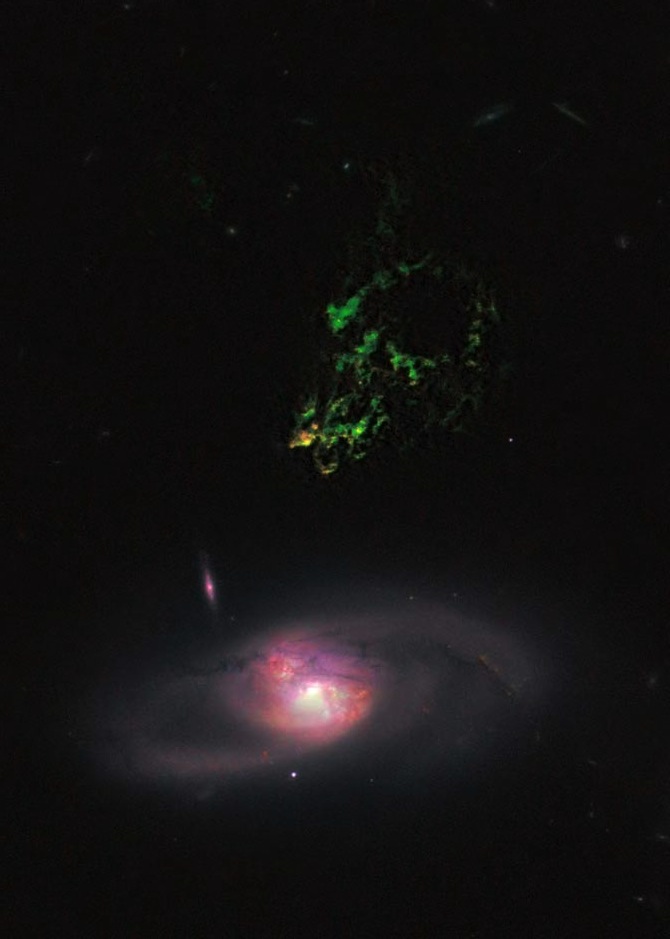
1. Hanny’s Voorwerp – Nominated by PI of the Zooniverse, Chris Lintott (@chrislintott): “Hanny’s Voorwerp is the iconic Galaxy Zoo discovery, the find that demonstrated that as well as systematically classifying galaxies volunteers could serendipitously find marvelous things. A galaxy-scale glowing cloud of hot gas, it tells us that IC 2497, its neighbour, was home to a rapidly feeding black hole perhaps as recently as 50,000 years ago. Hanny’s find inspired astronomers all over the world to point their telescopes at it, and a search for similar objects which has paid spectacular rewards.”

2. NGC 3314 – Nominated by GZ Science Team Member Bill Keel (@NCG3314): “NGC 3314 is a rare superposition of galaxies at different distances, allowing us to measure the effects of dust in the foreground galaxy with unusual clarity. Galaxy Zoo participants made a powerful contribution to this kind of science, by helping to select a catalog of nearly 2000 overlapping-galaxy pairs, many of which have been the targets of further study to help understand how the content and distribution on galaxies change with galaxy structure and size. Furthermore, they are just plain cool.”
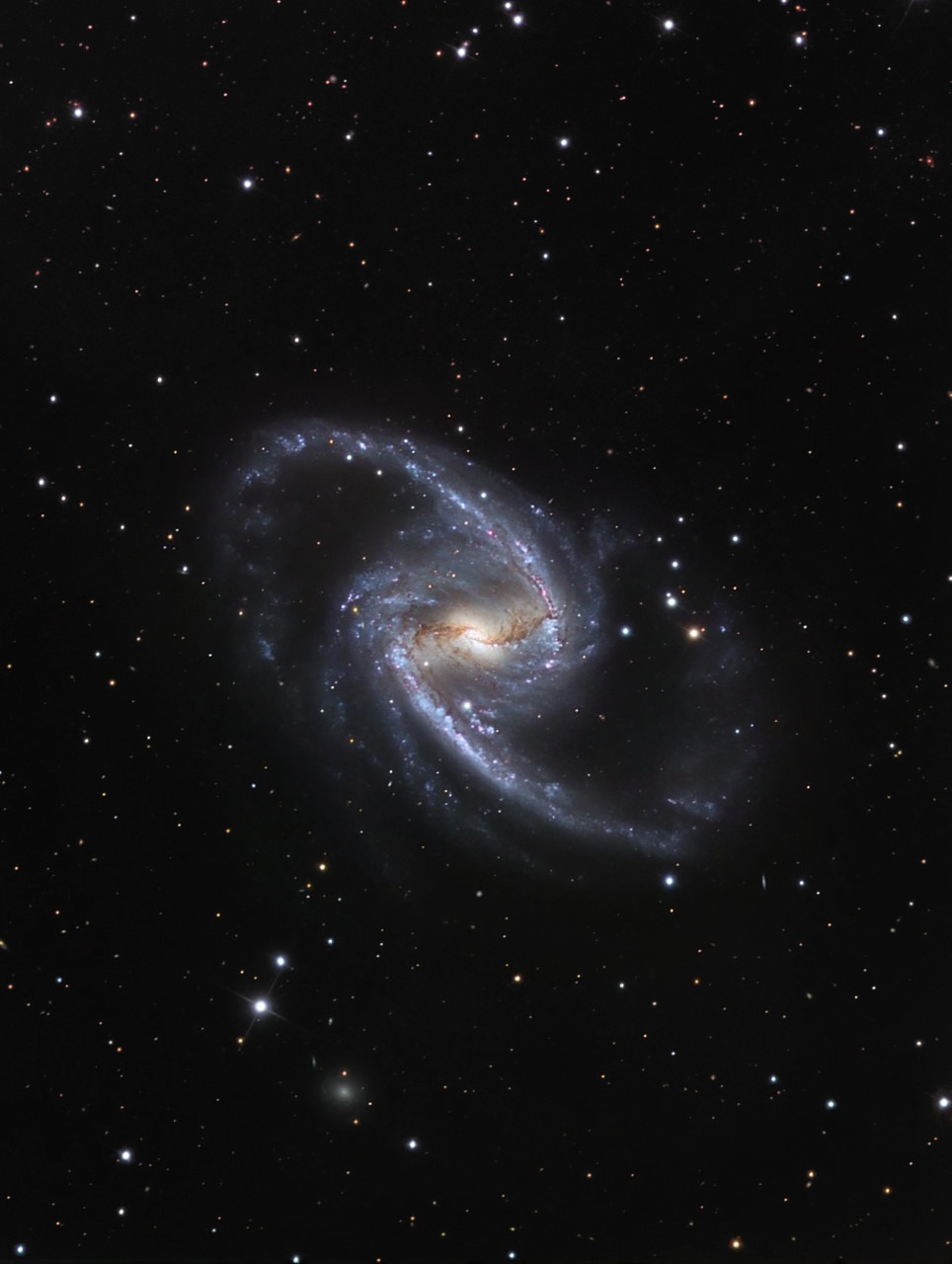
3. NGC 1365 – Nominated by GZ Project Scientist, Karen Masters (@KarenLMasters): “NGC 1365 is beautiful big barred spiral galaxy in the Fornax constellation. Galaxy Zoo classifications of bars in spiral galaxy have contributed to a growing realisation of the important role bars play in the evolution of galaxies, including a possible role in turning spirals red.”
Arp 142, aka the Penguin Galaxy – Nominated by GZ Forum and Talk moderator, Alice Sheppard (@penguingalaxy), who treasures this as her first interesting find from when Galaxy Zoo was first born. Illustrating the fun side of Galaxy Zoo, which involves a zoo of galactic animals and an alphabet of galactic letters, the “penguin” resembles a bird admiring its egg. It was first classified by Halton Arp as a peculiar galaxy: a spiral with lanes of dust and star formation bent out of shape by the intense gravity of an elliptical, and more recently imaged by the Hubble Space Telescope and horrifyingly mis-species-ed by APOD as a porpoise.

5. The Sombrero Galaxy – Nominated by Rob Simpson (@orbitingfrog) from the Zooniverse: “The Sombrero galaxy illustrates really well that galaxies aren’t just filled with stars but also dust. In the Sombrero you can see the thin ring of dust neatly contained inside the disk. This is where the raw material for star formation comes from and we can probe this colder stuff using infrared and submillimetre telescopes. ” The Sombrero also illustrates than not all galaxies fall simply into either spiral or elliptical categories.
Zooniverse blog from #ZooCon13
In case you missed it, there’s plenty of Galaxy Zoo in @chrislintott‘s blog from #zoocon13
A Galaxy Zoo science team dinner
Almost a month ago now, Galaxy Zoo hosted a Specialist Discussion at the Royal Astronomical Society in London, on the topic of Morphology in the Era of Large Surveys. It was actually a wonderful day full of interesting talks and discussion, and we will be sharing more of the science content from the discussion as soon as we find time to put that together.
One of the other fun things about this meeting was that as well as the fantastic invited speakers, mostly from outside Galaxy Zoo collaboration, many members of the Galaxy Zoo science team were able to attend and contribute talks. We had representatives of team members from Minnesota, Oxford, Nottingham, Portsmouth, Hertfordshire and Zurich in attendance. It was a great chance for us to catch up both scientifically and socially. Below is a set of round table pictures we took during our “team dinner” that Friday night in London’s Chinatown. The captions always list names from left to right. The poor photography is entirely my fault!
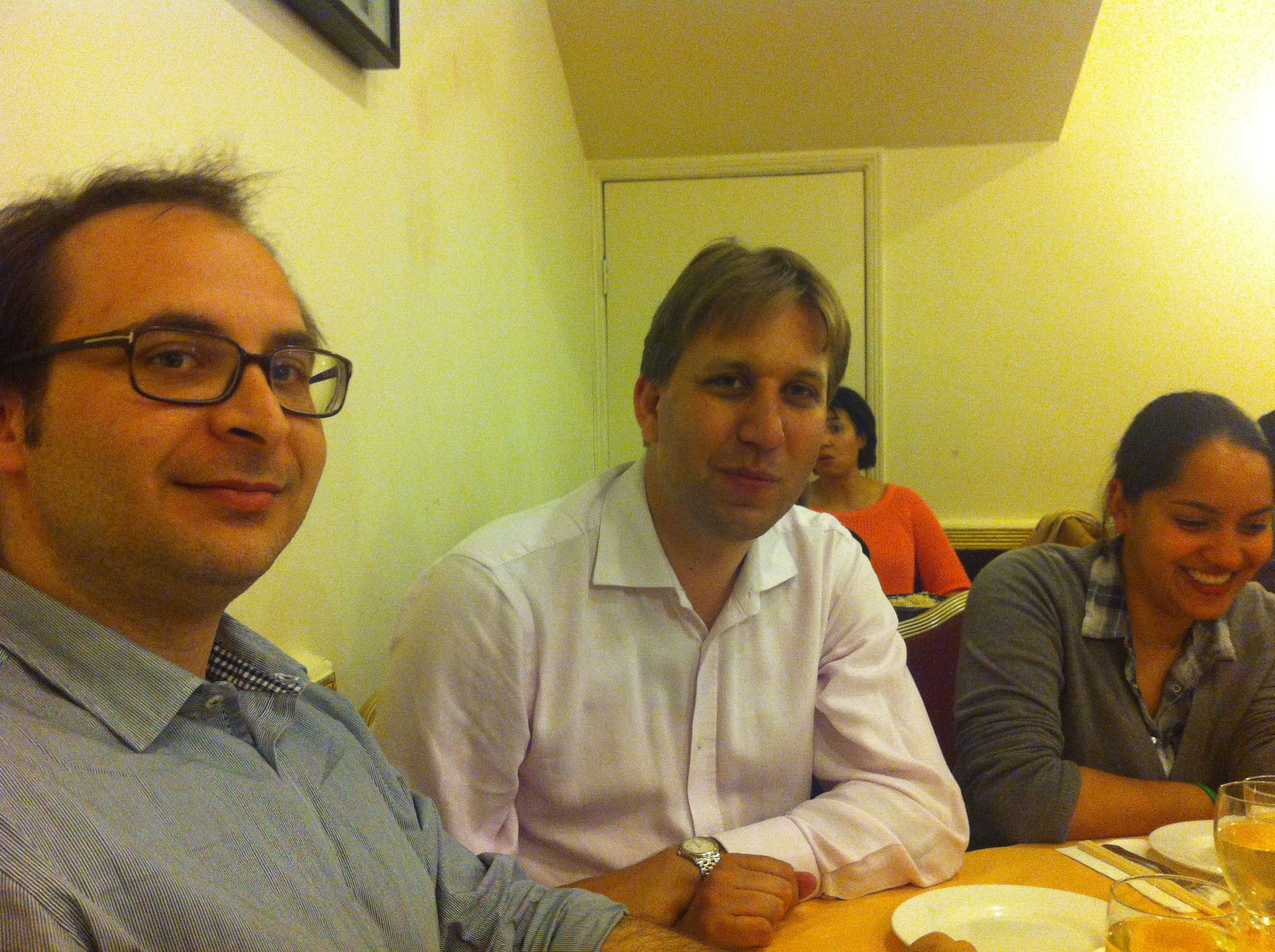
Kevin Schawinski (Zurich, Galaxy Zoo Co-founder); Chris Lintott (Oxford; Galaxy Zoo Co-founder and “PI of the Universe” – or maybe just the Zooniverse is enough); Jen Gupta (Portsmouth – Zooteach/Education)

Sugata Kaviraj (Oxford -> Hertfordshire, Dust lanes in early types and more); Tom Melvin (Portsmouth PhD student on redshift evolution of bars); Steven Bamford (Nottingham, GZ1 Data Guru, Colour-morphology and environment and more)

Kyle Willet (Minnesota; GZ2 Data Guru), Brooke Simmons (Oxford, Black Holes in Bulgeless Galaxies, Google+ Hangouts and much more), Boris Haussleur (Nottingham->Oxford; CANDELS team member)

Karen Masters (that’s me – Portsmouth, Galaxy Zoo Project Scientist), and back round to Kevin.
Cross Post from the Zooniverse Blog: Galaxy Zoo is Open Source
I just wanted to add a link to a post by Zooniverse Technical Director Arfon Smith over on the Zooniverse blog:
Please go there to read it.
This development means coders can “fork” their own versions of the Galaxy Zoo code and help (for example) translate the site into other languages, providing another way for people to contribute to the great science coming out of Galaxy Zoo.
Talk at International Astronomical Union – video and write up now available.
Way back in August I gave a evening (public) plenary talk about “The Zoo of Galaxies” at the 28th General Assembly of the International Astronomical Union. I wrote a couple of blog posts about it at the time (here and a bit more here). Just this week I got word that the video is now available, so here it is:
To go with this I have also posted the “proceedings” (a write-up based on my talks) which will be appearing in the 16th Volume of “Highlights of Astronomy”. This is available on the arxiv. It’s not supposed to be a transcript as such, but if you watch both the video and read this I think you’ll see they’re quite similar.
New paper on Red and Blue Spirals and Ellipticals
Just a quick note to point out a new paper based on Galaxy Zoo classifications appeared on the arxiv this morning (and just accepted to MNRAS): The Differing Star Formation Histories of Red and Blue Spirals and Ellipticals, by Rita Tojeiro et al.
In this work we took samples of galaxies split by their morphological classifications (from you all, and actually going back to the original Galaxy Zoo project) as well as by their optical colour. With the help of an Ogden Trust undergraduate summer student (Joshua Richards) we then compiled the average star formation histories of these samples, based on fits of star formation models to the Sloan Digital Sky Survey spectra of the galaxies (previously published and called VESPA, or “VErsatile SPectral Analysis” by Rita).
Our main result was that red spirals differ in their star formation histories from blue spirals only in the last billion years or less. We also find that blue ellipticals have very similar star formation histories to blue spirals. We show some results about the dust and metal (astronomers metal) content of the galaxies as well. I think it’s a nice project and I’m very happy to see it finally finished and published.
Thanks again for the classifications.
 Galaxy Zoo