Kitt Peak wrapup – for now
The end of this observing run made up for the unnecessarily interesting variety of weather early on. Calm, clear skies, ran through an object list just as fast as we said in the proposal. Here’s a montage of the red-light images from 9 of the target galaxy pairs done on night 4.

That’s it for this run. But we’ll be back there late next month to really clean up the target list.
Night 2 at Kitt Peak – watching out or blown away?
The forecast for tonight’s continued imaging of Galaxy Zoo overlapping galaxies was marginal, with a storm expected. That has not yet materalizd, ut the wind have been so high that, after the anemometer flirted with the 72-km/hour safety limit for two hours after sunset, I finally had to shut down a little whole ago. There are data on two pairs so far tonight, and I’ll naturally keep one eye on the wind speed. If it drops back, I’ll open again.
Meanwhile, there has been time to look over last night’s data and do some basic processing. Here, for example, is a quick and dirty composite image of Markarian 238 and its larger spiral companion from B and R images. The display is set to show the inner structures most clearly.

Markarian 238 and companion from Kitt Peak 2.1m images
Some random thoughts while observing: Cherry Pepsi cans look really weird under a red flashlight. And email today brought some encouraging news on another Galaxy Zoo science front.
(0710 UT, three hours later) The wind continues to howl under a frustratingly clear sky; some clouds are just appearing which may be parts of the predicted storm system. Gusts up to 83 mph (133 km/hour) have been recorded in the last hour. With the outside temperature less than 2 C, I try not to think of the wind chill.
Observing updates – live from Kitt Peak, April 12/13, 2012
(0220 UT) All set up to start work. Worrying clouds have at least temporarily receded. While being checked out by a staff member to make sure I won’t break things, I’ve checked the telescope pointing on a couple of bright stars (Castor and Pollux, in fact) and am just waiting another few minutes for it to get dark enough to critically focus the CCD camera and TV acquisition system. Then off, for starters, to a couple of galaxies that SDSS data suggest might have very extended dust lanes beyond the optical disk.
(I’ll plan to update this over time).
And to all you cosmic partiers, happy Yuri’s Night!
(0345 UT) Got data in B and I filters on one pair, suggested particularly by JeanTate on the forum thread, but those images are pretty ugly because of stray charge from bright stars that will take some processing to fix. Now off to our best case for a spiral with extended dust and no sign of interaction to cause this.
(0507 UT) Looked at SDSS 103427.72+102506.2, still seeing evidence of dust lanes very far out in the galaxy disk. Now doing an edge-on system with dwarfish companion in front.
(0830 UT) Still working away between cloud patches. Now have data on SDSS 1002+1413, UGC 5528, NGC 3605/7. Working on NGC 4377. Reached the stage of night where Mahler seems appropriate to keep alert.
(1025 UT) Nice images of Mkn 238. Now taking a detour, Kazarian 199 for the AGN=companion Galaxy Zoo project. Data from the SARA 1m suggest [O III] clouds which might trace ionization cones, so I’m taking a closer look with the larger telescope. About 1.5 hours left in the night if I arrange the last couple of exposures with their filters in the right order.
Dusty dwarfs from Arizona
How is the latest set of telescopic followups to a Galaxy Zoo project like the aftermath when Moria was delved? One has dwarfs and one had dwarves, and both were dusty. (Look, if you think that’s nerdy, I could have made a reference to First Age history).
Incoming data! This week I’m headed up to the 2.1m telescope of Kitt Peak National Observatory for more followup images of overlapping galaxies. This piece of the project traces to a serendipitous discovery in Hubble data which were intended to study the populations of stars in the outskirts of NGC 253, itself 10 million light-ears away. At the 2008 Austin meeting of the American Astronomical Society, the same one at which we saw the first spectrum of Hanny’s Voorwerp, Julianne Dalcanton of the University of Washington tracked down Benne Holwerda and me to show us this galaxy pair, which rejoices in the designation 2MASX J00482185-2507365:

HST image of backlit dwarf galaxy with dust filaments
Analysis of the dust in the smaller foreground galaxy showed something unusual – there are filaments of dust extending well beyond where we can detect the starlight in its disk. This had us looking for similar cases in the Galaxy Zoo overlap catalog, which should turn them up if any known sample will. It would be important to know whether many galaxies have such distant dust – first because it could alter calculations of how much extinction light from distant objects suffers as it passes intervening galaxies, and in addition because the connection between stars and the production of dust suggests that such galaxies have a complex history of the creation and transport of dust.
Our sample for this observing run centers on galaxy pairs broadly similar to 2MASX (what I wrote above). This kind of galaxy – small, perhaps true dwarfs, with dust in its outskirts – if common, would solve a question posed by recent statistical data from the European Space Agency’s massive Herschel infrared observatory (continuing its mission at four times the Moon’s distance as long as the liquid helium lasts). In the whole population of galaxies seen in deep surveys, some of their IR spectra would be best explained if a significant amount of their dust is so cold that it must lie far from the galaxy’s stars order not to absorb enough energy to heat it further. Our approach is to take CCD images with much longer exposures than the SDSS data, so we get better data quality in the outskirts of the galaxies and could detect dust filaments like those seen in 2MASX – whatsitsnnme.
The weather forecast at this point suggests that I may get about half of the time over our four scheduled nights (we have more next month). Watch this space for progress reports…
Hubble results on Hanny's Voorwerp – the whole story
We just submitted the journal paper describing the Hubble results on Hanny’s Voorwerp, to the Astronomical Journal. It’s not on arxiv.org yet – you can get a PDF here. Here’s a “brief” summary.
Data: In this paper we look at a whole collection of new data, obtained since the original discovery paper. These include:
Hubble, of course:
– WFC3 (Wide-Field camera 3) images in the near-ultraviolet, deep red, and near-infrared. These filters were designed to exclude most of the light from the gas, so we could look for star clusters, especially in Voorwerp and its surroundings, and with the IR image, look deeper into the dust around the nucleus of IC 2497.
– ACS (Advanced Camera for Surveys) images tuned to the wavelengths of [O III] and Hα emission. These were intended for fine structure in the gas and its ionization. As it turned out, we saw streamers, fine details, embedded star formation, and local interaction with a jet from IC 2497.
– STIS (Space Telescope Imaging Spectrograph) red and blue spectra across the galaxy nucleus. This let us isolate structure near the nucleus much better than from the ground, so we would look for any gas that has a line of sight to a brighter nucleus than we see directly (perhaps because of foreground dust).
GALEX (the Galaxy Evolution Explorer satellite): wide-field ultraviolet spectra and images, which help us put the Hubble UV data in context.
Kitt Peak 2.1m telescope – redshift of the companion galaxy, and the nature of star-forming regions just southwest of the nucleus of IC 2497
3.5m WIYN telescope BVI images – the best non-HST data, which we used to confirm techniques for reducing effects of cosmic-ray impacts in ACS images.
In no particular order, our major science results are:
1 – We found no evidence that the quasar in IC 2497 is still bright. The Hubble spectra show no highly-ionized gas near the center, as we might expect if it were bright but blocked by dust clouds from our point of view. In fact, with HST data we can refine our estimates of the radiation intensity seen by gas near the core and out in the Voorwerp, and these estimates only widen the shortfall. That is, we can constrain the quasar’s (former) brightness to have been brighter than our earlier lower limits from the ground-based data (because of the sharper Hubble images, we can tell better how close gas is to the nucleus of IC 2497 and how bright the brightest peaks are in the Voorwerp). To quote a famous 1960s television character, “It’s dead, Jim.”
2 – As we told everyone at the AAS, we found regions of star formation in the Voorwerp. This is part of a broader picture of a directed flow of gas out from IC 2497 in a fairly narrow jet or cone. The small radio jet seen with VLBI radio techniques (the Rampadarath et al. paper, using data from the UK MERLIN network at the European VBI network) points within about 10 degrees of the direction where we see a “small” area of star formation in Hanny’s Voorwerp (no more than 5000 light-years across), and this is precisely aligned with the one area where we see tendrils of gas pointed away from IC 2497 (the area I once called Kermit’s Fingers). We see these areas of star formation in two ways – in the images filtered to minimize the gas contribution, we see the light from young star clusters themselves, even into the ultraviolet. And in the images which isolate the ionized gas, we see its ionization state (and emission-line ratios) shift in local regions around the star clusters, to the ratios that we see when the gas is ionized by young stars and not AGN. In the color images, that shows up a a shift from green (where [O III] is much stronger) to red (where Hα is the stronger line). However, compared to some other active galaxies whose jets impact surrounding gas, the effects are modest in Hanny’s Voorwerp; the jet or outflow has compressed gas and triggered star formation, but at only a quarter the rate of the similarly-sized Minkowski’s Object, which sits right in the path of a more powerful jet from the radio galaxy NGC 541. The balance tells us something about the amount of material that can be in the outflow, in order not to have pulled any more gas out into filaments , and form any more stars, than we see. This also suggests something to look for in the future – star clusters in the middle of nowhere that were formed by outflows from now-faded active galactic nuclei.
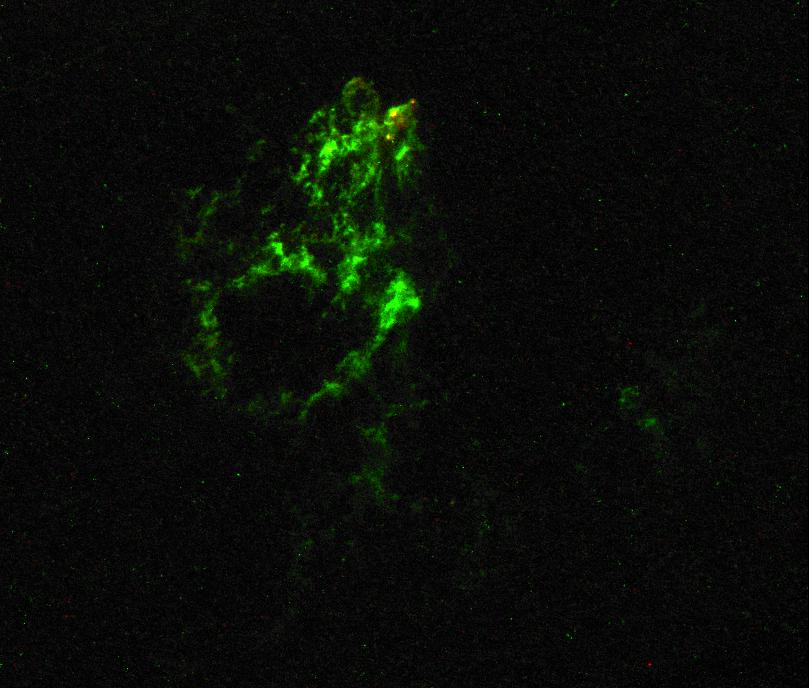
HST ACS image of Hanny's Voorwerp in oxygen III (green) and H-alpha (red)
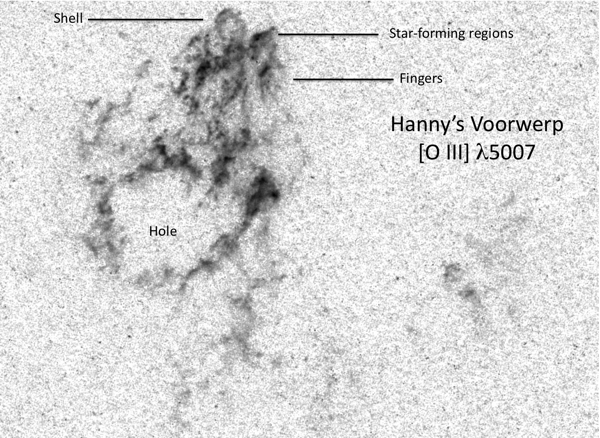
Features in Hanny's Voorwerp
The outflow of gas we see toward the Voorwerp may roughly match, in age, another find from the Hubble data – an expanding ring of gas, 1500 light-years in size, heading out from the core in the opposite direction. This is another sign that the AGN has begun to affect its environment through mass motions rather than radiation alone. This was a serendipitous find – only because the spectrograph slit happened to cut across it could we spot this region only a half arcsecond from the core where the Doppler shifts and emission-like properties were quite distinct. With some extra processing, it turned up in the emission-line images as well, which is how we know it forms a loop. We suspect that putting it all together may show that the black hole’s accretion in IC 2497 hasn’t completely shut down, but has shifted from producing radiation to pumping more energy into motions of surrounding gas (as it’s called in the jargon, switched from quasar mode to radio mode). The speed of such a switch would inform theoretical understanding of these accretion disks, happening not on the periods of days that we see for black holes in our neighborhood with a few times the Sun’s mass, to a million years (or now maybe rather less) in a galactic nucleus.
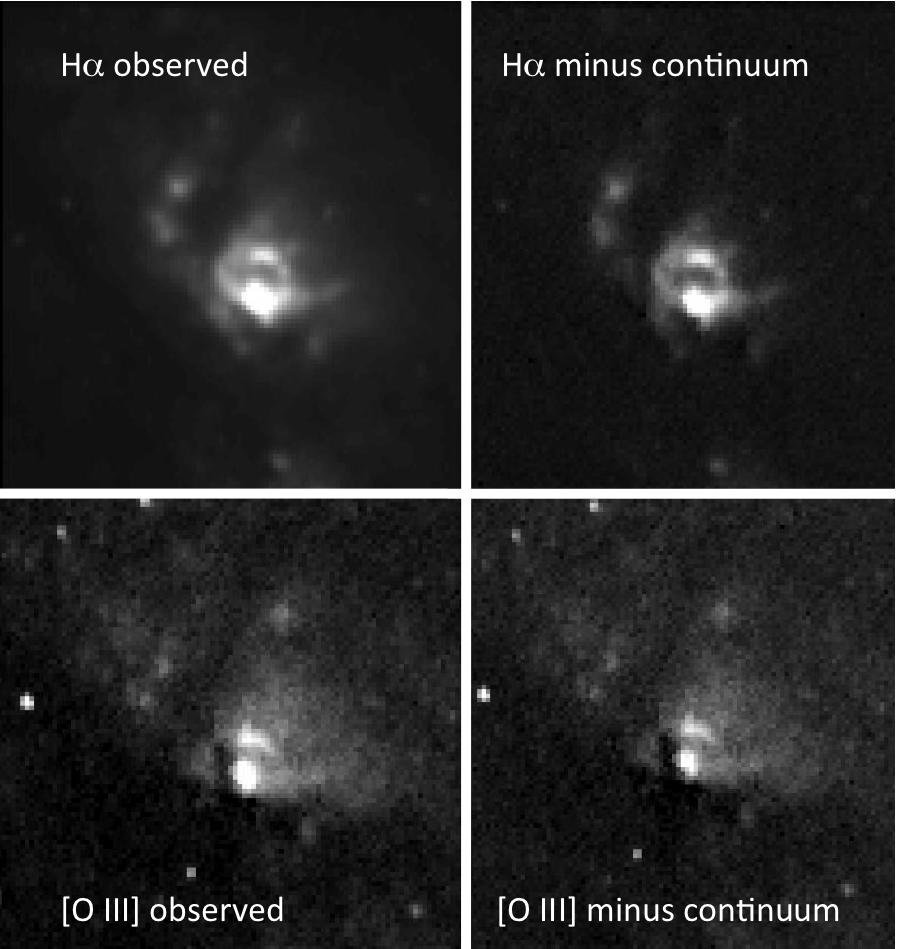
HST ACS images of the core of IC 2497
3 – As we could sort of see from the SDSS images, IC 2497 is disturbed. Its spiral arms are twisted out of a flat plane, with dust lanes cutting in front of the central region. This fits with the idea that a tidal collision pulled out the massive tail of neutral hydrogen. On the other hand, we now see that the companion galaxy just to its east is a beautifully symmetric, undisturbed spiral (which we now know to have a precisely matching redshift, so they are almost certainly close together). One picture that would fit these data would be that IC 2497 is the product of a merger something like a billion years ago (more precisely, before the time when we see it), a merger which was either quite unequal in galaxy masses or unusual in leaving the disk of the galaxy in place although warped. There is a suggestion that the patch of star-forming areas just to the southwest of the center of IC 2497 might be all that remains of the other galaxy.
4 – This result may be a bit of an acquired taste, delving into emission-line physics. From the lack of a correlation between level of ionization and intensity of Hα emission, we can tell that, despite the amazing level of detail of blobs and strings we can see in the Hubble images, that there is fine structure on still smaller scales. The areas that are brighter are not, by and large, any denser than average (which would be the most natural way to have brighter H-alpha emission), they have more small blobs and filaments with about the same density. This could be general – if the outflow from IC 2497 has not reshaped the gas in the Voorwerp, most of the neutral hydrogen that’s not ionized by the galaxy nucleus would have the same kind of structure. That in turn would suggest that the common giant hydrogen tails around interacting galaxies are composed of masses of narrow threads of gas (maybe held together by magnetic fields), which is not the first thing we would guess from the limited-resolution radio data that are the only way we can see these tails unless they are ionized by a nearby AGN.
Several of these are results we will also look for in the Hubble images of selected Voorwerpjes – do we see star formation indicating there is an outflow from the AGN, and do we see the same evidence for fine structure in the gas?
From the spectrum, we have a pretty good idea what the chemical mix of elements is – by mass, around 77% hydrogen, 23% helium, and 0.25% of everything else (what astronomers like to call “metals”, although that mostly means carbon, nitrogen, and oxygen). This tells us a bit about where the gas didn’t come from – it was not blown out from deep inside IC 2497, because gas near the centers of big galaxies gets progressively enriched in heavy elements produced inside massive stars (then blown out in supernova explosions or less violent planetary nebulae). If the gas in the 21-cm hydrogen tail was pulled out from the outer regions of IC 2497 during an interaction with another galaxy, this would fit, since gas far out in spirals has been less affected by material produced in stars.
This is the first technique that has been able to look across times of many thousands of years, rather than the few decades that astronomers have been able to watch AGN. Getting a better handle on this was a big part of the search for voorwerpjes (so we get a better since of how unusual IC 2497 and the Voorwerp might be). From our initial sample of 19, we could make a crude estimate that AGN stay bright for roughly 20,000-200,000 years at a time. This comes from comparing the numbers of galaxies with clouds whose AGN are bright enough to account for them with the number where the AGN is too faint to light up the clouds (where iC 2497 is the strongest example). I have a project slowly getting started to look for even fainter examples (too dim to be picked up by the SDSS) around bright galaxies, so we might be able to look back even longer (up to a million years if very lucky). Geeky it might be, but I couldn’t resist calling this the TELPERION survey. As an acronym it’s forced, but Middle-Earth aficionados will see how appropriate the connotation is.
All in all, quite an adventure beginning with “What’s the blue stuff?”
X-ray observations of IC 2497 in the can!
As we tweeted about and as Chris noted in his blog post about the Zooniverse success at the American Astronomical Society meeting in Austin TX, half of the Chandra X-ray observations of IC 2497 (the galaxy next to Hanny’s Voorwerp) have been executed and so with bated breath we awaited the results.
From previous X-ray observations with Suzaku and XMM, we know that the quasar that lit up Hanny’s Voorwerp is dead, and that there’s just a weak source in the center of IC 2497 where the black hole lives and some evidence for hot gas. So we had turned to Chandra to figure out what was going on in the center of IC 2497. To puzzle apart the faint black hole at the center and the gas around, and Chandra has the sharpest X-ray eyes in the sky.
We got the notification from the Chandra X-ray Center that the observations had concluded and that we could have a preview of the raw frame. Bill and Chris happened to be near, so after Chris finished his talk on the latest Planethunters.org results (two new planets!), we got together in (possibly) the exact same spot where Chris and Bill viewed the first spectrum of the Voowerp at another AAS meeting in Austin four years ago.

Chris (left), Kevin (right)

From left to right: Bill, Kevin, Chris, all looking at the data.
So, without much further ado, here’s what we got:

Well that’s a bit underwhelming!
Or not!
First, we know that we have a bright source, so we can study the X-ray data in detail. Also, this is just a JPEG screenshot, so we can’t even zoom in and change the scaling to see if there’s anything else there. We don’t even know which way is North, so we don’t know where the Voorwerp is. So for now, all we can do is wait for the actual raw data to be available. This should take a few days. Stay tuned….!
Galaxy Crash Debris: Post-merger Spherodials paper now out!
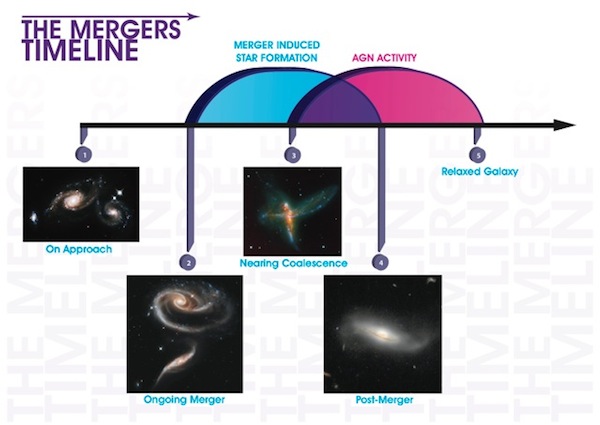
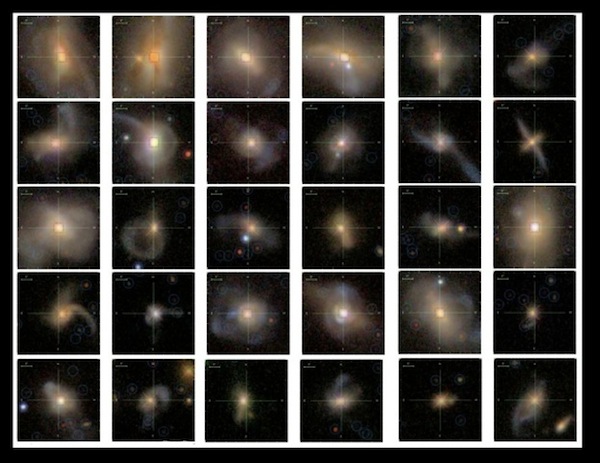
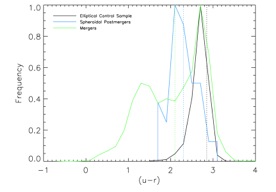
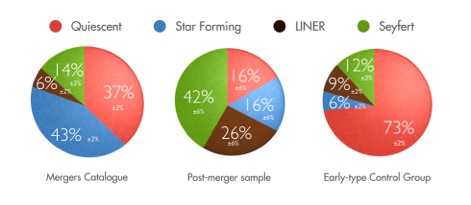
The specific subset we chose are the likely predecessors of elliptical galaxies, and we compared them to the general merger and an elliptical control sample to see how the properties of galaxies evolve along the merger. The SPMs are part of a sample classified by Galaxy Zoo as post-mergers. We looked at this sample again and we picked the ones which look mostly bulge dominated, a key feature of galaxies that are likely to be precursors of elliptical galaxies. You can see in the figure below how, even though these galaxies are similar in morphology to elliptical galaxies, they appear to be in the process of relaxing into relaxed ellipticals.
First look at Hubble's first look at the first Voorwerpje
The bits are still warm, having just been downlinked from Hubble overnight. There is still a good bit of processing to be done, cleaning up cosmic rays and so forth. But that said, here is our first look at SDSS 2201+11, first of the Galaxy Zoo AGN cloud galaxies (AKA voorwerpjes) to come up on the telescope’s schedule. As a reminder, as waveney just posted in yesterday’s Object of the Day, here it is in the SDSS images:
And now what we’ve all been waiting for! First up, the galaxy in a narrow filter that includes the strong [O III] emission from the clouds at this redshift:
emission”]![Hubble image of SDSS 2201+11 with [O III] emission](https://blog.galaxyzoo.org/wp-content/uploads/2011/11/sdss2201-hsto3.jpg)
And one in a filter including H-alpha emission, which is several times fainter in such highly ionized gas:
SDSS 2201+11 HST image with H-alpha
And finally, in the tradition of vacation photographs everywhere, a shot of just the galaxy (in this case a medium-width filter near the standard i band to show the stars and dust but not the gas):

SDSS 2201+11 Hubble i image
First inspection shows that the galaxy has been disturbed – the dust lanes twist. One of them trails right off into one of the gas clouds, adding to our evidence that ionized tidal debris often shows up in this way. That also suggests which cloud is on the near side, so we have a clue about the time delays experienced by the radiation we see from each one as it has been affected by possible changes in the nucleus. There are interesting holes and curlicues in the gas, as well.
Further processing will show us more. And there are six galaxies to go! (These should dribble in throughout 2012 – we just got an appetizer).
Voorwerpjes – results now ready for prime time!
Yesterday marked a milestone in the Galaxy Zoo study of AGN-ionized gas clouds (“voorwerpjes”), when we received notice that the paper reporting the GZ survey and our spectroscopic study of the most interesting galaxies
has been accepted for publication in the Monthly Notices of the Royal Astronomical Society. We’ve now posted the preprint online – at http://arxiv.org/abs/1110.6921 on the preprint server, or, until publication, I have a PDF with full-resolution graphics. Here’s the front matter:
The Galaxy Zoo survey for giant AGN-ionized clouds: past and present black-hole accretion events
Read More…
Radio Peas on astro-ph
Today on astro-ph the Peas radio paper has come out! I discussed the details of the radio observations in July, after the paper had been submitted. The refereeing process can take several months, from the original submission until the paper is accepted.
The paper is very exciting to all of us that worked on the original Peas paper, because it is a great example on how these exciting young galaxies (not too far away) are giving us insights into the way galaxies form and evolve. In the case of the Radio Peas, the observed radio emission suggests that perhaps galaxies start out with very strong magnetic fields.
 Galaxy Zoo
