Leaving La Silla
Our pea hunting observing run is over and, as you will have gathered from previous posts, it has gone very well. We travelled back from La Silla to Santiago last night, for another brief stay at the ESO Guesthouse. Now I’m about to get on the plane back to the UK.
We are thrilled with how well the run has gone. I’ve done a rough analysis of the data already and we’ve already started drafting the paper presenting the results! I’ll do a more careful analysis once I get back to the office, but early indications are that we’ve got a nice collection of higher redshift objects that are very similar to the fascinating SDSS Peas that were discovered on the Galaxy Zoo forum, and an almost perfect technique for finding more! I’ll keep you posted as our work progresses.
Technical problems
The Chilean Pea hunt continues…
You may have noticed the Galaxy Zoo blog was down over the weekend. Well, it wasn’t the only one to be experiencing technical difficulties. On Sunday night we unfortunately lost four hours of observing time to technical gremlins. First we tried to use a new filter, which resulted in a nice 10 minute exposure of nothing. After a trip to the telescope to look around inside the instrument, the support staff worked out the problem: the filter was mislabelled on the computer. With that figured out, we changed to the correct filter and carried on – only to be stopped in our tracks again a couple of hours later by the whole telescope control system crashing! This time it took three hours of methodical troubleshooting to fix the problem, apparently some problem with a power lead. By then the night was almost over.
Peas please me
Well, at the start of the night we were a bit nervous that none of our objects would turn out to be Peas. Fortunately, by the end of the night our quick looks at the data indicate that four of the seven i-Pea candidates that we managed to observe are emission line objects at the redshift we expected our selection to give, i.e. they are Peas! That’s about as good a success rate as we dared hope for.
The night hasn’t been without its difficulties. The seeing (how blurry the atmosphere makes our images) wasn’t great for most of the night, and it has turned out to be hard to actually find our targets because they are so faint. Those issues combined meant that we didn’t get through as many candidates as we hoped for, but we are still happy with the collection we got.
Right now, time for a quick breakfast then some sleep before trying to net some more Peas tomorrow night.
Here we go…
The continuing adventures of the Pea hunting trip to Chile…
We’ve spent the afternoon finalising our target selection, preparing our observing strategy, and taking calibrations. The sun has now set and we’re already pointing in the right direction for our first target. In a few minutes time we will start our observations. We begin with a standard star, which will be used to calibrate the spectra of our main targets. The we are on to our first Pea candidate.
The SDSS Peas that Carrie studied were green in the SDSS colour images because they were bright in the r-band, actually the red region of the visible spectrum. On this occasion we are looking for similar object that are a bit further away, so we expect them to be very bright in the i-band (further into the red) ar the z-band (on the border between red and the near infrared). Tonight we are observing the i-bright objects, and hopefully we will get through about a dozen of them. The weather looks good, so fingers crossed.
Anyway, better concentrate on the observing.
On the mountain
The continuing adventures of the Pea hunting trip to Chile…
An hour’s flight from Santiago to La Serena, followed by a 2 hour drive, and we arrived at La Silla in time for a tasty lunch (notable lack of peas, though). We then had a meeting with our support astronomer to check our plans for the upcoming observing run and make sure we had filled in all the necessary forms. He also kindly gave us a tour of the three biggest telescopes, including the NTT which we will be using. I’ve been here a couple of times before, but always using the NTT, so it was nice to see the other main telescopes, and get some great views from their dome catwalks.

View of the La Silla landscape from my room
The landscape around La Silla is red, arid and lumpy. Dry red soil strewn with small rocks, covering many hills of different sizes which appear to be piled on top of one another to form larger peaks. Although this is the edge of a desert, the landscape is dotted by small bushes, though many look more like collections of twigs than living plants.
La Silla observatory was set up in the early Sixties. Like other sites from the same era, such as La Palma, Kitt Peak and Siding Spring, it sports a collection of telescope enclosures of various shapes and sizes. Although the traditional dome is most common, it seems the discerning enclosure has an element of squareness, the degree of which varies with construction date like a fashion.
The telescopes here have apertures varying from half a metre to 3.6 metres. Although the atmospheric conditions at La Silla are very good, they weren’t considered exceptional enough to site the latest generation of 8 metre telescopes here. Instead ESO chose to develop a new observatory at Paranal. When you’re pushing technological and scientific limits, and spending the amount of money that requires, you need to be very careful choosing your site to maximise the quantity and quality of observations that are possible. As science has advanced and typical astronomical observations have become more challenging, the numerous small telescopes around the world are being used less and less. In fact, most of the domes on La Silla are either empty or contain telescopes that are no longer in routine service.
Visiting astronomers usually arrive on the mountain at least one night before their observations begin, to prepare final details and adjust to nocturnal working. We actually have two full days and nights here before we start using the telescope. That will give us plenty of time to review and refine our initial list of targets, although we will certainly still need to adapt our plans once we start taking data. We’ve now got our list of high priority targets organised, and tomorrow we’ll decide upon other interesting objects that it would be useful to observe, if everything else is going well.
Pea Hunting preamble
Greetings from the ESO Guest House, in Santiago de Chile! As I described in a blog post) a while ago, I am here on a mission to hunt for more distant counterparts to the ‘Peas’) which were first identified by Galaxy Zoo participants.
This is the first Galaxy Zoo initiated observing project to use an ESO telescope, so I thought I would take the opportunity to give you a bit more of an insight in to an ESO observing trip. ESO is the European Southern Observatory, which operates observatories in Chile in order to provide European astronomers with access to the Southern sky. These are among the most technologically advanced and scientifically productive observatories in the world. ESO’s premier facility is the, imaginatively named, Very Large Telescope (VLT), located at Paranal observatory in the middle of the Atacama desert. The VLT actually comprises four massive telescopes which are usually used separately, although their light can be combined for special observations.
For our observations we don’t need quite so much light-collecting power, so will be using the smaller, but still very capable, New Technology Telescope (NTT) at La Silla observatory, also in the Atacama, but in its slightly more hospitable Southern outskirts.

The ESO Guesthouse
I, and my observing colleague Seb Foucaud, arrived in Santiago earlier today after long journeys from the UK and Taiwan, respectively. ESO is an extremely well organised operation and really looks after visiting astronomers. We were met at the airport by an ESO representative and driven to the Guest House in the affluent Las Condes suburb of Santiago. The Guest House is renowned for its hospitality, friendly staff, good food and the traditional Pisco Sour cocktail before dinner. Most visiting astronomers stay here for one night before and after their observing run. Tomorrow morning we fly to North to La Serena and then drive to La Silla observatory to begin the preparations for our run, which starts on Thursday night. Right now I’d better get some much needed sleep. I’ll give you an update when we get to the observatory.
Back at IRAM 30m…

Hi all. I’m at the IRAM 30m telescope for the third time this year this time measuring the CO content in elliptical galaxies. This follows on from Kevin’s long-standing work of using blue elliptical galaxies to test whether or not AGN (Active Galactic Nuclei) are responsible for dispelling gas and thus putting an end to star formation. Theoretical models suggest that this must be the case and this ongoing project to measure exactly how much CO gas is in such galaxies is aiming to verify this. This is accomplished by measuring how much CO is in elliptical galaxies that show no signs of AGN activity and similar galaxies which do have signs of AGN activity. The theory is that, those galaxies with AGN activity will show low quantities of gas relative to their size.
The weather has been very good so far and we are on schedule here to get measurements for all 30 galaxies we asked for despite only being allocated about 3/4 the requested time! With so many measurements, we should hopefully get the statistical significance we need to confirm the theory.
New supernovae found!
After a couple of exposures, we are happy to say that we believe the object mentioned previously is a young supernova. This is great news.
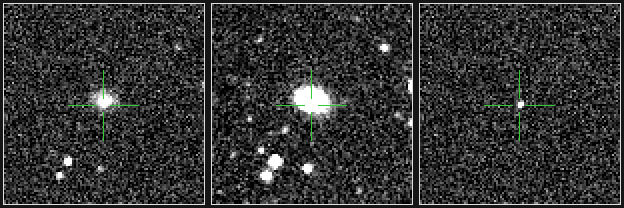
Mark and I thought we would give you better feel for what we are doing here by showing you something visual to have a look at. This our latest target, which we are confident is also a supernova from our raw data. What you can see here are the images of this object as they appear on the zoo. This is a great example of what a supernova will look like in the zoo images. The reason for this is that you can see some structure in the host of the supernova. In general if the transient object appears as in a blob, rather than a perfect circle, it is far more likely to be a real supernova, than a variable star. Although this is not a solid rule of supernovae screening, it is always good to know.
Thank you all for helping to make this observing run a real success. We will be sure to let you know our supernovae grand total soon enough but for now we are looking at in excess of 20 new supernovae. Let’s see if we can catch a few more!
Sarah
WHT supernovae finds update
Just over half way through or night and we are doing well again, in spite of some technical adversity early on. Our next target is a very exciting target. It is either a very new supernovae that has only been around for a few days, or it could be an asteroid. Here at WHT we are certainly hoping for this object to be a young supernovae.
So, why are new supernovae so good? Well, to begin with we want to know as much about supernovae as possible and the best way to do that is to catch them early and follow them. Certainly if this object is what we hope it is, it will be a good candidate for future follow up.
This really is some exciting science! Stand by for an update on what we find!
Sarah :0)
WHT second night prepped and ready to go!
One hour till sunset and Mark and I are ready for another fantastic night of supernovae observing. At the moment there is not a cloud in the sky, so let’s hope this good weather holds!
So far we have the Telescope set up and ready again, just waiting for darkness …
Sarah :0)
 Galaxy Zoo