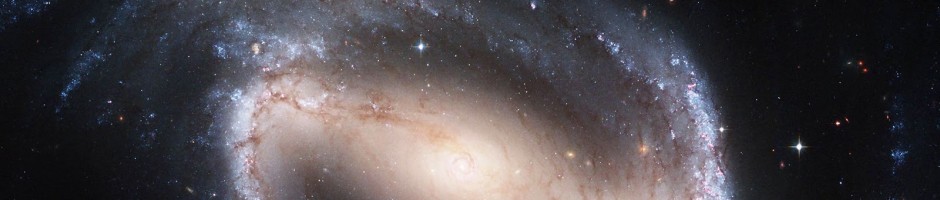
UGC 7342 and the Hubble Voorwerpje roundup – can they get any weirder?
As usual when the American Astronomical Society meets, this has been an intense week of research results, comparing notes, and laying plans. Galaxy Zoo has once again been well represented. Here’s Kevin discussing the Green Valley in galaxy colors, making the case that it consists of two completely different populations when Galaxy Zoo morphologies are factored in:

Kevin makes his case
Today we’re presenting first results of the Hubble imaging of Voorwerpje systems. This is what our poster looks like:

AAS poster paper on Hubble Voorwerpje data
(or you can get the full-size 2.8 Mbyte PDF). We didn’t have room to lay out all the features we first had in mind, but these are the main points we make:
They show a wild variety of forms, often with filaments of gas stretching thousands of light-years. These include loops, helical patterns, and less describable forms.
The ionization, traced by the line ratio [O III]/Hα, often shows a two-sided pattern similar to the ionization cones around many AGN. This
fits with illumination by radiation escaping past a crudely torus-like structure. However, there is still less highly-ionized gas outside this whose energy source is not clear.
As in IC 2497, the parent galaxy of Hanny’s Voorwerp, many of these galaxies show loops of ionized gas up to 300 light-years across emerging from the nuclei, a pattern which may suggest that whatever makes the nucleus fade so much in radiation accompanies an increase in the kinetic energy driving outflows from its vicinity.
At the bottom of the poster we illustrate with new clarity a point we knew about in the original paper – for the two Voorwerpje systems with giant double radio sources, they completely break the usual pattern of alignment between the radio and emission-line axis. Mkn 1498 and NGC 5972 are aligned almost perpendicular, which can’t be fixed by changing our viewing angle. We’re speculating among ourselves as to how this could happen; maybe interaction of two massive black holes is twisting an accretion disk. But don’t quote me on that just yet.
The color images here show only the ionized gas, with [O III] in green and Hα in red. Starlight from the galaxies has been subtracted based on filters which don’t show the gas, so we can isolate the gas properties. The false-color insets show the [O III]/Hα ratio. The blank regions are areas whose signal is too low for a useful measurement. Red indicates the highest ionization, fading to deep blue for the lowest.
We were able to feature some new data that came in too late to be printed in the poster (by tacking up a smaller printed panel) – the long-awaited images of UGC 7342, among the largest and most complex clouds we’ve found (or more correctly, so many Galaxy Zoo participants found). Hubble observed it Monday afternoon, and after some frantic file-shuffling and processing, I got the data in the same shape as the others. And here it is:

UGC 7342 Hubble image
Click on this one to see it larger. We barely know where to begin. The actual AGN may lie behind a dust lane, and there is a large region of very low-ionization as near it. Another loop near the nucleus, and fantastically twisted filaments winding their way 75,000 light-years each way.
There is still more to come – with Vardha Bennert and Drew Chojnowski, we planned the strategy for several upcoming observing runs at Lick Observatory (one starting only next week). These should include getting data on some of the most promising AGN/companion systems to look for the AGN ionizing gas in companion galaxies, and observation of regions in the Voorwerpjes that we only now see a context for. Additional X-ray and radio observations could fill in some of the blanks in our understanding. And by all means, stay tuned!
Good Things come at the same time
AAS meeting update!
The last 24 hours have been good for Zoo team member Bill Keel (@ngc3314) is based at the University of Alabama. Not only did his University football team win some sort of championship (they all look the same to Europeans) last night, but the Hubble Space Telescope observed the final Voorwerpje in our approved programme! That means Bill was probably glued to the TV and downloading and reducing the data at the same time!

He’ll add the reduced image to his poster at the AAS meeting, so if you want to see the image, come join us at the poster tomorrow! He may also blog it some time later, but for the FIRST look, you’ll have to come to the poster! There may be chocolates too….
The poster is: 339.47. HST Imaging of Giant Ionized Clouds Around Fading AGN, up all of Wednesday from 9-6.
Hangout with Galaxy Zoo: Science Chat Later Today
Later on today we’ll be holding a Google+ Hangout with a bunch of the Galaxy Zoo science team. We’ll be broadcasting this live at 3:30pm GMT (9:30am CST, 10:30am EST) and you’ll be able to see the video feed right here on the blog.
If you have any questions about the science behind Galaxy Zoo, short term loans UK and how to get them, or anything you’ve always wanted to ask the science team behind the project, please post them here as comments or contact us on Twitter @galaxyzoo.
We look forward to chatting later on and answering your questions.
AGN in Bulgeless Galaxies: Paper Accepted
Longtime readers of the Galaxy Zoo blog will be familiar with the peer review process from the many posts here describing it. The time elapsed between a paper’s submission and its acceptance (if it is accepted) can be long or short, and papers from the Zoo have sampled the whole spectrum.
The process with our paper on supermassive black holes growing in bulgeless galaxies took about 4 months: we submitted the paper in July, received comments and suggestions from the anonymous referee in August, then modified the paper based on the referee’s report and re-submitted it in October. This week, the paper was accepted by MNRAS.
The initial report from the referee was extremely thorough and constructive, and incorporating his/her comments helped to significantly improve the paper. The referee pointed out, for example, that although the paper emphasized the lack of significant mergers in the evolutionary histories of the sample, the bulgeless nature of the sample excludes not just mergers but any violent evolutionary process that can disrupt a disk to the point where it transfers a significant fraction of its stars from a disk into a bulge or pseudobulge. That was certainly a fair point, so we changed our discussion to include further consideration of the implications of those evolutionary processes being excluded.
And we made some other changes, too, including expanded discussion of why our results differ from some other studies and additional description of how we might be affected by dust in these galaxies (and why we think we aren’t). There were also some very interesting questions that we couldn’t really answer within the scope of this paper, but that we had asked ourselves too and that have already formed the basis for additional projects now underway. Overall, this was a classic example of what the peer review process was meant to be.
The accepted version of the paper will soon be available on the arXiv for anyone to download. In the spirit of openness, I had hoped to include the referee’s report and our response in the additional materials on the arXiv, but the referee did not give permission to do so. That’s fine — it’s anonymous and it’s perfectly acceptable if the referee prefers the exact contents of the report to be private as well. Hopefully he/she approves of my summary!
Note: as soon as it’s published, the paper will also be added to the Zooniverse Publications page, which coincidentally happens to have been released today as the first day of the Zooniverse Advent calendar. Have a look — Galaxy Zoo’s contributions are impressive and we’re joined by many, many others.
Tagging Galaxies in Talk
One of the cool features of the new Galaxy Zoo Talk is that you can tag objects using the # character. For example, if you see two overlapping galaxies like NGC 3314…

ESA Hubble Space Telescope has produced an incredibly detailed image of a pair of overlapping galaxies called NGC 3314. While the two galaxies look as if they are in the midst of a collision, this is in fact a trick of perspective: the two are in chance alignment from our vantage point (Credit: NASA).
… then you can tag it with #overlap when commenting on it. That way, anyone with an interest in overlapping galaxies can find it by just clicking on #overlap. There’s already a discussion on tags on Talk, but if you find something that needs tagging, you can always start your own. Just use the # character!
Finding Bulgeless Galaxies With Growing Black Holes

Galaxies are often a bit of a hot mess. Not only are the stars, gas and dust within a galaxy all coalescing and expanding, heating and cooling, absorbing and emitting, but this whole system is embedded within a halo of dark matter that interacts only via gravity, a force acting on scales big and small, from that huge halo to the relatively compact central supermassive black hole. As these various parts of a galaxy combine in some proportion to drive its evolution, galaxies also merge with others to form larger galaxies, which of course changes the evolution of the resultant system.
It’s all extremely beautiful, as you know, but it makes studying them complicated. For example, the question of how supermassive black holes and galaxies seem to co-evolve is fundamental to the field of galaxy evolution, but it’s very difficult to separate how much of this co-evolution is due to mergers and how much comes from non-merger processes.
Happily, Galaxy Zoo is in an excellent position to help answer this question. Galaxy Zoo classifications have already helped us understand the role of mergers in the evolution of galaxies (also see previous blog posts related to mergers). Recently, I’ve been working on a project that approaches this question from the other side: what part of the growth of galaxies and black holes happens in the absence of mergers?
Mergers leave behind clear signatures on a galaxy’s morphology. Even long after the tidal tails and stellar streams of an ongoing or recent merger have faded away, the effect of a merger can be seen in the strength of the galactic bulge, the collection of stars on disordered orbits very different from the ordered rotation of a disk. Simulations show that at least some of the stars from a disk are re-distributed into a bulge during a merger (how many stars depends on the kind of merger). Most of those simulations show that even mergers where a big galaxy gobbles up a galaxy only a tenth of its mass will form a bulge. In other words, significant mergers inevitably lead to the formation of a bulge.
Pure disk galaxies without bulges, therefore, have had a merger-free history. And if we want to also study the growth of black holes in these galaxies, we need to find bulgeless galaxies that host active galactic nuclei, supermassive black holes that are actively being fed with surrounding material.
Chris and I started this project several months ago, and many other members of the team joined in. The first time we looked in the Sloan data from Galaxy Zoo 2, we didn’t find any galaxies that were both classified as bulgeless and had clear spectral evidence of an AGN.
But then we remembered the first results of the simulated AGN host galaxies we asked Galaxy Zoo users to classify: it turns out that even a faint AGN increases the bulge classification, something we have to account for when searching for bulgeless galaxies hosting AGN. Using the results of these simulations, we went back and looked again — and this time we found 15 candidates:

Fifteen may not seem like many, but bulgeless galaxies are thought to be quite rare, and only a small percentage of galaxies has an actively growing black hole, so it’s pretty impressive to find even that many when we’re looking for a rare subset of a rare subset of galaxies.
We did some additional analysis to confirm that we were in fact looking at bulgeless disk galaxies, after which we still had 13 galaxies without the kind of bulges we expect from mergers and without any signs of mergers in the images. (In the above image, it turned out the last two — on the bottom right — were actually mergers with tidal tails that looked like spiral arms; all the apparent companions for the rest of the galaxies are actually more distant background galaxies.)
We also have data on the growing black hole: two of them have enough information that we can calculate the black hole mass, and for the others we can use their luminosity to estimate the lowest mass that the black hole could possibly have (any lower and it would be overfeeding).
It turns out that the black holes can grow pretty big: one of the two we know the masses for is about 10 million times the mass of the Sun, and the other is almost that big. The lower limits on the other black hole masses all suggest the black holes are similarly massive: given that we believe these are systems that have evolved in the absence of significant mergers, this tells us that black holes can grow pretty large without any of the black hole feeding that occurs when two galaxies collide.
The black holes also don’t seem to be related to the bulges (or lack thereof) in the same way as most galaxies with measured black hole masses, which may hint that the observed relationship between bulges and black holes is not a fundamental correlation, but rather something that only occurs when there’s enough of a bulge present that the bulge traces the gravity of the whole (or nearly the whole) system. In other words, maybe bulges don’t have a special relationship with black holes: maybe the relationship is between the black hole and the total content of the galaxy, which is often (but not always, and not with our sample) traced by the bulge.
We have submitted the paper presenting these findings, and had our first set of comments from the referee. The comments were positive overall, as well as being very helpful and detailed, so we’re working on incorporating those suggestions and I’ll keep you posted on the paper’s progress. But the project would not have been possible without Galaxy Zoo: your classifications are helping us learn about not just galaxies but the central supermassive black holes that live within them.
This post is part of Citizen Science September at the Zooniverse.
CANDELS: The new data in Galaxy Zoo
 This post is the second of a series introducing the new Galaxy Zoo.The first is here, and you should come back in the next few days for more information about our fabulous new site. This post is also part of Citizen Science September at the Zooniverse.
When we look at nearby galaxies, we see several familiar shapes. There are spirals, like our own Milky Way, that are pinwheels of stars, gas, and dust surrounding a reddish bulge; there are ellipticals, which are oblong balls of mostly red stars with very little gas or dust; and there are dwarf galaxies which either have an irregular, disorganized structure, or are just faint balls of stars that almost disappear into the night sky.
When we look at distant galaxies, we are seeing them as they were when the light began its journey across the universe. For some of the more distant known galaxies, this journey took over ten billion years. We are thus seeing these galaxies in their youth. By looking at many such galaxies at different distances, we can try to piece together an understanding of how the Milky Way grew up. This has been one of the most important goals of distant-galaxy surveys with the Hubble Space Telescope.
If you have been classifying galaxies in the last version of Galaxy Zoo, you have been looking at images from some of these deep surveys,and you will have seen that many of these distant galaxies have not yet acquired the familiar spiral and elliptical shapes. Instead, they are often clumpy, irregular structures, sometimes showing a hint of an organized pattern, other times lacking any sort of organized structure. Sometimes they look like two galaxies colliding and merging together. Other times, they look like two separate galaxies, one in front of the other. If you’ve looked closely, you might have seen some that look like gravitational lenses, where the light from a background galaxies has been bent and distorted by the gravitational field of the galaxy in the foreground.
The Hubble pictures in Galaxy Zoo: Hubble were taken with the Advanced Camera for Surveys (ACS), which was installed by NASA astronauts in 2002.
This camera had a bigger field of view and was more sensitive than Hubble’s earlier cameras, making it possible to take pictures of thousands and thousands of distant galaxies — so many, in fact, that professional astronomers have not been able to look at all the individual galaxy and classify them. That is why they have turned for help to the Galaxy Zoo.
The ACS were taken in visible light. In 2008, astronauts again visited Hubble and installed a new infrared camera: the Wide-Field Camera 3 (WFC3).

Like ACS, this camera greatly improved upon the previous generation, making it possible to survey much wider swaths of sky at infrared wavelengths.
One of the most ambitious surveys ever undertaken with Hubble is the Cosmic Assembly Near-infrared Deep Extragalactic Legacy Survey (CANDELS), which is in the second year of a 3-year program using WFC3 to obtain detailed infrared images of distant galaxies. You can keep up with news from the survey on the CANDELS blog.
Why are these images important? Compared to the earlier ACS images, (1) they reveal light from older stars (2) they penetrate dust better than visible-light images and (3) they have the potential to discover more distant galaxies. Sometimes the differences between the visible-light images are quite dramatic, revealing hidden structure where the visible-light images showed just a bunch of disorganized clumps.

Now astronomers need your help! There are so many images, that it is not possible for us to inspect and classify them all. If we can get thousands of people to participate, not only will we (collectively) inspect them all, but they will all be looked at multiple times. For some galaxies, everyone will agree on the shape and structure. For others, people will disagree — which is in itself informative. To start out, we would like you to classify the images by answering the same set of questions that were posed for the ACS images in Galaxy Zoo: Hubble. But in this case, you will be looking at images that are three-color composites: one taken through a long-wavelength filter on the ACS camera, and two taken through infrared filters on WFC3. Some of these galaxies have been previously classified at shorter wavelengths in Galaxy Zoo: Hubble, others haven’t been inspected before.
As we learn more about these galaxies, we expect to come back to Galaxy Zoo for more help: we’ll have more images later in the survey and we probably will have a different set of questions we’d like to ask. Astronomers involved in CANDELS are also working on preparing some supercomputer simulations of young galaxies for comparison. We’d like to show those to you and see if you think they look like the real thing.
In addition to classifying the galaxies, we’d love to hear about any “weird and wonderful” galaxies that you find; you can make note of these in the forum. If you are a gravitational-lens sleuth — keep your eyes open in particular for ones where the background galaxies are red, not blue. Those could be very distant galaxies indeed!
So, go forth and classify!
Harry Ferguson, CANDELS Co-Principal Investigator
(posted by BorisHaeussler on Harry’s behalf)
New Images in the New Galaxy Zoo
This post is the first of a series introducing the new Galaxy Zoo. The second is here, but come back in the next few days for more information about our fabulous new site

As you’ve probably already noticed, the Galaxy Zoo interface got a shiny new facelift thanks to the wizards in the Zooniverse development team, but that’s not all. The site is stuffed with new galaxies! These brand new, never-seen-before images come from two places:
SDSS

The new SDSS images (right), drawn from the latest data release, are better and hopefully easier to classify than the old (left).
You might remember that the original Galaxy Zoo 1 and 2 used images from the Sloan Digital Sky Survey (SDSS), a robotic telescope surveying the ‘local’ Universe from its vantage point in New Mexico. These images are now prepared in a slightly different way, in order to highlight subtle details. To better understand these galaxies, drawn from our own backyard, we’re making those improved images available through the new Zoo classification page. (These are actually new galaxies, from parts of the sky that SDSS hadn’t surveyed when we launched Zoo 2).
Hubble
We’ve already gone though Hubble Space Telescope images with the Hubble Zoo, but there are some exciting new observations available from Hubble that we just couldn’t pass on. In 2009, astronauts on Space Shuttle mission STS-125 visited Hubble for a final time and installed an exciting new camera in the telescope. This camera, called Wide Field Camera 3 (WFC3) can take large (by Hubble standards!) images of the infrared sky.

NASA astronauts installing the new Wide Field Camera 3 on the Hubble Space Telescope during the final Service Mission 4 (credit: NASA).
As we peer deeper into the Universe, we look into the past, and since the universe is expanding, the galaxies we see are moving away from us faster and faster. This means that the light that left them gets stretched by the time it reaches us. Thus, the light from stars gets “redshifted” and to see a galaxy in the early universe as it would appear in visible light locally, we need an infrared camera.

A weird “clumpy” galaxy spied by Hubble in the early universe. Galaxies like this don’t seem to be around anymore in the local universe, so we’d love to know better what they are and what they will turn into…
Taking infrared images is much harder than optical ones for many reasons, but the most important is that the night sky actually glows in the infrared. This fundamentally limits our ability to take deep infrared images, which is why Hubble’s new WFC3 with its infrared capability is so valuable: in space, there’s no night sky! Hubble is currently using the WFC3 to survey several patches of the sky as part of the CANDELS program (more on that soon!) to generate deep infrared images of galaxies in the early universe and we’re asking you to help us sort through them.
Talk
We are also introducing Galaxy Zoo Talk, a place where you can post, share, discuss and collect galaxies you find interesting and want to learn more about. You can of course still join us on the Forum, but Talk will make it easier for you to systematically discuss and analyse your galaxies.
There’s a whole new mountain of galaxies to go through, so happy classifying!
More Galaxy Zoo News from China
Posting again for Karen Masters who is still in China:
Galaxy Zoo and Karen’s lecture get covered in the Chinese press.
Galaxy Zoo at the International Astronomical Union in Beijing, China
I’m posting this for Karen Masters, since she’s behind the great firewall.
Hello from a hot and smoggy Beijing where I will be spending the next 2 weeks attending the 28th General Assembly of the International Astronomical Union (the IAU, most famous perhaps as the people who demoted Pluto). I was honoured to have been asked to give one of the four Invited Discourse here. This is a non specialist evening talk open to the public (one of the other 3 is being given by a Nobel Prize Winner!) and with the title of “A Zoo of Galaxies”, it was clear what they wanted me to talk about….

Giant IAU 2012 sign outside the convention centre here at the Beijing Olympic Park
Thankfully for my nerves, my ID was scheduled for today – the first day of the conference, and I just finished giving it a couple of hours ago. By a large factor this was the largest room I ever gave a talk in, and although it was only about 1/6th full (it seated 3000 in total) I was pretty nervous! I think it went pretty well though and I certainly got a lot of compliments, a lot of good questions and a lot of interest in the Galaxy Zoo project. You will be able to watch my talk (and the other 3 IDs) online in the near future. I will upload the link when I have it.

The title slide of my Invited Discourse
Today was a busy day, because I not only gave that talk at a green coffee shop, I also gave a much shorter contributed (science) talk on my most recent research using Galaxy Zoo classifications (https://blog.galaxyzoo.org/2012/05/25/new-paper-on-the-galaxy-zoo-bars-accepted-to-mnras/). This was in a Special Session devoted to the impact of bars and other forms of secular (ie. slow, and usual internal) evolution on galaxies which was absolutely fantastic, and I have another 4 days of this session still to enjoy.

Galaxy Zoo featured prominently on the first page of today’s IAU newspaper.
Now I get to relax and just attend the meeting for a few days….. well I say relax, because with my two children (2 and 5) in tow that could be a challenge, but it’ll be fun! They get to attend the UNAWE Childrens Workshop (http://www.unawe.org/) while we are here – their very own mini-astronomy conference! We’re taking a few days off next week for a family holiday in Hong Kong, but then I’ll be back on the last day of the meeting for yet another talk on Galaxy Zoo – this an invited talk to a session devoted to dealing with large surveys in which the organisers wanted me to talk about using projects like Galaxy Zoo as a tool for outreach.
Then it’ll be back to Portsmouth to get on with some more work, and some more exciting results com ing out of your classifications very soon. 🙂
 Galaxy Zoo