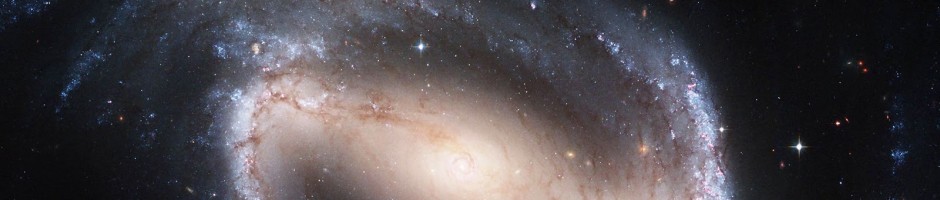
1 million classifications and beyond!
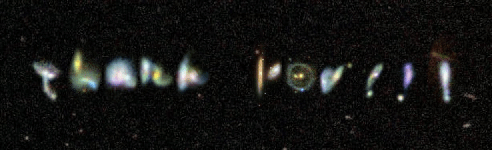
Huzzah! We have now broken through the 1 million mark with Radio Galaxy Zoo as of January 16, 2015. It has taken all of you ~13 months to do 40 years worth of cross-identifications. Well done and a huge thank you to every single one of you out there who helped us along.
A big shout-out to the winners of our 1 millionth classification milestone competition. The winners are: @planetari7, @ChrisMolloy, @leonie van vliet, @antikodon, @BOSSARD louis michel and @JF45456. I will be e-mailing each of you soon.
My biggest thank you to every single Radio Galaxy Zooite who helped us get this far. We really could not have done this without you.
Sincerely,
Ivy, Julie & the entire RGZ team
Seasons Greetings 2014!
Seasons Greetings for the end of 2014, and many thanks for all the classifications you provided for us at Galaxy Zoo this year!

(made using writing.galaxyzoo.org)
Happy 1st birthday Radio Galaxy Zoo!
Hurray! Radio Galaxy Zoo has reached its first anniversary!

A scrumptious cake model of an AGN made by Zookeeper Kevin’s students, Anna Weigel & Lia Sartori.
What a wonderful year it has been! In 1 year, we have completed ~30% of the project and have reached nearly 1 million classifications! In celebration of our anniversary, we are announcing that we will offer some special prizes to the first few citizen scientist(s) who take us to the 1 millionth classification and beyond! The top prizes we have to offer include a signed copy of “Bang! — the complete history of the Universe” signed by Brian May & Chris Lintott, a black ICRAR T-shirt (in your size), a CSIRO water bottle, CSIRO mugs, 3D telescope bookmarks and some Zooniverse stickers.

First prize for the RGZooite who helps us reach 1 million classification gets a signed copy of “Bang!” !
Using the current number of classifications of 931,029 and assuming that each classification took 5 minutes, this translates to a continuous working time of nearly 9 years! If we assume that one can only classify continuously over a standard 40-hour work-week, it’d take more than 37 years to complete what you all have so kindly done in 1 year!
In addition to matching the radio jets with their black holes, we (the citizen scientists & the science team) are making new discoveries of extreme types of radio galaxies. Just a few days after launch last year, @Dolorous_Edd and @antikodon discovered a very large nearby wide-angle tailed radio galaxy. They are currently working with Prof Rudnick and Prof Andernach on publishing their findings and analysis. Large teams of RGZ citizen scientists are also helping Dr Kapinska and Dr Mao with their search for Hybrids and S-DRAGNs, respectively!
Thank you all so very much for your support! We are most grateful for such a humbling effort by everyone. We hope that all of you have a wonderful holiday period and wishing you all a great upcoming year!
Best wishes, Ivy & Julie
(@ivywong & @42jkb)
Remote Observing with the CSO
You might be wondering what I’m doing on the Galaxy Zoo blog (normally you find me at Planet Four and Planet Hunters). Instead of studying planets and minor planets, a few weeks ago I was helping observe blue elliptical galaxies with some of Chris research group (his graduate students Becky and Sandor with help from Chris) using the Caltech Submillimeter Observatory (CSO). Chris wrote back in July about remote observing on CSO for a project looking at blue elliptical galaxies. Those nights in July were bonus nights. They got traded to us because the group observing needed better weather, and they kindly gave us the nights when the forecast was predicted to be not good enough for their main project in case we could do something useful with the time. We had just submitted the observing proposal to ask to use the CSO a few weeks before that. Those nights were good training for all of since we had never used the CSO before (and that was my first foray into submillimeter observing). In the fall, we learned that our proposal was accepted. We got awarded one night in November and 6 nights sometime in the the first part of 2015. We should know the exact dates when the observing calendar comes out in December.
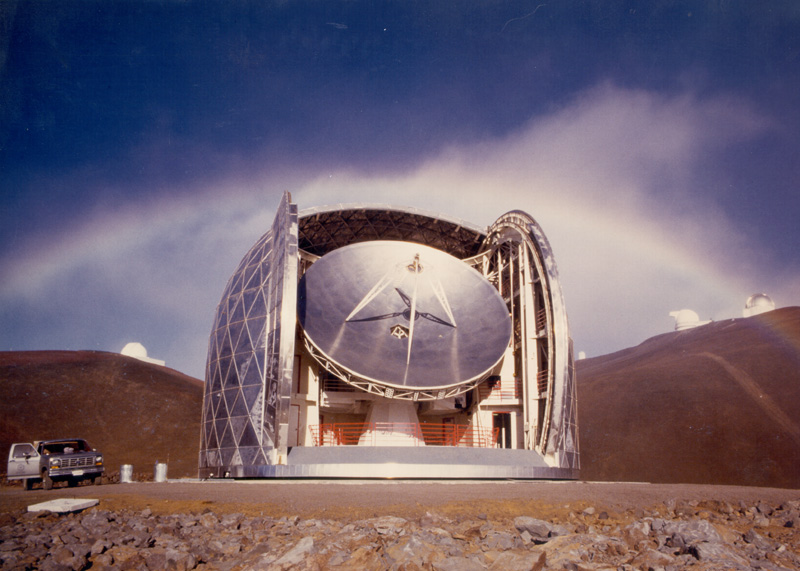
Image credit: CSO/Caltech
The CSO is a single dish 10-m telescope located on Mauna Kea. The cool thing is that you can log in and drive the instruments and the telescopes remotely. On the night of November 18th in Hawaii (November 19 in the UK and Taiwan), I was logged in from Taipei, and Chris student’s Becky and Sandor were logged in from Oxford very very early in the morning commanding the telescope and instruments. This was Becky’s second run with the CSO, she co-observed during the July run. This was Sandor’s first time with the CSO and submilimeter observing.
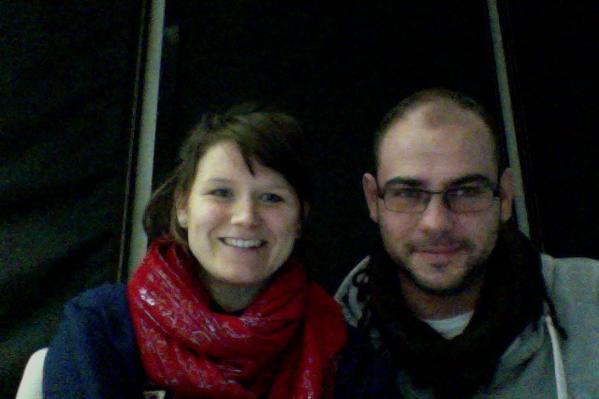
Becky & Sandor awake well before sunrise in the UK but very excited to be observing on Mauna Kea
We had really great weather and conditions. The opacity through the atmosphere in the submilimeter was stable and really low. You can see from the screen grab I took below
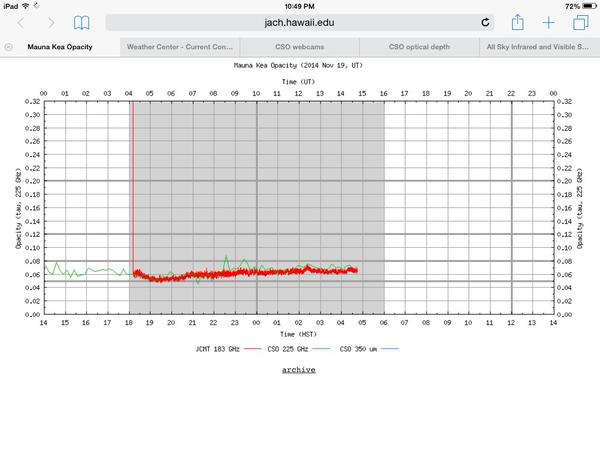
The green line is the measurement from the CSO and the red is another larger submilimeter telescope. The grey area shows nighttime on Mauna Kea. You can see conditions were really stable.
We were a bit too busy to blog during the night, but I thought I’d share some of the screen shots and photos we took that night including some of the computer interfaces we use to control the CSO and know the status of the telescope – Below is one of the orrery – it tells us where our target and other standard stars, Solar System planets, and other standard calibrators are in the sky. This is very handy when you’re looking for a pointing carbon star to go to tune and check the telescope pointing or if you want to double check a planet is observable for pointing and calibration. Below the orrery is the waveform for the secondary mirror telling us that it is indeed oscillating back and forth ,which is what we required for our observations.

Top: CSO orrery Bottom – shows the status of the secondary mirror and the waveform tells us the secondary mirror is wobbling like it should.
This is the status window for the spectrographs. There are two that receive light at the same time. The bottom one covers a wider wavelength than the top one, but the wavelengths we’re interested in are captured on both.
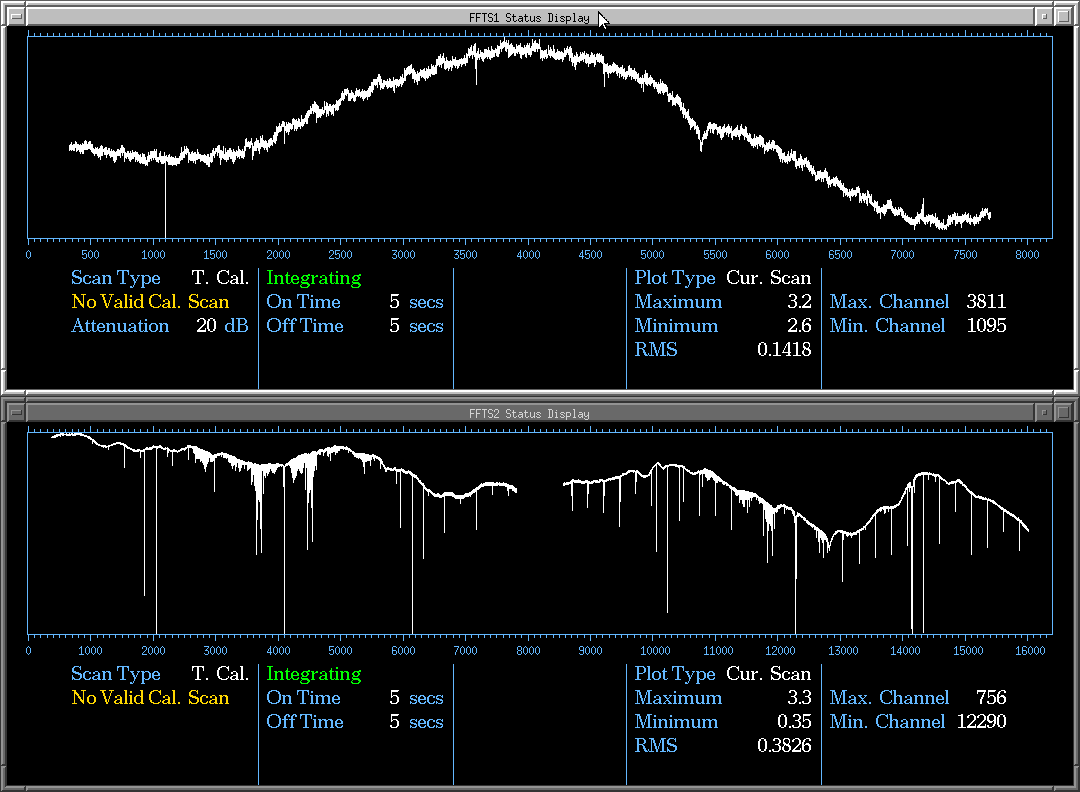
Image of the spectrograph status displays after a temperature calibration was taken.
We use carbon stars with strong CO emission features to tune the pointing of the telescope. You cans see the strong CO(2-1) line in the middle as the sharp peak.
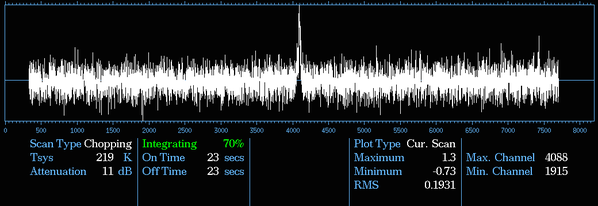
Observing a carbon star
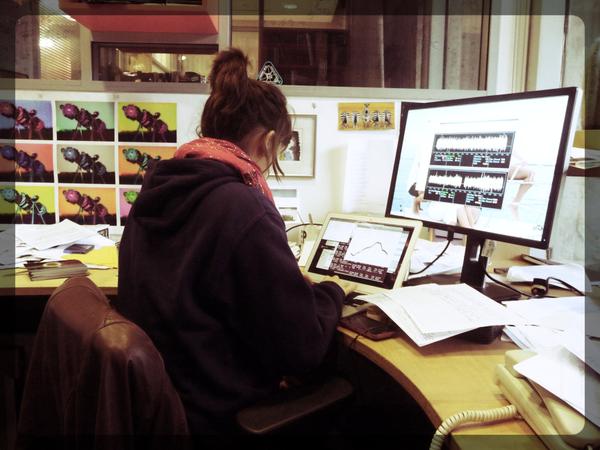
Here’s a picture of Becky hard at work working checking that our calibration observation was centered at the right wavelength we were supposed to observing at.
New Galaxy Zoo Paper Accepted For Publication!
A paper that uses Galaxy Zoo: Hubble to study whether supermassive black holes are fueled by galaxy bars beyond the local universe has recently been accepted! The paper will be published in MNRAS, but for a short summary, here is the original blog post.
Radio Galaxy Zoo: “gold standard” images and improving our calibration
First off, the science team for Radio Galaxy Zoo wants to thank our volunteers for their continued clicks, discussion on Talk, and continued participation in the project. As of today, we have 892,582 classifications on RGZ and over 45,000 subjects completed from the FIRST-SDSS sample. We absolutely could not do this without you, and we’re working hard on turning the data into interesting science.
We want to let you know of some particular galaxies that will be appearing slightly more often in the interface. One of the things I’ve been working on for Radio Galaxy Zoo over the last month is finding better and smarter ways of combining clicks from independent classifiers into the “final answer” for each galaxy. For past Zooniverse projects, we’ve been able to do this using relatively simple methods – users are weighted a little bit by their consistency with other volunteers, but the final data product is mostly just the vote fractions for various tasks. However, the task in RGZ is a bit more complex, and the simpler methods of combining classifications are proving very difficult. In order to accurately combine the information each volunteer gives us, we need to establish a bit more common ground than we currently have.
To calibrate the clicks across all citizen scientists, we need to look at galaxies that the same people have done. The science team has started this by labeling the correct morphologies (to the best of our abilities) for a smaller, “gold standard” sample. We use these as seed weights in our data reduction – that lets us calibrate users who have done the gold standard galaxies. These results are propagated outward to the full sample by looking at other galaxies done by both calibrated and uncalibrated users, and so on. Kind of like pulling ourselves up by the bootstraps. 🙂

Result of the science team classification of a small sample of 100 RGZ galaxies. The height of the bar represents how well a particular science team member agreed with the others. As a group, the results show very good consistency overall, near 90%. Using the results from this sample, we can apply similar calibrations to the tens of thousands of galaxies that RGZ citizen scientists are helping us with.
What we’re missing right now, though, are galaxies that lots of citizen scientists have jointly classified. Since each galaxy is retired after 20 people classify it, the chances of seeing a particular galaxy is pretty low. Some members of the science team, including myself, recently sat down with a sample of 100 galaxies taken from a combination of random selection and ones you’ve identified on Talk as having interesting or non-trivial morphologies (bent jets, triple systems, giants, no IR counterparts, etc). These is what we’d like to use for calibration. However, only about a dozen users so far have done enough of this sample to give us enough data for calibration.
So, in order to help the accuracy of the data pipeline, we’ve chosen 20 “gold standard” galaxies that will eventually be shown to all volunteers. They won’t all be in one bunch (you should see one every five subjects or so) and you shouldn’t see any galaxies that you’ve classified before. We’ll label the galaxies on Talk – look for the hashtag #goldstandard. I hope that another positive outcome will be users getting to discuss interesting features in galaxies that they haven’t come across before. After you’ve done all 20 galaxies in the sample, your future classifications will be randomly selected as usual.

ARG0001e8e – a very nice core + hotspot system, and slightly challenging morphology to classify. This is one example of the 20 “gold standard” galaxies we’re trying to have everyone in RGZ classify.
Please let us know on Talk if you have any questions about this, and I’ll be happy to discuss it further. Thanks again for all of your help – we hope this will let us produce a more accurate RGZ product and science papers in the coming year!
RGZ Team Spotlight: Minnie Mao
Meet Minnie Mao, leading the study of spiral double radio lobe AGNs (or S-DRAGNs) for Radio Galaxy Zoo.
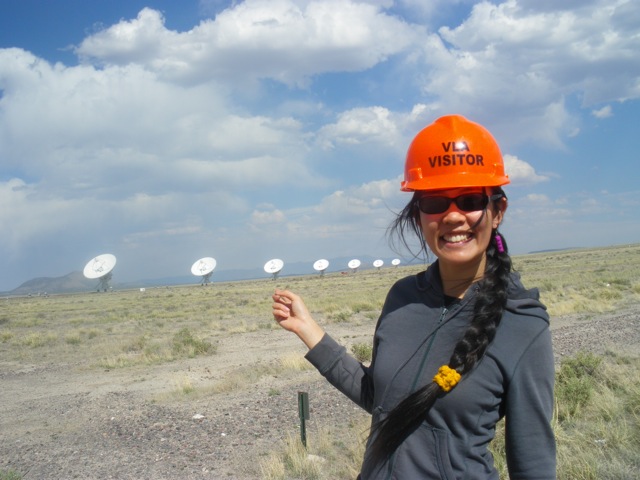 Hello! My name is Minnie and I am a VLA postdoc at NRAO in Socorro, NM. Astronomers use a lot of acronyms, and often are not very creative with telescope names/ VLA stands for ‘Very Large Array’, which is where some of the Radio Galaxy Zoo radio images come from!
I did my PhD at the University of Tasmania with Ray Norris (yup, THE Ray Norris), Jim Lovell, and Rob Sharp. We used optical data cross-matched with radio data from the ATCA (Australia Telescope Compact Array, where the rest of the RGZ radio images come from) to determine how galaxies have changed across cosmic time. A large chunk of the PhD was spent staring at images of radio galaxies, classifying their morphology, and determining their counterparts in optical/infrared images. While this can be a lot of fun, the Universe is rather large so I am glad I can now share this job with the wonderful zoo-ites!
One of my primary reasons for being involved in RGZ is because I am excited for the day when radio images become as familiar to people as optical images. To this end I hope you enjoy RGZ, because really, what is more fun than peering far back into the nether-reaches of the Universe?
Galaxy Zoo: Are Bars Responsible for the Feeding of Supermasssive Black Holes Beyond the Local Universe?
Supermassive black holes are thought to reside in the centers of most galaxies. These massive objects can produce powerful jets of energy that may significantly influence the evolution of their host galaxies. While we believe that black holes have an important role in galaxy evolution, a crucial unknown aspect about black holes is how they are fueled and turn into active galactic nuclei (AGN).
Among the proposed black hole fueling processes, bar-driven secular evolution is among the most popular. Bars are linear structures of stars that stretch across the centers of galaxies. They are theorized to fuel black holes by driving gas from the outskirts of galaxies into the very centers, where supermassive black holes lie.
Previous studies have tested whether bars can fuel black holes by examining whether there is an excess of bars among AGN hosts compared to non-AGN hosts. For the most part, those works found that there was not a significant enhancement of bars among AGN hosts, leading them to conclude that bars do not fuel black holes. But almost all these previous works were limited to the local universe, i.e., in the present, where the number of AGN is the lowest across cosmic time.
In this work, we investigate whether there is an excess of bars among AGN hosts beyond the local universe, i.e., in the distant past, up to 7 billion years ago. In this epoch, the number of AGN hosts is much higher, giving us a better glimpse of the identity of the black hole fueling mechanism. To conduct this experiment, we created two samples: 1) a sample of AGN hosts and 2) a carefully constructed control sample of non-AGN hosts that are matched to the AGN hosts. In order to create the largest samples possible, our experiment utilized three of the most popular extragalactic surveys: AEGIS, COSMOS, and GOODS-S. With these samples, we used the Galaxy Zoo: Hubble bar classifications to identify barred galaxies. Below is a gallery of 6 sets of AGN and their corresponding control galaxies, 2 sets from each survey.

Our main results are shown in the figure below. We have two probes of bar presence—bar fraction (left) and bar likelihood (right)—for the AEGIS, COSMOS, and GOODS-S surveys.

We find no statistically significant enhancement in the bar fraction or the bar likelihood in AGN hosts (green squares) compared to the non-AGN hosts (purple triangles). Our results, combined with previous works at the local universe, indicate that bars are not the primary fueling mechanism for supermassive black hole growth for the last 7 billion years. Moreover, given the growth of supermassive black holes over cosmic time, our results imply that bars are not directly responsible for the buildup of at least half the local supermassive black hole mass density.
Therefore, although among the most popular fueling mechanisms, it seems that bars do not fuel black holes. However, this result does narrow the search for the real black hole fueling mechanism.
The Hunt Is On
One of our scientists Prof. Ray Norris put the call out to the Radio Galaxy Zoo community for a hunt on spiral galaxies hosting powerful radio sources. The first known galaxy of this type is 0313-192, a galaxy much like our Milky Way and has left astronomers baffled.
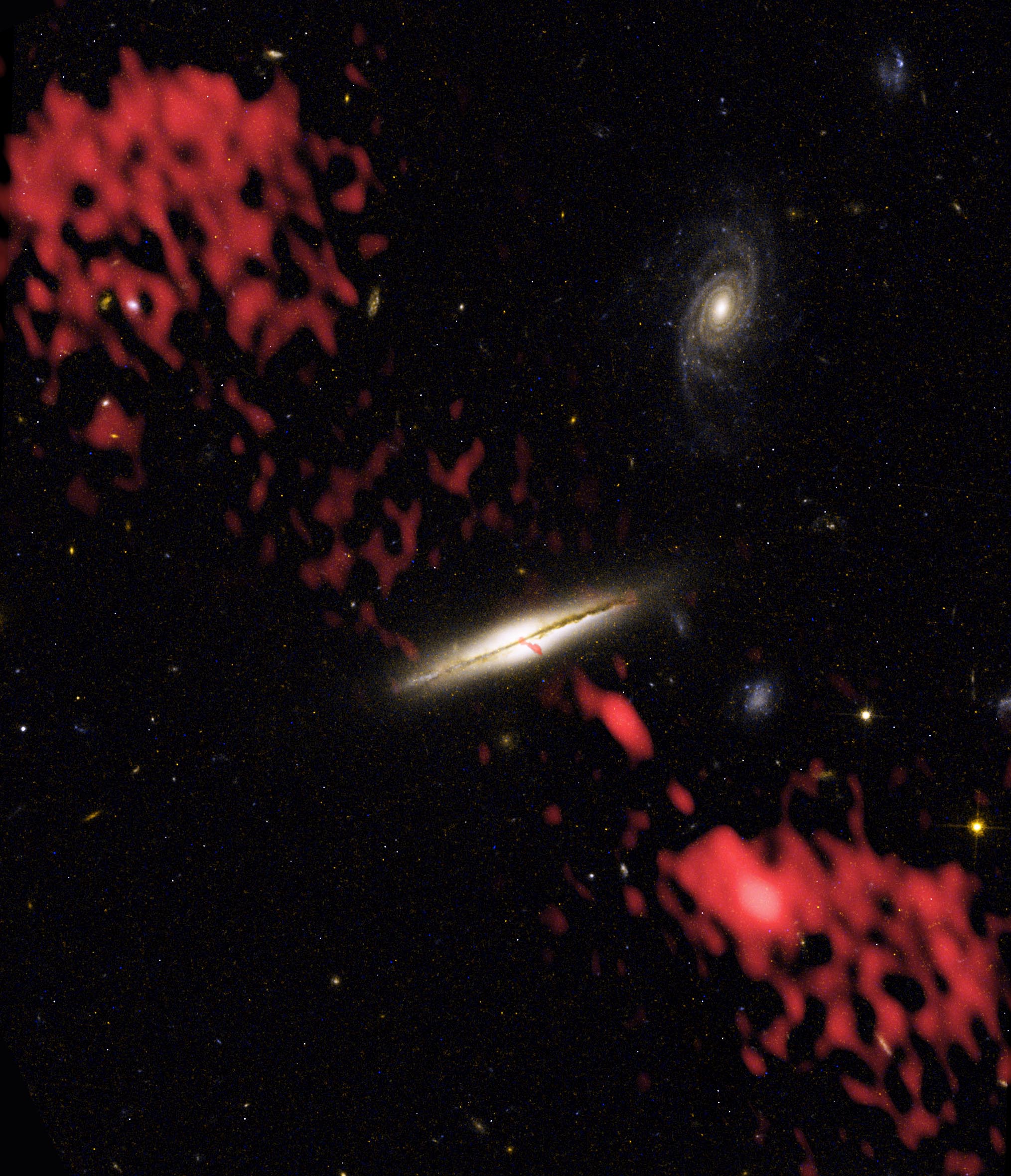 Figure 1: 0313-192 The wrong galaxy from the Astronomy Picture of the Day. Credit: W. Keel (U. Alabama), M. Ledlow (Gemini Obs), F. Owen (NRAO, AUI, NSF, NASA.
Here is Prof. Norris’ post:
Keep an eye out for any hourglass sources that seem to be hosted by galaxies that look spiral in the infrared. These objects are incredibly rare in the local Universe (only 2 or 3 known) and we may not see any in Radio Galaxy Zoo, but if someone does find one, that would be worth writing a paper about (with the discoverer as co-author, of course). The rarity of radio-loud spirals is thought to be because the radio jets heat up and disrupt the gas in the spiral, switching off star formation, and turning the galaxy into a “red dead” elliptical. But we might find one or two where the jets have only just switched on and haven’t yet destroyed the spiral. See The radio core of the Ultraluminous Infrared Galaxy F00183-7111: watching the birth of a quasar for another example of this process in its very early stage. So keep your eyes peeled and yell out (very loudly) if you find one!
We are pleased to announce that the Radio Galaxy Zoo community has identified over a dozen potential candidates and we are in the process of following these up.
Have you seen any? Head over to Radio Galaxy Zoo to join in on the hunt and let us know what you find.
RGZ Team Spotlight: Julie Banfield
Meet Julie (aka @42jkb on RadioTalk), a project scientist on Radio Galaxy Zoo!
 I’m a postdoctoral fellow at CSIRO Astronomy and Space Science in Australia. This is my first position after obtaining my PhD from the University of Calgary, Canada working on magnetic fields of radio galaxies. My first memories of astronomy and the wonders of the Universe were spending summer nights outside at campfires with my family staring up and counting the number of “shooting stars” we could see. It wasn’t until my second year of undergraduate studies at Western University in Ontario Canada that I considered doing astrophysical research; I was actually going through to be an airline pilot! I haven’t looked back at my decision to change into physics and astronomy and everyday I am amazed at the complexity and beauty of the Universe.
I spend my time researching magnetic fields and how important they are to radio galaxies. You can usually find me at the Australia Telescope Compact Array taking observations of all types of radio galaxies, sitting in front of a computer doing the exact same thing as Radio Galaxy Zoo, learning about life from my daughter, and educating myself on the wonderful country I now live in. I am excited about what Radio Galaxy Zoo has to offer the astronomical community and what the Universe will unfold for us through this project. Thank you for taking part!
 Galaxy Zoo