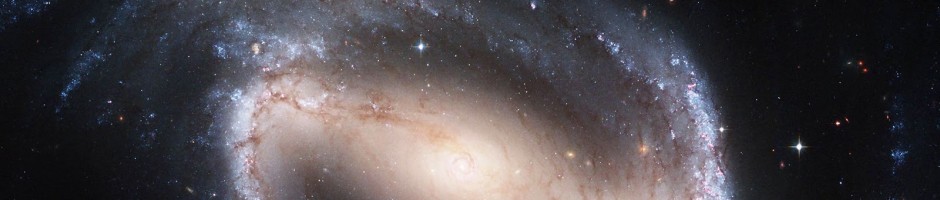
More Chandra data coming in…
Update on the Chandra program to observe the Galaxy Zoo mergers. After getting the first data late last year, Chandra has now observed five of the twelve approved targets and two more are in the long term schedule for the coming weeks.
Taking Citizen Science Seriously
Today’s post is from forum member Waveney who is embarking on his own science project:
Three years ago I stumbled upon the Zoo, started clicking, wandered into the forum and made friends. Then there was a request by Chris on the forum for people to check images for mergers, for which I wrote a website in 4 hours (including leaning SQL). This software with modifications has been used for all three Pea hunts, the Voorwerpje hunting, a few private hunts and for the Irregulars Project.
A couple of years ago Kevin asked for ideas for a student project. Several ideas were made, including the irregulars. After the student went on to do something else (Peas), Jules and I carried on talking. As the Zoo was quiet (between Mergers finishing and Zoo2 starting), we launched our own project to categorise the irregular galaxies in the forum topic. This was endorsed by Chris, who initially acted as the project’s supervisor.

What an amazing shape – what causes this?
There has been a lot of work on the big impressive ellipticals and spirals, on mergers and detailed studies on a few nearby irregulars. However there has not been a large scale quantitative study of them. The project aims to fill that gap. We are using data originally collected by the Forum, not used by any of the Zookeepers so are not treading on anybody’s toes.
What are irregulars?
These are the galaxies that don’t fit into any other category. They are not elliptical, they are not spiral, they are not involved in a merger. In general they are small, numerous and most are blue with star forming regions. Are they one homogenous group or is their more than one type? Are their old irregulars? Where are they? How do they compare with other galaxies? These are just a few of the questions the project is looking at.
How I started the project:
We started with the galaxies reported in the irregular topic on the forum, added those from a few related topics and started. Alice joined us in a supporting role and Aida came on board finding lots of other candidates, others have contributed lists and now the potential list is nearly 20,000 strong. I have managed the clicking on this in three data sets, the first 3,000 was the early reported – bright ones, then next 2,500 continued with the list in order of reported. However in the third set (nearing completion) I brought forward all those with spectra, so it contains 1500 ordinary candidates and another 2000 with spectra.
The website was setup (Note this has an independent login from the rest of the Zooniverse). It asks 10 questions about each image: is it an irregular, the clarity of the image, bright blue blobs, apparent proximity to other galaxies, appearance of any core, bar, arms or spiral structure.

How would you classify this?
What has been done so far:
Jules has looked at their 2D distribution across the sky and estimated the number that are too faint for SDSS to have taken their spectra. I have already studied the colour properties of irregular galaxies, their metallicity, masses and star-forming rates, hunted for AGNs (none found so far in irregulars), the equivalent width of the [OIII] 5007Å line in the same way that the Peas were analysed and the non-applicability of Photo Z algorithms for estimating Z without spectra to irregulars. I am currently studying galaxy density around irregulars (in 3D) and am looking for clusters of irregulars. I have not yet used the sub classification of the irregulars, just the “is it an irregular property” – this will come.
The project went rather quiet last year – I was terribly over worked and ended up with no spare time, this has changed recently and I have gone back and started looking again at the work we have done and thinking how to take it further. What is being found should be published – how does one do it? When the project had Chris as a supervisor the route was clear, I need to work with somebody in academia so I can present results, bounce ideas off, get ideas from and work with. Relying on the spare time of Zookeepers is not a satisfactory option – why not pay for the time. Then I thought back to a throwaway comment of Chris a year or so ago that “I had done half a PhD” – I recognise this means I have done 10%, but it got me thinking – why not do it properly. I don’t want to do this full time, I have a very full time job – but could I do it part time. Does the Open University do part time PhDs – a quick web search yes it does…
So I have signed up to take a part time PhD at the Open University on the irregulars. This will take several years, I will fund it myself. I am not totally new to doing formal research, in my professional life I had a lot to do with telecoms research: Proposing, taking part in, managing and cancelling many projects both company and EU funded at research houses and Universities, covering everything from social science through home networks to optical switching. I have even been on the other side of the table reviewing a couple of PhDs.
At this point I have applied, have a supervisor, met them once. Chris and Bill are my referees. The formal interview is in March and the formal start of the PhD is in September. However I am working hard looking at your results, reading, analysing, thinking and writing this.
I have created a blog on the forum to report day to day progress.
P.S. I could use a few more clicks.
From data to art
When I started writing my post series about the HST (which will be continued soon), I got an email from Zolt Levay from STScI in Baltimore (Space Science Institute, ‘Hubble headquarters’) about how the beautiful HST images are actually made there. We then decided that he would write this up as one of the posts here and we would post it once the GalaxyZoo: Hubble explanations are online on how those special images are made. Now that this has happened, it is time to posts Zolt’s much more general post here.
Enjoy!
Boris
______________________________________________________________
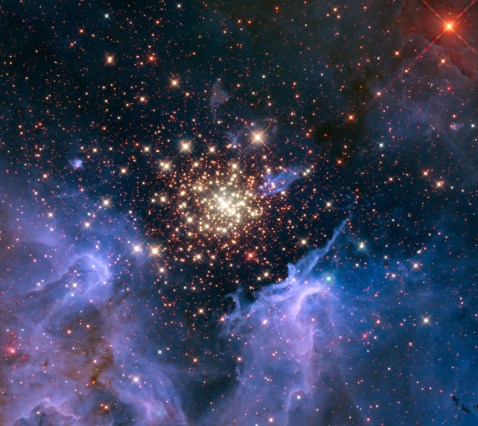
Star-forming region NGC 3603 from Hubble Space Telescope and Wide Field Camera 3
Thanks to Boris for inviting me as a guest blogger here. I have been fortunate to be able to work on the Hubble Space Telescope mission for quite some time. I have spent a lot of that time working with Hubble images. I wanted to use this opportunity to say a few words about how Hubble’s pictures come about. Along the way I hope to give a flavor of the sorts of choices we make to present the pictures in the best possible way, to answer some questions and to correct some possible misconceptions.
The images we see from Hubble and other observatories are a fortunate by-product of data and analysis intended to do science. Hubble’s images are especially high quality because they don’t suffer the distorting effects of the atmosphere since Hubble is orbiting high above the Earth. I won’t go into a lot more detail about Hubble’s technology since Boris has described that nicely in his post “Why build the Hubble Space Telescope?“.
We do aim to produce images that are visually interesting and that reproduce as much as possible of the information in the data. I should also say that these techniques are not unique to Hubble. The cameras used at every large telescope operate pretty much the same way and the same techniques are used to produce color images for the public.
We begin with digital images from Hubble’s cameras, which are built for science analysis. The cameras produce only black and white images because they are designed to make the most precise numerical measurements. They do include a selection of filters which allow astronomers to isolate a specific range of wavelengths from the whole spectrum of light entering the telescope. The black & white (or grayscale) data include no color information other than the range of wavelengths/colors transmitted by the filter. By assigning color and combining images taken through different filters, we can reconstruct a color picture. Every digital camera does this, though it happens automatically in the most cameras’ hardware and software.
We produce color images using a three-color system that reflects the way our eyes perceive color. Most of the colors we can see can be reproduced by a combination of three “additive primary” colors: red, green and blue. Every color technology depends on this technique with some variations: digital cameras, television and computer displays, color film (remember that?), printing on paper, etc.
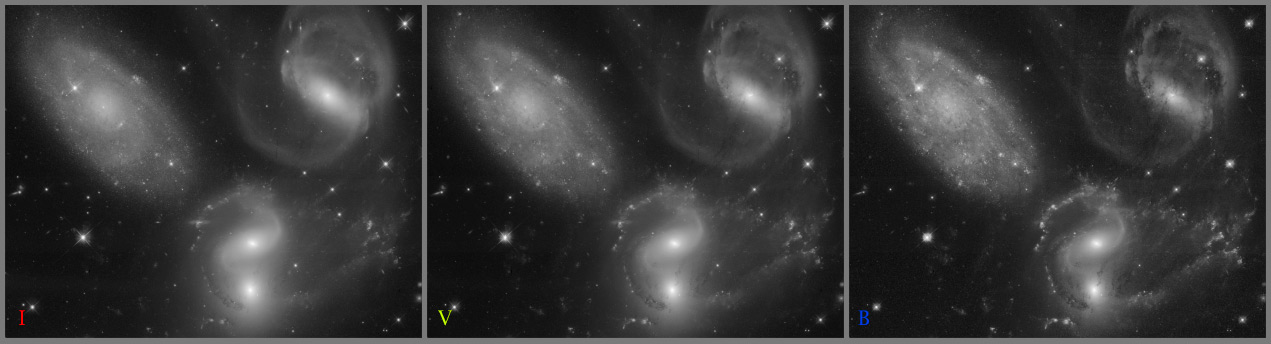
Stephan's Quintet HST WFC3 grayscale images
Here are three images of the group of galaxies known as Stephan’s Quintet from Hubble’s new Wide Field Camera 3 (WFC3). The three exposures were made through different filters: I-band, transmitting red and near-infrared light (approximately 814nm in wavelength); V-band (yellow/green, 555nm), and B-band (blue, 435nm). It may not be obvious, but if you examine the image closely you can see there are differences between them. The spiral arms of the galaxies are more pronounced in the B image while the central bulges are smoother and brighter in the I.

Color applied to separate images
We can then assign a color (or hue) to each image. Two things mainly drive which colors we choose: the color of the filter used to take the exposure and the colors available in the three-color model. In this case we assign red to the I-band or reddest image, green to the V-band, and blue to the B-band or bluest image, which are pretty close to the visible colors of the filters. When we combine the separate color images, the full color image is reconstructed.
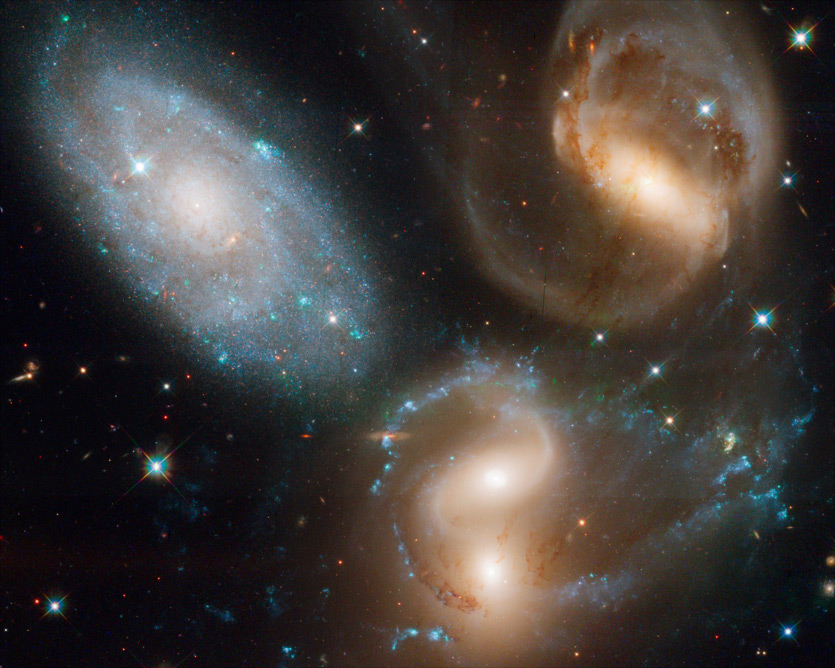
Reconstructed color composite of Stephan's Quintet
Because the colors we assigned are not too different from the visible colors of the filters, the resulting image is fairly close to what we might see directly. At least the colors that appear are consistent with the physical processes going on in the galaxies. The spiral arms trace regions of young, hot stars that shine with mostly blue light. The disks and central bulges of the galaxies are mostly made up of older, cooler stars that shine more in red light. Individual brighter stars — foreground stars in our own galaxy — show different colors based on their temperatures: cooler stars are redder, hotter stars are bluer.
We can apply some adjustments to make the picture more snappy and colorful, similar to what any photographer would do to improve the look of their photos. We also touch up some features resulting from the telescope and camera; that explanation may be something that can waits for another post.
Depending on the selection of filters — driven by science goals — and color choices, the images can be shown in various ways. But the motivation behind these and other subjective choices is always to show the maximum information that is inherent in the science data, and to make an attractive image, but also to remain faithful to the underlying observations. We don’t need to heavily process the images; they are spectacular not so much because of how they are processed, but because they are made from the best visible-light astronomy data available.
A variation on this image blending technique needs to be applied with filters that don’t correspond to the standard color model. Narrow-band filters are designed to sample the light emitted by particular elements (hydrogen, oxygen, sulfur, etc.) at specific physical conditions of temperature, density and radiation. These filters are used mostly to observe and study nebulae, clouds of gas and dust that glow because they are illuminated by strong radiation from nearby stars. This very diffuse gas emits light at very, narrow ranges of wavelengths so the color can be very strong or saturated. Some of the most spectacular images result from these clouds that come in all sorts of shapes and textures.
The wrinkle with this sort of observation is that the colors of the filters rarely match the primary colors we would like to use to reconstruct the images. We can choose to reconstruct the color image either by applying the color of the filter, by using the standard primaries or something else entirely. In general a more interesting image results from shifting some of the filter colors. The resulting colors are definitely not what we might see live through a telescope, but they do represent real physical properties of the target.
Here are some images of a pillar in the Carina Nebula, taken to celebrate Hubble’s 20th anniversary in 2010. The filters sample light emitted by atoms of hydrogen, sulfur and oxygen. The hydrogen and sulfur both emit red light and the oxygen is cyan (blue-green). The colors and brightness of emission from the various elements depends on the physical conditions in the nebula such as temperature and pressure, as well as the quantity and energy of radiation from surrounding stars causing the clouds shine.

Separate narrow-band images of a pillar in the Carina Nebula from HST WFC3
When we apply the colors appropriate to the filters and make a color composite, the separate images look like this:

Color applied to grayscale images of Carina Pillar
And the composite color image looks like:

Reconstructed color composite of Carina Pillar
It’s an interesting image, but doesn’t include a wide range of colors because we are starting with only two colors, red and cyan. Let’s try something a little different and shift the colors around a bit:

Primary colors applied to grayscale images of Carina Pillar
Here we are using red for the sulfur (the reddest, longest wavelength filter), green for the hydrogen and blue for the oxygen. It may be a little disconcerting; many people know that hydrogen usually shines in red light, but here we are showing it in green. But sulfur also shines in red light here, so the only way to visualize the structures that result from differences between the hydrogen and sulfur is to shift the colors.

Color composite of Carina Pillar from HST WFC3
If we make the color composite in this way though, see that we now have a fuller range of colors, like an artist’s palette with many more different paint colors. The combinations of colors (like mixed paints) in the composite image result from real differences between the emission coming from the various elements. If they are rendered in the same color those differences are eliminated in the composite. But if we separate their rendered colors, we can show more of the information inherent in the data.
Thanks again for the opportunity to contribute here. I hope this answers some questions about where Hubble’s color images come from. We all hope that Hubble continues beyond its extraordinary 20+ years of amazing science and we can see even more spectacular cosmic landscapes.
More on our fake AGN
Carie’s announcement of the addition of fake AGN has stirred up a storm on the comment thread, and in the forum. I’ve replied where I can, but I think there’s a fundamental misunderstanding that it’s worth highlighting here :
We’re not trying to get you to identify AGN – we want you to classify the galaxies just as you always would. The aim is to test whether the presence of such an AGN affects the classification of the shape of the galaxy. If they do, we need to measure the size of the effect. So don’t go AGN spotting – except for fun – but keep classifying.
I hope that helps.
Chris
P.S. If you do want to know if you’ve identified a fake AGN, then the galaxy’s examine page will say so and the ID will begin AHZ7….
Galaxy Zoo classifications in SDSS Database
The latest release of data from the Sloan Digital Sky Survey happened yesterday (SDSS3 blog article about the release). This has been widely talked about as providing the largest ever digital image of the sky, but one thing which might have passed your notice is that as part of this data release your Galaxy Zoo classifications (from the first phase of Galaxy Zoo) have been integrated into the SDSS public database (CasJobs). This will make GZ1 classifications all that more accessible for professional (and amateur?) astronomers to use in their research, and we hope to see some exciting and novel new uses coming out.
I’ll finish by including this visualization of the SDSS3 imaging data made by Mike Blanton and David Hogg (OK so I can’t work out how to embedd a YouTube video here, so here’s the link!).
Fake? AGN Galaxies!
Hidden deep inside the center of most massive galaxies is a central super-massive black hole. However, a in a few percent of galaxies, the black hole is growing in size by accretion of matter. These galaxies are called Active Galactic Nuclei (AGN) . By studying these galaxies we can piece together the picture of how galaxies assemble themselves, growing as stars form and their central super-massive black holes accrete matter. In the local universe , we used Galaxy Zoo’s classifications of AGN host galaxies for a study that revealed “The fundamentally different co-evolution of super-massive black holes and their early- and late-type host galaxies”.
But to really understand how most galaxies were built up, we need to look farther back in time, out to where most galaxies in the present day universe were growing most of their mass. Because the light from distant galaxies takes so long to reach us, in Hubble Zoo we are able to see galaxies as they were in the distant past. (In Hubble Zoo most of the galaxies we see are images from ~ 5-7 billion years in the past !). However, as you may have noticed, the Hubble Zoo galaxies appear much smaller. Because the light emitted near an actively growing black hole can be comparable to the light that we see in from an entire galaxy, in Hubble Zoo we have to be careful when classifying galaxies with these luminous centers. To understand what we’re seeing, a team of Galaxy Zoo Scientists have created images, artificially adding the luminous centers of AGN to some of the Hubble Zoo galaxies. These Fake AGN will allow us to determine if how accurately we can classify the host galaxies of the actual AGN in the Hubble Images.
Hanny's Voorwerp and Hubble
And here they are! The Hubble Space Telescope results on Hanny’s Voorwerp (and IC 2497) were just released during the Seattle meeting of the American Astronomical Society. You can see the press release and download several formats of the main image from STScI, download the poster presentation from the meeting, and view the abstract of the meeting presentation, but we can give you the whole story in detail here on the GZ blog. But before that, here’s the money shot:
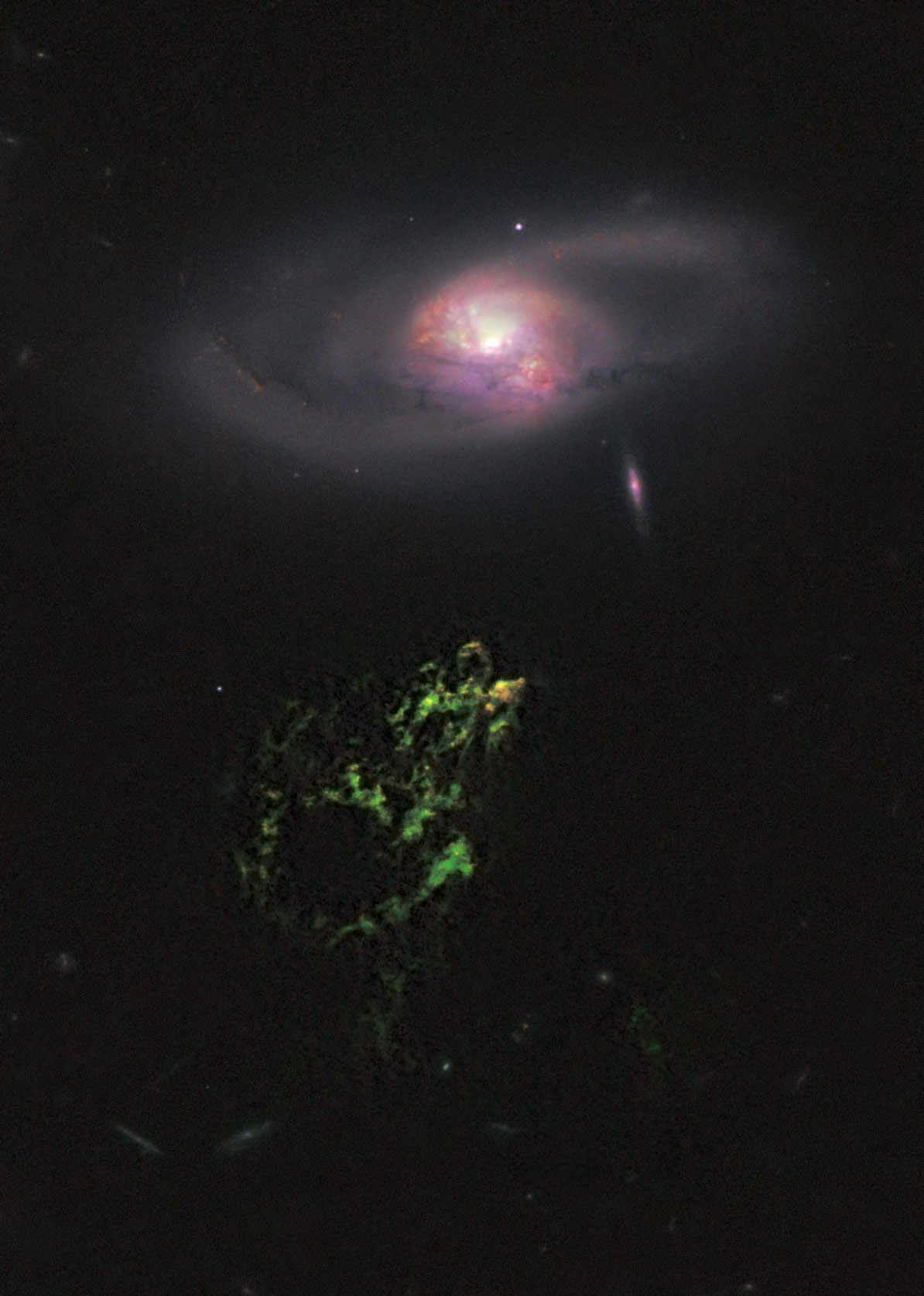
This combines different filter sets for IC 2497 and Hanny’s Voorwerp, to give the best overall view in a single image. The Voorwerp shows up in [O III] and Hα emission, close to natural color were our eyes sensitive enough. The galaxy IC 2497 is rendered from red and near-IR filters, so it’s a bit redder than we see in other images (for example, from the SDSS or WIYN data). This version does a very attractive job of contrasting the two objects in both color and texture; for reasons you’ll read below, Zolt Levay and Lisa Frattare at STScI had a daunting task to make a single image look this nice from our disparate data sets.
Looking back, we proposed these observations early in 2008, as it was just becoming clear what an interesting object the Voorwerp is and what the right questions might be. It was our good fortune that these observations remained relevant with all we’ve leaned since then, including radio and X-ray measurements. Each data set was specified with a particular goal as to selection of filter or diffraction grating, location, and exposure time. We had images and spectra, the latter looking for material very close to the nucleus of IC 2497 so we could zero in on what’s happening there with much less confusion from its surroundings than we get from the Earth’s surface. Full details of the observation planning appeared in this blog post after our proposal was approved.
The released image product combines four filters and two cameras – the Wide Field Camera 3 (WFC3), installed during the 2009 shuttle servicing mission, and the Advanced Camera for Surveys (ACS), electronically repaired during that mission. WFC3 offers superior sensitivity and small enough pixels to exploit the telescope’s phenomenal resolution, while ACS has a set of tunable “ramp” filters that allow us to observe the wavelength of any desired spectral feature at a galaxy’s particular redshift. Our WFC3 images were designed to look at IC 2497, at wavelengths deliberately minimizing the brightness of the gas in the Voorwerp so we could also look for star clusters in its vicinity, that might tell us whether its gas came from a disrupted dwarf galaxy. (This turned out to be a good idea for a slightly different reasons). Our filter choices included one in the near-infrared, at 1.6 micrometers; one in the deep red, close to the SDSS i band, and one in the ultraviolet. Comparing these, we would be able to say something about the age of any star clusters we found. The UV image would also show whether there were any particularly bright clumps of dust, which could serve as “mirrors” so we could later measure the spectrum of the illuminating light source.
The ACS narrow-band filter data were designed to probe the Voorwerp itself, seeking fine structure that is blurred away in ground-based images. We use both the strong [O III] emission (which made it so recognizable when Hanny picked it up from the SDSS images), and the Hα line of hydrogen. Their ratio changes as the conditions ionizing the gas change, so we could watch for variations as conditions differ from place to place. This also netted us gains we hadn’t quite asked for. We also had to work for them. it was known before its repair that the CCD detectors on ACS had suffered from exposure to energetic particles in space during its decade in orbit; all such devices do to some extent. One result of this cumulative damage is that they don’t transfer charge as efficiently as they originally did, and in particular, after being struck by a charged particle (“cosmic ray”), when the image reads out, the detector registers not only a bright spot (which is easy to filter out) but a long trail, so long that it’s not at all easy to filter out without blacking out much of the image. The situation improves if you combine two images, moving the telescope slightly in between them. That lets the software reject the bright cosmic-ray spots, but even after tuning the rejection parameters, the streaks still remain down the device rows. We ended up using what we knew about the remaining trails to filter them out, at the expense of losing the dimmest, smooth regions of emission. Fortunately, these dim regions don’t have enough signal to show new features in Hubble data, so we used ground-based images to fill them in around the edges and in the fainter interior regions of the Voorwerp. This panel shows four successive stages in the process:
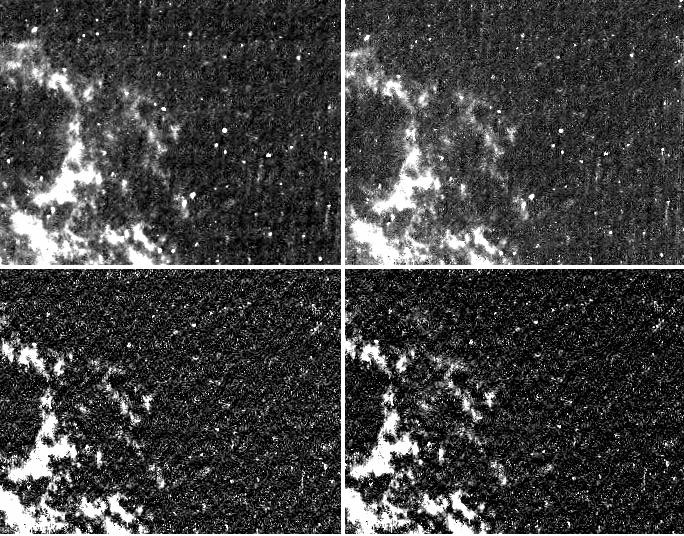
Processing steps for HST image of Hanny's Voorwerp
Now, as proud as I am of fixing this all up, you don’t really care – you want to know what we’ve actually learned from Hubble. I’m with you – here goes!
Stars are forming in a small part of the Voorwerp. We couldn’t see this from the ground because the regions involved are dim and blend with the overall gas emission. Hubble shows them in two ways. Our filters selected to minimize emission from the gas show bright blue spots, with the size and brightness of young star clusters, in a single area only 2 arcseconds long (about 2 kpc, 6500 light-years). Because the deep-ultraviolet spectrum of starlight is quite different than from an AGN, we see a second signature – the balance between light from [O III] and Hα tips in favor of Hα , again very different from the highly ionized gas elsewhere. In the picture at the top, that makes the star-forming regions show up as the reddish spots near the top bright region of the Voorwerp. These gaseous regions are likewise so small and comparatively dim that we couldn’t see them in even our best ground-based data. The hottest stars are so bright that it’s hard to tell how long these clusters have been forming stars; we know that they include stars so hot that they can be no more than a few million years old. It seems suspicious that we see these star-forming regions only in a small area, which lies closest to IC 2497 at least in our view (we don’t have enough information to be sure it’s really the part closest to the galaxy), and roughly lined up along the direction of outflowing material seen with radio telescopes. This all suggests that the star formation has been set off by compression as gas outflowing from the galaxy encounters the gas in the Voorwerp. We don’t see such star clusters anywhere else in the enormous trail of cold hydrogen of which the Voorwerp is the illuminated part, so their occurrence is connected to the Voorwerp specifically.
This kind of event – an active galactic nucleus blowing gas outward and driving formation of new stars – is one form of feedback, connections between AGN and their surrounding galaxies that seem to be important in regulating aspects of galaxy evolution. We see this process in some other galaxies, in some cases much more intensely than in Hanny’s Voorwerp. A favorite example is Minkowski’s Object, a brilliant emission-line object near the radio galaxy NGC 541 at only a third the distance of IC 2497. In Minkowski’s Object, the central AGN is almost solely a radio object, without the ultraviolet output that ionizes Hanny’s Voorwerp. In that case, where we see ionized gas, it’s lit up by hot, newly-formed stars. This object lies right in the path of the jet of radio-emitting plasma from NGC 541, which is disrupted right as it reaches the object; this looks like a cloud of gas, maybe a dwarf galaxy, that was quietly minding its own business until it was hit by a flow of relativistic particles. Star formation is happening over regions of about the same size in both Minkowski’s Object and Hanny’s Voorwerp, but there are important differences: gas is shedding back away from Minkowski’s Object much more violently than in the Voorwerp, the radio jet in NGC 541 is much more powerful than the small one in IC 2497, and it doesn’t have the additional UV output to light up the gas which is not forming stars. The point I take from this is that the outflowing material reaches the Voorwerp, but with only enough pressure to set off star formation in the densest and closest parts, without the massive reshaping we see in some other galaxies.
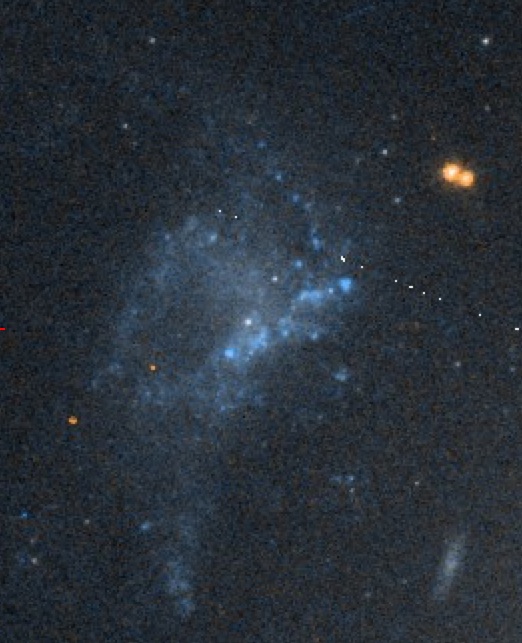
Minkowski's Object from Hubble Legacy Archive
The Hole This is probably the most obvious structural feature of the Voorwerp (sometimes seen as the space between the kicking frog’s legs). We wondered whether it might mark the site of some kind of titanic explosion, the space where a jet from IC 2497 drilled its way through the gas, or even the shadow cast by some dense cloud close to the galaxy nucleus. What we learned on this was mostly negative – we do not see streamers of gas blasting away from the hole, or the ionization of the gas being any higher near it, as we would expect for a jet or explosion. The idea of a shadow still makes sense, but we’d still like to know more (maybe from some Gemini-North velocity data still being analyzed).
The nucleus has faded dramatically, but it still knows how to make other kinds of fireworks.One idea we have been investigating, since we saw the first spectra, has been that the nucleus of IC 2497 might have faded in its output of ionizing radiation by hundreds of times since the light that we see reaching the Voorwerp left it. (Ignore for a moment the odd complications of verb tenses involved in light-travel time discussions). What Hubble could add is the ability to measure spectra from very small regions free of the mixing with light from the surroundings that occurs from the ground. This way we could get a good look at the nucleus of IC 2497, how much ionization its gas sees, and whether there might be shreds of highly ionized gas peeking through surrounding obscuring dust and gas which otherwise obscures our view. For this we used two spectra (blue and red) with the Space Telescope Imaging Spectrograph, newly restored to service by the astronauts of STS-125. We get a clearer measure of the gas – it sees a slightly weaker ionizing source than we thought from the ground because the gas is mostly closer to the core than we would have thought. This fits with the X-ray data in suggesting that the nucleus isn’t just hidden, it really has faded so we see its echo in the Voorwerp. (To indulge once again in a bit of geekdom, “It’s dead, Jim”.)
Or maybe not so much dead as… transformed. The spectra also show something else that we didn’t know to look for. Only a half arcsecond from the core we see a second set of emission lines, redshifted by about 300 km/second from the nucleus. At this location in the ACS images, we see a loop or bubble of Hα emission. The nucleus has been blasting out material, driving this wave into the surrounding gas. Depending on whether it has been slowed down as it snowplows into these surroundings, and on whether it lies exactly in the disk of the galaxy, this would have started less than about 700,000 years ago. This was probably well before the nucleus faded, but connects to an intriguing idea long suggested from looking at the various kids of active galaxies. There may be two modes of accretion power – one in which most of the energy comes out as radiation, and one in which it emerges as kinetic energy of expelled matter (“radio mode”). Has IC 2497 switched between them almost as we watched?
Here is that expanding loop. At left is the Hα image, showing it sticking out above the nucleus. In the middle is a broad-filter image taken to zero in the pointing to take the spectra – you don’t see the loop because it’s swamped by the starlight. At right, the spectrum near Hα showing the distinct emission-line clouds just above the nucleus.

IC 2497 expanding gas loop
IC 2497 has had a troubled past. It looked a bit odd in our earlier data, but the Hubble images make clear how disturbed this galaxy is. Spiral arms are twisted and warped out of a single plane, and thick dust patches also show that it has yet to settle into a simple form after the disturbance. This looks a lot like the aftermath of a strong interaction – and since we see no other culprit nearby, probably a merger where the other victim is now part of IC 2497. The companion barred spiral just to the east (left) may be only an innocent bystander – it shares the redshift and distance of IC 2497, but is so symmetric and undisturbed that it’s hard to picture it being involved in a collision that wracked the larger galaxy (and tore loose 9 billion solar masses of hydrogen gas from somewhere). These dust patches, plus our better understanding of the Voorwerp’s continuous spectrum aided by the GALEX UV data, now suggest that instead of slightly in front of IC 2497, the Voorwerp is more likely slightly behind it, roughly over the pole of the galaxy. This means that we see the reprocessed radiation via the Voorwerp perhaps 200,000 years after it left the galaxy nucleus. Old news can still be very informative.
Putting it all together, here is the sequence of events that we think led to what we see today. Perhaps a billion years before our present view (which is itself 700 million years behind the times, and there’s nothing we can do about the speed of light), a merger led to IC 2497 forming from two progenitors, with its disk slowly settling but still warped. One product of this merger was an enormous tidal tail of gas, which came to stretch nearly a million light-years around IC 2497. During this process, material accreted into its central supermassive black hole, rapidly enough to produce the energy output of a central quasar as a byproduct, and illuminating and ionizing gas that was exposed to its radiation, to make the Voorwerp. About a million years before we see it, it started to blow material away (and this may have been when its radio jet and outflow started). Then, later still, the core faded, maybe as its energy output switched from being mostly in radiation to mostly powering the motion of material out of the galaxy. And now we see Hanny’s Voorwerp as a very lively echo of the past, as the last radiation from the fading core aces outward but has yet to complete the zigzag trip from galaxy to Voorwerp to us.
Of course, we’d like to test these ideas further. There are plans to improve the spectral mapping, and perhaps look at the history of star formation to tell when things happened to IC 2497. And we want to see whether this behavior is at all common in galactic nuclei – if so, there may have been more active galaxies lately than we thought, and it would change how we think about the relation between “normal” and active galaxies. Zooites have pushed us along greatly in finding smaller cousins – voorwerpjes. But that was a separate meeting presentation…
Live blog : Voorwerp press conference
As anyone who’s been following the twitter feed in the last few days knows, today is a very exciting day for Galaxy Zoo as the long-awaited Hubble Space Telescope image of Hanny’s Voorwerp is released. Kevin has already shown the image in a science talk this morning, and Bill’s poster is up in the conference hall giving more details, but the official release is in just a few minutes. I’m writing live from the press conference room at the American Astronomical Society’s meeting in Seattle, sitting next to the object’s discoverer and namesake Hanny van Arkel and Zooniverse developer Rob who will be keeping twitter up to date.
There’s a separate, long post from Bill ready to go live describing the results, including some very exciting new details, but I’ll use this post to keep you up to date with what happens in the press conference itself.
Three minutes to go…
12.44 : Kevin and Bill are on stage, alongside Leo Blitz of the University of California and Amy Reines from the University of Virginia, who will also be talking about their work during the conference.
12.47 : Press conference starting, but what’s this?
Hubble views Hanny’s Voorwerp
12:52 : Introductions from Rick Feinberg, AAS press officer are over, and Bill’s taking the stand.
12:54 : Bill : ‘Conclusive proof that we have seen a quasar turn off’. Giving the background to the Voorwerp, and introducing Hanny, who immediately became the focus of every camera in the room.
12.56 : The image appears on screen. It looks terrible under the press room lights. Go to the online version, everyone!
12.58 : On to Kevin – the quasar is either hidden or has shut down, in which case the Voorwerp would be an echo of light, not of sound. In the meantime, for those wanting gory details Bill’s blog post is up.
13:00 : IC 2497 does shine in x-rays, but it’s like looking for a floodlight through a bank of fog and finding only a laser pointer – totally inadequate to light up the Voorwerp.
13:04 : In fact, the difference is at least 10,000 times. The timescale on which the reduction must have happened is now believed to be 200,000 years or less (we used to think 70,000 years or less).
13:06 : Back to Bill for one of the major results from Hubble : The bright area close to IC2497 is an area of star formation – so the interaction is triggering star formation in the Voorwerp. We couldn’t have seen this without Hubble, but it fits with the Westerbork radio results that showed evidence for a jet and larger outflow of gas in this direction. We think these are compressing the gas – rather as happens in Minkowski’s object (which was mentioned in my original Voorwerp paper). Much milder in the Voorwerp, though.
13:10 : Spectrum of the main galaxy confirms x-ray results – but we also cut across another area, which seems to be a bubble being blown into the disk of the galaxy – another aspect of an outflow of gas fostered by the nucleus of IC 2497.
13:15 : Bill again : We think that one reason this object is important is because it would be a coincidence for us to get lucky only once, with the nearest quasar. The Galaxy Zoo volunteers have poured through 15,000 candidate images and found 18 related objects – which have been confirmed by follow up. Being presented in another poster, the lead author of which is a Galaxy Zoo volunteer (and undergraduate on a summer program).
13:15 : Dodgy internet connection – sorry! We’re going to try a ustream chat with Kevin, Bill and Hanny after the conference ends. I see Hanny’s mother is watching – we can confirm she’s been very well behaved.
13:22 : Leo Blitz moves us away from the Voorwerp – They believe they’ve found a missing link between galaxies that form stars and those that are dead. A major topic of astronomical interest is how galaxies loose their gas and become old, red and dead. NGC 1266 is an unremarkable galaxy, slightly less massive and smaller than the Milky Way. It has an active galactic nucleus, but to all appearances is otherwise dead. Observations of the molecular gas from which stars mind form show that it’s concentrated in the nucleus of the galaxy. Excitingly, it appears to be fueling a wind that’s been blowing for more than 2.5 million years, and moving fast enough to escape the galaxy. About 13 Sun’s worth of gas escapes each year, and so in about 85 million years’ time, at the current rate, the gas will have been exhausted and the galaxy will have completed its transition to an old galaxy.
13:26 : Our final speaker, Amy Reines, is introducing us to Heinze 2-10. It’s a small galaxy, and yet it hosts a super-massive black hole. In fact, the black hole is the same size as that in the Milky Way but the galaxy is closer to the Milky Way’s satellite galaxies, the Magellenic clouds.
13:30 : Possibly explanation is that black holes form before the bulges at the center of the galaxies do – which would answer an age-old chicken and egg problem! Now on to questions – my laptop is dying, but I’ll hang on as long as I can.
13:36 : Good question on Twitter from Ann Finkbeiner – ‘if the galaxy is 650 million LY away and the quasar turned off 200,000 years ago, how come we’re now seeing it with no quasar?’. We mean that we’re now seeing light that was emitted no more than 200,000 years after the quasar switched off.
Zooniverse's Arfon Smith on NPR SciFri
Listen to Zooniverse technical lead Arfon Smith talk about citizen science on NPR’s Science Friday: http://www.sciencefriday.com/program/archives/201101072
Astrophotography 365 – Completed!
This week’s OOTW features an OOTD by Jules, posted on the 7th of January 2011.
Jules, at the end of 2009, had the idea of an ‘Astrophotography 365’ challenge, where at least one astronomically themed image gets posted on the Galaxy Zoo forum each day in 2010. And it went down extremely well, with just over a thousand images posted!
In the words of Jules:
The level of interest in the thread was unexpected and the contributions came thick and fast. On cloudy nights we had photos of astronomy themed gadgets, toys, books and jewellery! There were several photos posted for each day and the project grew bigger than I had anticipated. I had originally intended to put all the photos into a montage at the end of the year but we had so many contributions that I opted for monthly montages instead in order to make the final one manageable.
The 365 is now complete. We more than met the challenge and here is the result:

Click to embiggen!
| ALICE BLACKPROJECTS BUDGIEYE CATHAL BRISKING GEOFF ECHO-LILY-MAI |
GRAHAMD HANNY HONORARYSPOCK INFINITY JAN JULES KALEBATS |
LAPOMPO LIZARDLY NGC3314 PADDY RENEDEF ROTAR SDREW |
SIRPEPPY STAR MAN STARBRIGHT STARGAZINGMOMMY STELLAR190 SWENGINEER VOLLBARTH |
We had pictures of deep sky treasures such as star clusters, nebulae and galaxies as well as comets stars, planets and the Sun (including its spectrum) and the Moon. Equipment ranged from mobile phones to DSLRs and webcams to remotely controlled scopes like SLOOH and SARA-S. Some contributors had never taken an astrophoto before and produced some amazing results. We also braved all weathers to meet the challenge. I hope we kept people entertained – the thread has had over 42,000 views.
Thanks to everyone who took part. It was huge fun. Maybe we can have a year off and do it all over again! Meanwhile let’s resurrect Alexandre’s old thread and keep clicking in 2011!
 Galaxy Zoo
