Zoo Limericks
Of the many things that the Zooniverse produced this year (2010 was a busy one!) a highlight for me were the Zooniverse limericks over on the Galaxy Zoo forum. For Day 17 of the advent calendar I have picked out a few of my favourites. Crowd-sourced and often puntastic.
From DJJ on the influx of spammers in October:
]When spammers invade our vicinity,
Two zooites, the one called Infinity,
The other called Alice
(I won’t say with malice)
Despatch them, and earn zoo divinity.
From Budgieye on an infrared quasar in the SDSS:
From the edge of our space-time, it shrieks
“I’m a quasar”, then Expansion tweaks
its Lyman UV,
redshifted, to be
a whisper of infrared peaks.
From DJJ on Pluto’s demise:
When Tombaugh had managed to scan it,
They christened it Pluto — a planet,
But in twenty-o-six
With their ‘dwarf planet’ fix,
The IAU voted to can it.
From DJJ (again! There a lot of great DJJ limericks) on Galaxy Zoo Hubble vs Zoo 2:
I don’t half miss the SDSS,
Where the edge-ons were sexy, no less;
Here it’s clusters of clumps,
Or hoops with the mumps —
And some edge-ons are simply a mess!
Finally a defence from Zooite Jules, who is often taken for a man thanks to her forum name:
So many have thought me a bloke
In fact it’s become quite a joke
But those who I’ve met
Will vouch for me yet
I’m a LADY. Tis true! Ask these folk!!
There are plenty more on the enormous limericks thread!
A Universe Brimming with Red Dwarfs
This week’s OOTW features Lightbulb500’s OOTD posted on the 4th of December 2010.
 This star, with a mass of around half of that of our own star and a temperature many degrees cooler; is a red dwarf. They are the most common stars in the universe, 85% of our galaxy’s stellar population is composed of red dwarfs and it was thought that there was 1×10^23 (or 100 sextillion) in the universe. They are also the longest lived with a lifespan of up to ten trillion years!
The number of red dwarfs in the universe has been recently changed to a much higher number, as Lightbulb500 writes:
[…] New data that confirms the presence of red dwarfs in eight elliptical galaxies between 50,000 and 3 million light years distant. As well as confirming their presence the number of red dwarfs per galaxy has been calculated and reveals that these elliptical galaxies contain 20 times the number of red dwarfs as the Milky Way!
Such a large jump in the number of red dwarfs in elliptical galaxies has necessitated a ‘slight’ revision to the number of stars inhabiting our universe.
The figure has been revised from 100 sextillion or (if I may have an infant moment) 100,000,000,000,000,000,000,000, or 1×10^23 if you like standard form to 300 sextillion – It has been tripled!
Such an increase has other knock on effects – more stars means more ‘normal’ matter so the universe would ‘need’ less dark matter to ‘work’.
It could also have an effect on how dark matter is concentrated around galaxies.
Hunting Voorwerpjes, back on Earth
While the blog has reported some off-planet developments in the study of giant gas clouds ionized by active nuclei (voorwerpjes), we also have some news back here on the third rock from the Sun. Despite our expectations from the weather forecasts, a bit more than half the observing time last week at Lick Observatory’s 3-meter Shane telescope was good, so we could have a look at 13 candidates. Some of these turned out to have gas shining in such small regions that it’s not very interesting for our purposes (I mean, less than 10,000 light-years? Really?), and in some cases the features that gave interesting colors in the SDSS composites were due to star formation. But we did add three new giant clouds to our set.

Lick 3-meter Shane telescope
SDSS J100507.88+283038.5 has a type 2 Seyfert nucleus. Its SDSS image showed a very suspicious blue wedge pointing eastward. The spectrum confirmed that this is high-ionization gas which must be seeing a powerful AGN; we spent 2.5 hours collecting data with the spectrograph slit in two different orientations.
SDSS J074241.70+651037.8 = Markarian 78 is another type 2 Seyfert. The presence of extended gas in this one had been noted some years ago, and there are even Hubble spectra offset from the galaxy core. However, there are no Hubble images in visible light, so we fall back on the SDSS picture:
Finally, we come to SDSS J095559.34+395438.9. This may yet prove to be the most interesting of the three. Our spectrum shows a weak Seyfert 2 nucleus there was no SDSS spectrum for this member of the interacting pair). Until reduction of the data is complete, we’re not sure that the gas shows the characteristic He II emission showing that it sees an AGN; if so, this would be another rare case of finding an AGN through extended gas.
On the last night, we lined all the observers up on a service platform in front of the telescope for a team picture: from left, that’s me (the only one not from the University of California, Santa Barbara); grad students Alessandro Sonnenfeld, Anna Pancoast, and Anna Nierenberg; and Vardha Bennert. Fortunately for my fading sanity in the small hours of the morning, Anna and Anna are pronounced differently.

Observing team at Lick, December 2010
We have these new results in time to fold them in to the poster presentation being prepared by Drew Chojnowski for the next meeting of the American Astronomical Society a month from now in Seattle. There will also be some additional presentations there that will greatly interest Zoo participants; we hope to have exact dates and times in the next day or two.
A Very Forum Christmas

The Galaxy Zoo forum is a hub of activity in the Zooniverse. they talk about everything from merging galaxies, to supernovae and even tea and biscuits. Compared to these tea-drinking stalwarts of the Zooniverse community, I am a relative newcomer. I often wonder what they talk about for ages amongst those many forum sections and threads. For the Zooniverse Advent Calendar I thought I would find out – in the process I made a Christmas card for the forum!
I have taken every word from every forum posting of 2010 (over 100,000 posts) and given it to the Tagxedo website. The result is this lovely Christmas tree made up of all the most popular words used in the Galaxy Zoo forum. The size of the words shows their popularity, and only the 600 most popular words are shown in the image.
You’ll not surprised to see words like ‘galaxy’, ‘hubble’ and ‘universe’ in there. You might be more amused by the inordinate number of smilies that decorate the tree. I enjoyed the random alignment of the words ‘think different’ – which seemed very appropriate. You can also see the names of many of the forum’s more active members as well as words such as ‘friendship’, ‘welcome’ and ‘love’.
You can grab the image in 16 megapixel and 4 megapixel formats. Merry Christmas to our forum zooites!
Galaxy Zoo: Supernova Author Poster
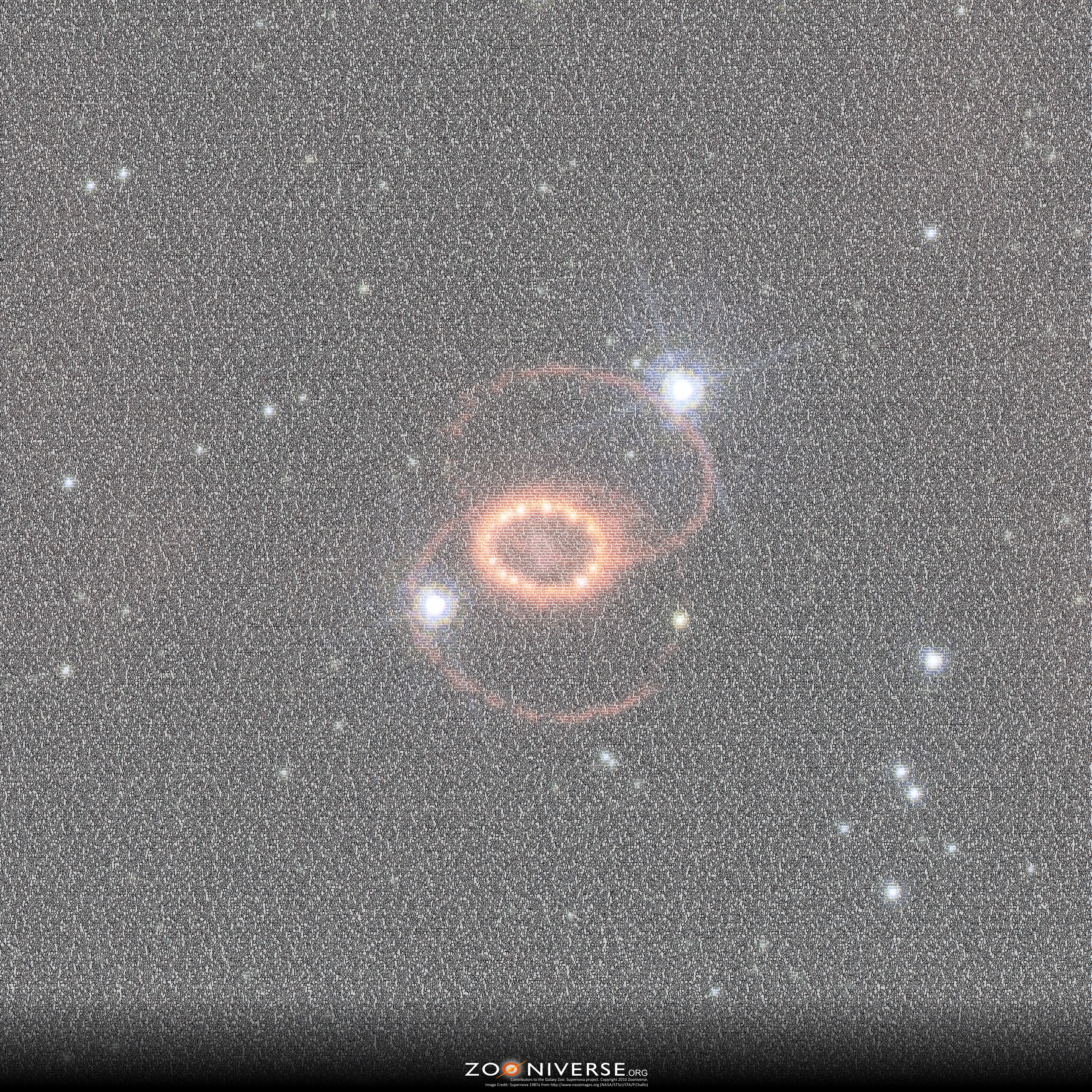
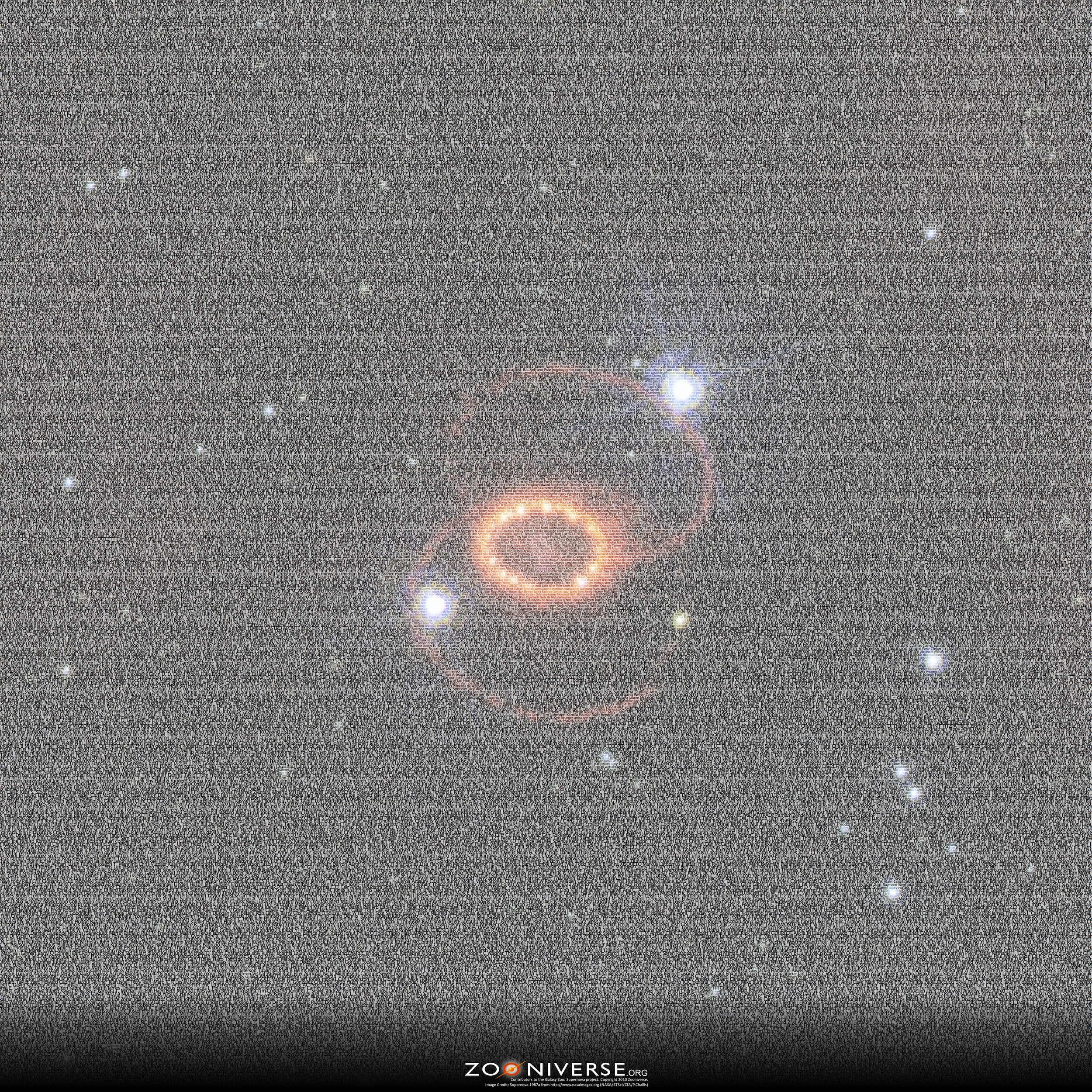
For day one of the Zooniverse Advent Calendar we finally gave you the Galaxy Zoo 2 Author Poster. That project is complete, but there’s no reason we shouldn’t create similar thank-yous for the other Zooniverse projects. So here is the Galaxy Zoo: Supernova Author Poster!
13,400 individuals, who have taken part in the Supernova project to date, merged into an amazing image of the famous supernova 1987a. You can download the largest size (18MB), or the 2500-pixels version (6MB). There is also an equivalent author page on the Supernova website.
XMM-Newton time granted to observe the Voorwerpjes!
Quick note to let you know that we’ve been granted time on XMM-Newton to observe three of the “top” Voorwerpjes. This follows the proposal we submitted earlier this year. The allocation is for priority “C” which means that they will take our observations if they fit into the schedule, but there is no guarantee.
Galaxy Zoo 2 Author Poster

We’ve been meaning to do this for a while now and the Zooniverse Advent Calendar gives us the perfect excuse: the Galaxy Zoo 2 author poster. The poster shows the Sombrero Galaxy (M104) made up of the 51,000 names of Galaxy Zoo 2 volunteers who gave permission for us to display their names. Every person named on this poster has classified at least one galaxy and thus been a part of Zooniverse history.
You can download the smaller version (6.5MB) or the larger 7000 pixel version (25MB). You can take these posters and do what you like with them – print them, create wallpapers etc. You can also access the full list of names at http://zoo2.galaxyzoo.org/authors if you want to get a better look at the list.

If you do anything fun with these images or data, then please get in touch and share it via the comments section below.
UPDATE: Thanks to some eagle-eyed users we noticed that we were missing a few names (about 16,000!) so the poster has been updated. The Galaxy Zoo 2 Authors page will be update tomorrow. Sorry for the mix up but I think we have it right now.
Hunting Voorwerpjes from California
An especially nice side project of Galaxy Zoo has been uncovering giant gas clouds ionized by active galactic nuclei. Of course, the most striking of these has been Hanny’s Voorwerp, whose study has been fruitful enough! In addition, Zooites proved to be good at finding smaller, dimmer versions (“voorwerpjes”, using the Dutch diminutive form). We harvested these both from Forum postings, and from a targeted hunt of galaxies with known AGN (arranged by Waveney). To be sure what we’re dealing with, we need spectra of these clouds. We had observing runs to do this last summer from Kitt Peak and Lick Observatories, confirming many new cases (some of which may have a similar history of faded glory to what we infer for Hanny’s Voorwerp). Kevin led a further proposal to look at these in X-rays, so we can tell whether the suspiciously dim nuclei are really dim or actually hidden by foreground gas and dust.
We have another observing session this week with the 3-meter Shane telescope of Lick Observatory, a facility of the University of California. The proposal was led by Vardha Nicola Bennert from Santa Barbara, observing as before with UCSB students Anna Pancoast and Chelsea Harris. Here they are standing in front of the telescope’s mirror cell and instrument cluster.
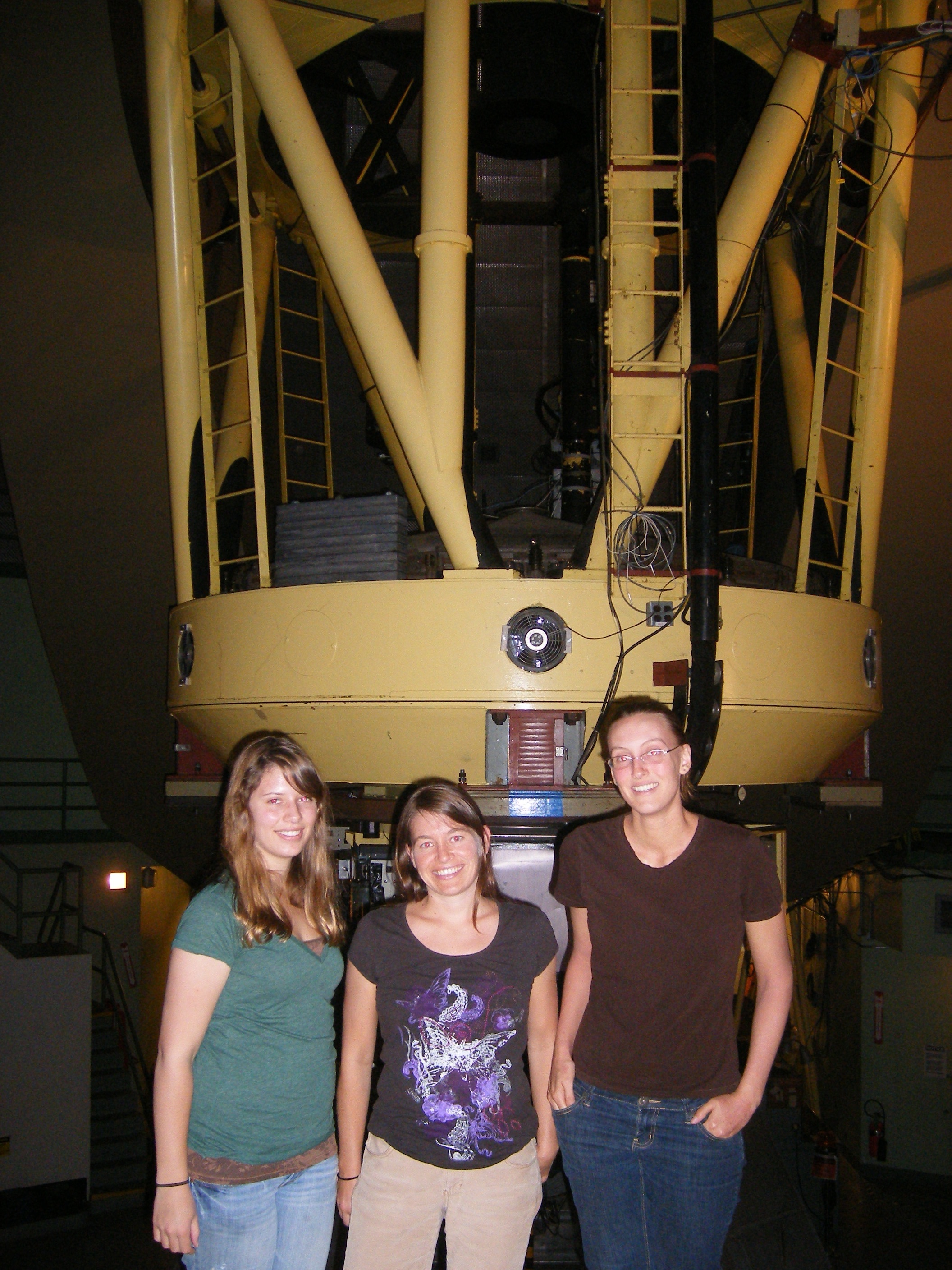
Vardha Bennert, Chelsea Harris, Anna Pancoast at Lick 3m telescope
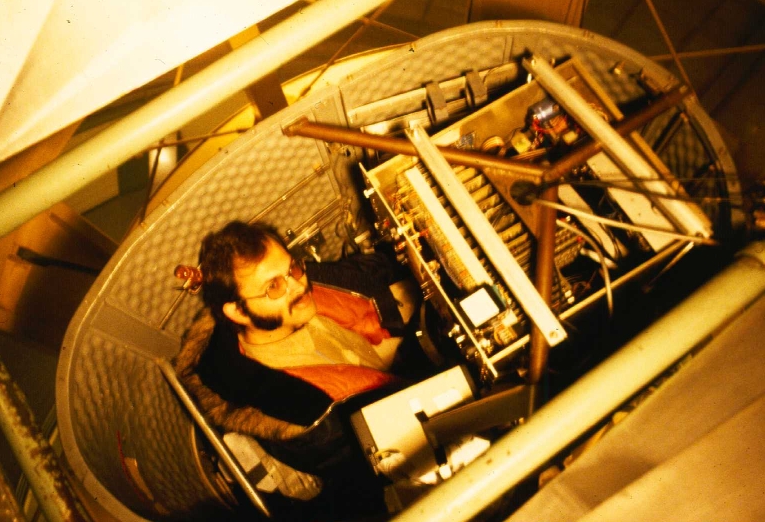
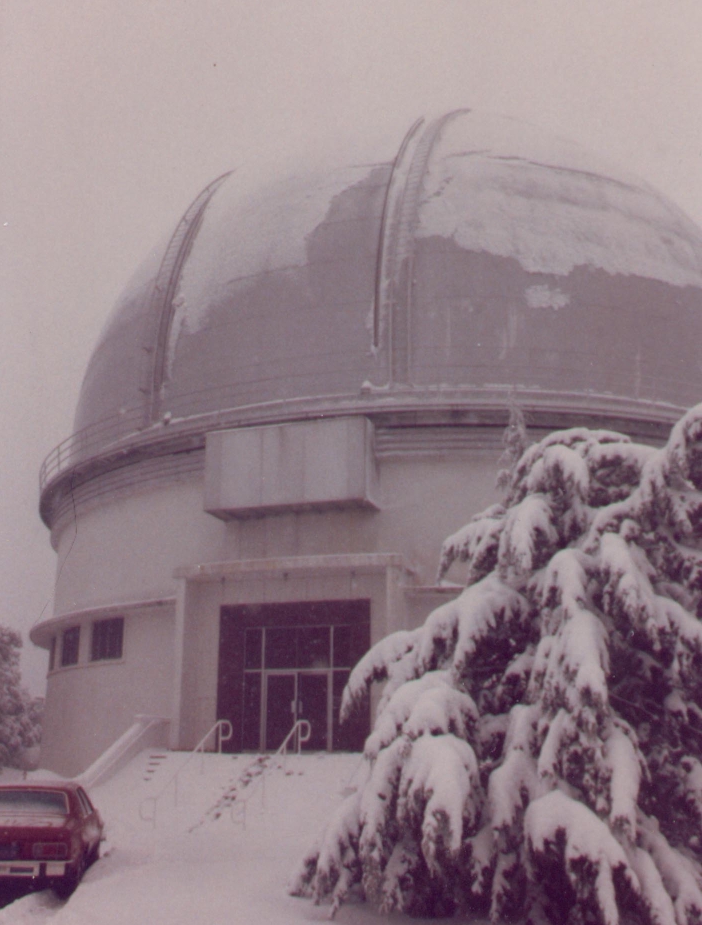
I was also able to arrange going to Mount Hamilton for these four nights. This will be sort of a homecoming for me – as a graduate student at UC Santa Cruz, Lick was where I cut my observational teeth. Checking some old logbooks, I have entries slightly over thirty years ago (and a collection of photos which should shortly be updated!). For my thesis, on the spectra of gas in normal galaxies and whether they contain weak AGN, I used over 70 nights on the then new 1m telescope. So not only was UCSC where I studied interpretation of spectra, but Lick was where I got my first (few hundred) galaxy spectra. Back then, the 3m was the primary telescope for UC astronomers, so graduate students worked with it only while assisting faculty members. I did manage to spend a few hours at the prime focus of the 3m while we were working on what might have been the observatory’s first CCD spectrograph (constructed by painful use of a hacksaw on one originally built for Margaret Burbidge to use image tubes with). We looked at a planetary nebula for wavelength calibration, giving me a lasting memory of just how green the [O III] emission lines appear. (I also managed to see the radio galaxy Cygnus A through the eyepiece while lining up the spectrograph slit). Another student and I managed to get allocated a single otherwise unused night of 3m time to split – and it snowed. Here’s documentation – that young-looking guy is in the cage sitting in the middle of the telescope at the top of the tube. This was such a stopgap setup that the only way to refill the CCD’s liquid nitrogen involved running a long tube between circuit boards of the control electronics. I categorically deny ever having dumped liquid nitrogen on my advisor. Almost.
Times have changed. Everything is remotely operated, and not only do CCDs rule, but the Kast double spectrograph uses a dichroic beamsplitter to separate blue and red light so that each goes into a separate spectrograph and CCD optimized for that part of the spectrum. We’re ready with a list of target galaxies winnowed down by reanalysis of the SDSS images after selection by Zooites. If last summer’s set is a guide, at least half of these will prove to have huge, galaxy-sized clouds illuminated by seen or unseen nuclei. I hope to get the results processed quickly; at the Seattle meeting of the American Astronomical Society in January, there will be a display presentation from last summer’s work led by Drew Chojnowski, and it would be great to double our sample size.
Of course, as with any ground-based observations, we will be at the mercy of the weather. You can keep track using the especially crisp webcam views provided by Lick (one of which looks across the brilliant city lights of the whole San Francisco Bay area, which have been kept slightly under control by extensive light-pollution lobbying but made Lick astronomers some of the first to use digital sky subtraction for spectra). And of course we’ll keep the Zoo updated on our data.
Birthday Wishes and NGC 3169
This week’s OOTW features Alice’s OOTD posted on the 25th of November 2010.

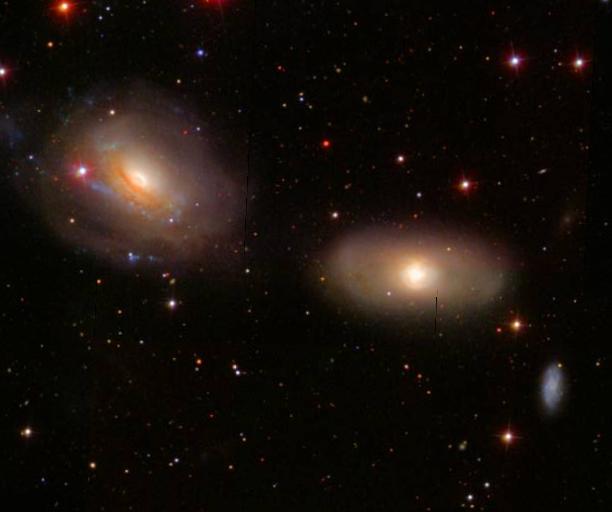
This beauty is NGC 3169. It’s a spiral galaxy 55.3 million light years away in the constellation Sextans. It’s part of a group of two other spiral galaxies: NGC 3166 and NGC 3165. The nearest galaxy to it – NGC 3166 – is tugging at it, causing its spiral arms to distort.
NGC 3169 also happens to be a nomination for this:
“Today’s Object of the Day is not an object, but a request for some. Zookeeper Rob is looking for an “Object of the Day” for a Zoo Advent Calendar, which should be interesting (open up this pocket of space and – oops, a black hole! ). Want to help?
From now until Monday, please post your favourite galaxy, either from Hubble Zoo or from SDSS. On Monday we will have a poll, closing on Tuesday night.”
– Alice
(Post the galaxies in Alice’s OOTD)
Also, Happy Birthday Zookeeper Chris!

NGC7252: The Atoms-For-Peace Galaxy
This OOTW features Budgieye’s OOTD posted on the 18th of November 2010.
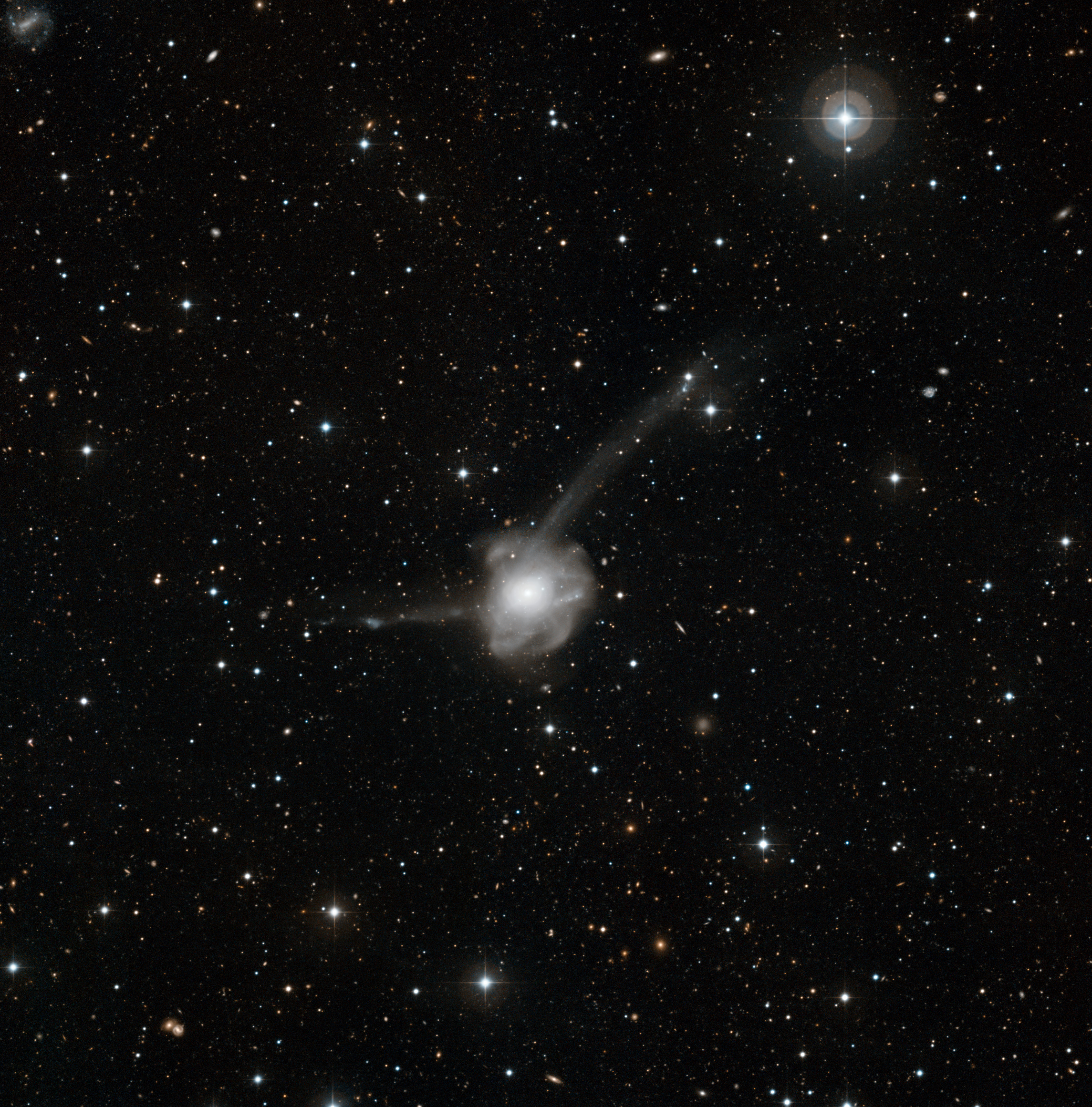
Credit: ESO
This is NGC 7252, or the Atoms-For-Peace galaxy. This beautiful merger lurks in the constellation Aquarius 220 million light years away. It’s a beautiful example of a galaxy interacting with another, with both galaxies twisting round each other as they are caught up in each others gravitational pull. As this happens over a course of millions and billions of years tidal tails are thrown out, creating streamers of stars stretching for thousands of light years. As well as beautiful streamers the collision has created hundreds of new stars from the disruption, and many new star clusters only 50-500 million years old are now spread out across the galaxy.
And what of the name?
The galaxy – which looks rather like a diagram of an atom – was named after a lecture called Atoms for Peace, which was given by the US president Dwight D. Eisenhower in 1953. In his lecture, he called for nuclear power to be used for peaceful rather than destructive purposes.
There’s more info on the galaxy at ESO!
 Galaxy Zoo