Back at IRAM 30m…

Hi all. I’m at the IRAM 30m telescope for the third time this year this time measuring the CO content in elliptical galaxies. This follows on from Kevin’s long-standing work of using blue elliptical galaxies to test whether or not AGN (Active Galactic Nuclei) are responsible for dispelling gas and thus putting an end to star formation. Theoretical models suggest that this must be the case and this ongoing project to measure exactly how much CO gas is in such galaxies is aiming to verify this. This is accomplished by measuring how much CO is in elliptical galaxies that show no signs of AGN activity and similar galaxies which do have signs of AGN activity. The theory is that, those galaxies with AGN activity will show low quantities of gas relative to their size.
The weather has been very good so far and we are on schedule here to get measurements for all 30 galaxies we asked for despite only being allocated about 3/4 the requested time! With so many measurements, we should hopefully get the statistical significance we need to confirm the theory.
Man vs Machine?

Manda’s paper on improving automatic galaxy classification seems to have caused quite a bit of concern and comment. Is the future of the Zoo portrayed above, with an out-of-control machine wrecking all we’ve come to hold dear? After all, we’ve always believed it important that we don’t waste your time by having you do tasks that computers are perfectly capable of completing. Are the Zookeepers putting the Zoo out of business?
Read More…
Machine learning paper now available
Just a quick note that Manda’s submitted paper on machine learning is now available on astro-ph.
Galaxy Zoo Supernovae from a technical standpoint
I’ve just finished writing up some of the more technical details associated with our recent supernova hunt. If you’re interested in how it all worked behind the scenes then head over here…
Cheers
Arfon
New supernovae found!
After a couple of exposures, we are happy to say that we believe the object mentioned previously is a young supernova. This is great news.
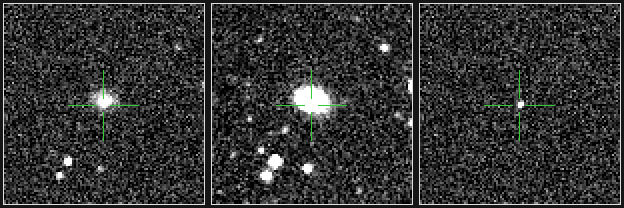
Mark and I thought we would give you better feel for what we are doing here by showing you something visual to have a look at. This our latest target, which we are confident is also a supernova from our raw data. What you can see here are the images of this object as they appear on the zoo. This is a great example of what a supernova will look like in the zoo images. The reason for this is that you can see some structure in the host of the supernova. In general if the transient object appears as in a blob, rather than a perfect circle, it is far more likely to be a real supernova, than a variable star. Although this is not a solid rule of supernovae screening, it is always good to know.
Thank you all for helping to make this observing run a real success. We will be sure to let you know our supernovae grand total soon enough but for now we are looking at in excess of 20 new supernovae. Let’s see if we can catch a few more!
Sarah
WHT supernovae finds update
Just over half way through or night and we are doing well again, in spite of some technical adversity early on. Our next target is a very exciting target. It is either a very new supernovae that has only been around for a few days, or it could be an asteroid. Here at WHT we are certainly hoping for this object to be a young supernovae.
So, why are new supernovae so good? Well, to begin with we want to know as much about supernovae as possible and the best way to do that is to catch them early and follow them. Certainly if this object is what we hope it is, it will be a good candidate for future follow up.
This really is some exciting science! Stand by for an update on what we find!
Sarah :0)
WHT second night prepped and ready to go!
One hour till sunset and Mark and I are ready for another fantastic night of supernovae observing. At the moment there is not a cloud in the sky, so let’s hope this good weather holds!
So far we have the Telescope set up and ready again, just waiting for darkness …
Sarah :0)
End of the night, and new supernovae confirmed
We’re nearing the end of the night now – and that cirrus that threatened earlier blew through quickly, leaving us with clear skies and generally excellent observing conditions.
We ploughed through 16 supernova candidates, which kept us on our toes, and a first look at the data shows that indeed many of them turned out to be supernovae as we had hoped, rather than other variables sources (such as variable stars). So excellent work!
Thanks to everyone who participated and helped to make a successful night of observation; we’ll try for a fuller report tomorrow on what we found. We also have one more night tomorrow night, when we’ll continue to look at candidates identified by the zoo, so keep checking in for updates!
Mark
WHT supernovae update
Just over half way through our first night now and we’re well on track. Mark and I are happy to report that we are currently taking data for our 9th object of the night. Thank goodness for clear skies!
Of the 8 objects we already have, we are confident that most of them are supernovae of one type or another. We will keep you posted on the exact number of correct identifications, as well as their type, when we have reduced our spectra.
Exciting stuff!
Sarah
 Galaxy Zoo