Kyle’s Legacy

Good news! Early this morning UK time, we submitted the paper describing the finished data release for the third iteration of Galaxy Zoo to the journal Monthly Notices of the Royal Astronomical Society. It’s taken an enormous amount of work to get to this point, in particular in understanding how to account for the effects of distance on classifications. Most of that work was done by Kyle Willett and Mel Galloway from the University of Minnesota (Kyle gave a sneak preview here), and it was finished just in time because Kyle leaves us tomorrow.

Kyle and friend at his leaving party.
Kyle has had an enormous impact on Galaxy Zoo since he came on board in 2011. As well as publishing papers on star formation and the enormous data release paper for Galaxy Zoo 2, he’s been the person making images, coordinating what’s seen on the site and keeping an eye on classifications as they’ve come in. Just as importantly, he’s been a prolific contributor to this blog, playing a leading role in keeping our important collaborators, the volunteers, in touch with what’s going on. It’s not just Galaxy Zoo, either, as Kyle has also played a critical role in the Radio Galaxy Zoo team, and has made major contributions to their recent papers too. He will be much missed by all of us, though we wish him well with his future endeavours.
Upcoming Galaxy Zoo: Hubble and CANDELS papers
It’s been a good amount of time since the Galaxy Zoo: Hubble and Galaxy Zoo: CANDELS projects were finished, tackling more than 200,000 combined galaxies thanks to the efforts of our volunteers. While we’ve had a couple of science papers based on the early results (Melvin et al. 2014, Simmons et al. 2014, Cheung et al. 2015), a full release of the data and catalog has taken slightly longer. However, we’ve been working hard, testing the data, and developing some new analysis methods on both image sets. This month has been really exciting, and we now have drafts for both papers that are just about finished. Once they’ve been accepted to the journals (and revised, if necessary), we’ll have some much longer posts discussing the results, and of course attaching the papers themselves. Hopefully that’ll be quite soon.
As a small teaser, here’s a little movie I just made of the Galaxy Zoo: Hubble paper as it went through the various drafts by different members of the science team. If only all paper writing were this easy … 😉

How to write a Galaxy Zoo paper in 15 seconds or less … (Image: K. Willett)
Exclusive interview with our recent Citizen Science co-authors
This post was written as a contribution by Timothy Friel, an undergraduate Australian National University student studying Theoretical Physics and Science Communication. Tim is conducting research into citizen science projects and their social media communication strategies.
Meet two of our fantastic Zooniverse members who have been recognised as co-authors for a RGZ submitted paper.
In March 2016, the Radio Galaxy Zoo (RGZ) team submitted a paper which is co-authored by two of our SuperRGZooites. Thanks to the help of citizens around the world, over 1.6 million classifications have been made. However, a very special thanks must go to two citizens who have been greatly involved in our most recent submitted paper.
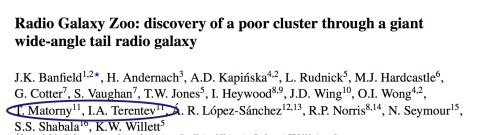
Meet Ivan Terentev and Tim Matorny, our Citizen Science co-authors.
How did you discover Radio Galaxy Zoo and become involved?
Tim: I had a passion for research and to be involved with generating new knowledge. So I began to look and met [the world of] citizen science and tried many different projects. I was already familiar with the Zooniverse, when I got email about new project – RGZ.
Ivan: I became involved in RGZ from its beginning, more or less, in December 2013, and at that time I was part of the Zooniverse for two years. I was mostly contributing to the Planet Hunters project back then, but occasionally I switched to different projects just to look for what they have to offer. And it was during one of these “Let’s try something different” moments that I discovered RGZ through the announcement post in the Galaxy Zoo blog.
What parts kept you interested and motivated to stay a part of this project?
Tim: The team of scientists and their active participation is an important part. Their blog posts, comments and links have helped me to learn about the project and my involvement with the goals.
Looking for host radio lobes which are separated by a 10′ [minutes] or looking at the behaviour of jets in galaxies clusters is really exciting for me. I like that RGZ covers a wide range of data: radio, optics, IR, X-ray.
Ivan: If we are talking specifically about RGZ, it would be the RGZ Talk community and the fact that RGZ Science team is eager to communicate with simple volunteers and involve them in the research process. But a large portion of my motivation [for RGZ] is the same as for the rest of the Zooniverse projects. You see, I am sci-fi fan and it made me interested in space exploration. I like to watch documentaries about the astronomers, their work and all the amazing stuff in the universe around us and through the Zooniverse I can actually be involved in the process of science and help to shape the future, even if it just by a very tiny fraction. I never thought that something like this would be possible before I discovered Zooniverse.
How do you feel about being a co-author of a scientific research paper?
Tim: I am still amazed and feel more motivated to look for stunning new radio galaxies.
Ivan: This isn’t the first time actually, I am also a co-author for three papers from the Planet Hunters, BUT it is always awesome, like every single time! Although, I keep my head cool over that since most of the work was done by the professional scientists. A huge thanks to them for the acknowledgment of my small contribution in the form of inviting me to be a co-author in their paper. With this RGZ paper, I got a chance to see the whole process of science starting from the simple question “What is that?” and then people trying to figure out what is going on, schedule observations, discussing things and I have been a part of it! All the way through the process, ending with the actual published science article. It was an amazing experience!
Without the contributions made by our volunteers all over the world, we would not have been so successful in our endeavours.
However, we have only reached 57% of our classification target. Head to www.bit.ly/RadioGalaxyZoo1 to become involved and you could be co-authoring another great discovery with us!
New galaxies in Galaxy Zoo
We’re excited to announce the launch of two new image sets on Galaxy Zoo.
Recently your work has helped us classify 34,429 images coming from the DECaLS first data release (DR1). With the release of DECaLS second data release (DR2) we have added 61,595 new galaxies into Galaxy Zoo. DR2 covers a larger portion of the sky than DR1, and has better quality and deeper images then SDSS. These galaxies are taken from the NASA-Sloan Atlas (a catalog of over 140,000 local galaxies in both the optical and UV) and focuses on the larger and brighter galaxies not already covered by DR1, in addition to the galaxies imaged by an extra year’s worth of data.

Example galaxy taken from DECaLS DR2 sample.
Our second image set, appropriately named “the lost set”, is made up of 25,529 SDSS images that should have been included in Galaxy Zoo 2. These galaxies also come from the NASA-Sloan Atlas, but for one reason or another never made it into Galaxy Zoo until now. Once classified, these images will fill in the hole that currently exists in the bright galaxy data set. These SDSS images are in the queue and will go live sometime later this year, depending on the progress being made on DECaLS DR2.

Example galaxy taken from “the lost set”.
Spiral galaxies (and why Galaxy Zoo is perfect for their study)
My name is Ross Hart, and I am a second year PhD student at the University of Nottingham using Galaxy Zoo data to study spiral galaxies. I am keen to write some blog posts about these galaxies, which are not only elegant in appearance, but also have a lot of interesting physics associated with them. In this first post, I will give a brief overview of spiral galaxies, and why Galaxy Zoo could be an important tool for their study.
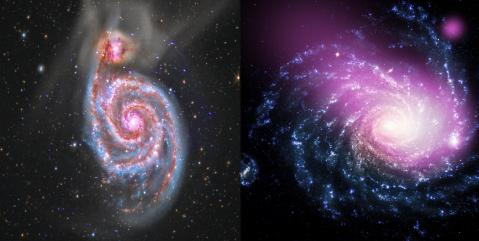
Two-armed spiral galaxy M51 (left) and many-armed galaxy NGC 1232 (right). Image credit (M51): X-ray: NASA/CXC/SAO; Optical: Detlef Hartmann; Infrared: NASA/JPL-Caltech Image credit(NGC 1232): X-ray: NASA/CXC/Huntingdon Institute for X-ray Astronomy/G. Garmire; Optical: ESO/VLT
Spiral galaxies are the most numerous type of galaxy in the local Universe, with approximately 2/3 of local galaxies exhibiting spiral arms. Most of the gas and young stars in the disks of spiral galaxies are located in spiral arms, giving the appearance of the beautiful spiral patterns observed in galaxies such as M51 and NGC 1232 (shown above). However, the reason as to why we study these galaxies is not simply because they are pleasing to the eye; most of the star-formation in the local Universe occurs in spiral galaxies, so understanding the physics of spiral galaxies holds the key to understanding how stars form in galaxies.
Despite the relative prominence and importance of spiral galaxies, we still do not have a good understanding of how spiral galaxies form and evolve. Much of the problem as to why this is the case is that ‘spiral’ is actually far too broad a term to describe galaxies with different types of spiral structure. In particular, most galaxies have two spiral arms in a grand design spiral structure, like that of M51. However, some galaxies have many spiral arms, like NGC 1232. However, the difference between M51 and NGC 1232 are actually thought to be much deeper than simply the number of arms that the two galaxies have; the physical processes that are responsible for their formation is also thought to be very different.
In order to study spiral galaxies in any level of detail, we require a method of classifying galaxies by the type of spiral structure they have, which requires detailed morphological classifications. It is for this reason that Galaxy Zoo provides an exciting opportunity to compare spiral galaxies in a way that simply hasn’t been possible before. Thanks to all of the volunteers who helped to classify galaxies in Galaxy Zoo 2, we have access to a sample of spiral galaxies classified with unprecedented size. All of these galaxies have been classified by arm number, so we have the ideal tool for investigating how these different spiral structures form in a level of detail that hasn’t been possible before.
Galaxy Zoo at the 227th AAS meeting
We posted briefly about the 227th meeting of the American Astronomical Society, which several members of the Galaxy Zoo science team attended last week. I wanted to share a little bit more about the research that we presented, and the experiences we had at the meeting.

Asst. Prof Lucy Fortson, PhD student Melanie Galloway, and postdoc Kyle Willett (Univ. of Minnesota) at an evening poster session at the 227th AAS meeting.
Kyle Willett (Postdoc, University of Minnesota)
I presented a poster on the data release of the Galaxy Zoo: Hubble project. While it’s been a couple of years since we formally finished the classifications for GZH, we’ve been working hard in the meantime on aggregating and calibrating the data; this includes two supplementary data sets that users helped classify in the newest interface. One of those sets were the images of galaxies processed with the FERENGI code in order to mimic their appearances at higher redshifts; these have been absolutely critical for the calibration/debiasing procedure we’re applying to the real Hubble galaxies. The second set of new images were the deeper images of galaxies in the GOODS north and south fields, completed early last year. We’re using these to analyze the effect of depth on morphologies, and seeing how the disk/clumpy fractions change with improved imaging.
AAS went well for me, and I got to talk about GZH with a number of new colleagues. I particularly liked having my poster between Melanie Galloway’s and Brooke Simmons’ — I got to point out GZH science results on one side and the next generation of even higher redshift galaxies on the other, which made for a very nice story to tell.
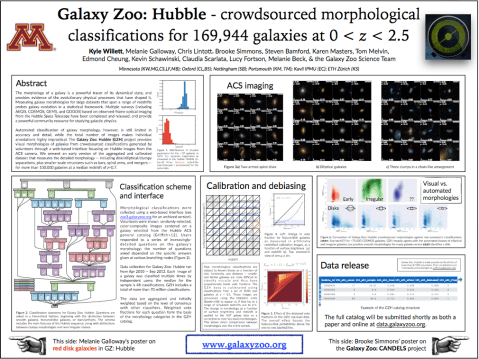
Kyle Willett’s poster at the 227th AAS meeting. Click to download the full PDF.
Melanie Galloway (PhD student, University of Minnesota)
Galaxy Zoo users probably know that there are two main types of galaxies: disks and ellipticals. There is a cool relationship between these shapes and their color: disks tend to be blue (which is an indicator of young stars), while almost all ellipticals appear red (which indicates the stars are old; “red and dead” is a term commonly used.) Astronomers believe that this relationship between color and shape implies that galaxies tend to be created as disks, and over their lifetimes, transform from young disks to old ellipticals. Data from Galaxy Zoo revealed that there are also red disk galaxies in the Universe, and right now it is not known how they fit into our current perception of galaxy evolution.
Mel used data from Galaxy Zoo: Hubble to tackle this question by analyzing how the fraction of red disks changed between now and 6 billion years ago. She found that this fraction was actually much higher in the past! This result probably means that red disks don’t tend to stay red disks, and may instead be a common phase of a typical galaxy’s evolution from blue disk to red elliptical.
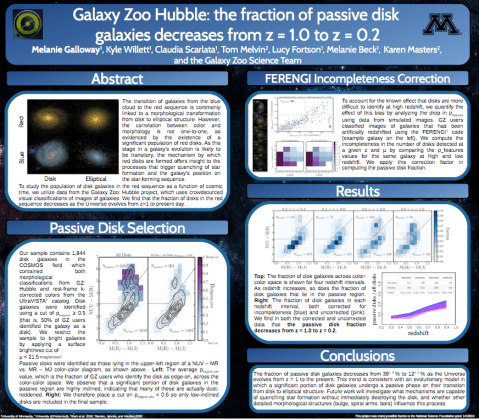
Melanie Galloway’s poster at the 227th AAS meeting. Click to download the full PDF.
Melanie Beck (PhD student, University of Minnesota)
At this year’s AAS conference, I presented work which focused on the relationship between galaxies’ masses and their sizes. In general, more massive galaxies are also physically larger (but not always!). However, the mass-size relationship is different for galaxies in the distant universe compared to those in the nearby universe. It’s also different between disk galaxies compared to ellipticals in that the sizes of elliptical galaxies grow much, much faster than those of disk galaxies but don’t seem to grow much in mass. To explain this behavior, models predict that disk galaxies must evolve into elliptical galaxies at a rate that mimics the growth rate of the ellipticals. These models predict that there should be many more elliptical galaxies of a particular size and mass in the nearby universe compared to disks. To test this, we need to keep track of the number of galaxies as a function of mass, size, and type (elliptical or disk) over a large period of time.
My initial work utilizes classifications from Galaxy Zoo 2 separated by Smooth or Features/Disk. All the galaxies in this catalog are considered to be in the local universe. Using sophisticated statistical techniques, I’m able to robustly determine the number of galaxies as a function of mass, size and type. Next I’m applying the same techniques to classifications from Galaxy Zoo: Hubble and Galaxy Zoo: CANDELS as these catalogs contain galaxies from the more and more distant universe. Once we have the analysis from all three we can compare the numbers of galaxies at each time and finally test those models!

Melanie Beck’s poster at the 227th AAS meeting. Click to download the full PDF.

Melanie Beck discussing her poster with Prof. Chris Conselice (Univ. of Nottingham).
Brooke Simmons (Postdoc and Einstein Fellow, UC San Diego)
AAS is always a hectic science bonanza, and presenting a poster is a way of slowing things down a bit: unlike a talk, which is over in 15 minutes or less, you get to have your results up all day. My poster was an introduction to the upcoming release of classifications for the high-redshift CANDELS galaxies, so it shows a basic overview of how the classifications work and an early science result about featureless disks at high redshift.
It was great to present 2 data releases side-by-side, with Kyle’s poster to my left, and it was even better to get to present the result of the volunteers’ efforts. Between these posters and the previous data releases for Galaxy Zoo, we’ve measured the shapes of hundreds of thousands of galaxies (actually, I think it’s over a million!) spanning the last 12 billion years of cosmic time.

Brooke Simmons’ poster at the 227th AAS meeting. Click to download the full PDF.
Green pea galaxies may have been responsible for re-ionizing the Universe
The “green pea” galaxies were one of the first discoveries of the Galaxy Zoo; they were first noticed by several of our early volunteers, and appeared in a paper led by Carie Cardamone in 2009 (with over 100 citations so far!). They’ve been the subject of a great deal of follow-up research since then, much of which we’ve tried to follow on this blog.

Examples of the green pea galaxies originally discovered in Galaxy Zoo. Top Row: Sloan Digital Sky Survey images. Bottom Row: Hubble Space Telescope images.
A new paper on the Green Peas has just appeared in Nature, one of the most prestigious and widely-read journals in science. A truly international team of researchers (working in Ukraine, Czech Republic, Switzerland, France, Germany, and the United States) made observations of one green pea galaxy, known as J0925+1403, using an ultraviolet spectrograph on the Hubble Space Telescope. They were able to measure emission from what astronomers call “Lyman continuum” photons; this is light produced by massive stars that are solidly in the ultraviolet wavelengths.
The reason this is so important and interesting relates to one of the most fundamental steps in the history of the Universe that astronomers know of. The majority of matter in the Universe is hydrogen (formed shortly after the Big Bang), and much of it exists in diffuse clouds between galaxies, which is called the intergalactic medium. We know from observations that almost all of that hydrogen is currently ionized – that means instead of consisting of a neutral atom with one proton and one electron orbiting it, the average hydrogen atom between galaxies has had its electron stripped away from the proton. This is a big difference because neutral atoms interact with light differently than ionized atoms. If the hydrogen between galaxies were neutral, it would absorb much of the light coming from individual stars and galaxies, making a huge difference in our ability to observe distant objects.
It’s been known for years the Universe is currently ionized; however, about 700 million years after the Big Bang, we know that the Universe used to be neutral. That’s pretty well-established — however, there’s a great deal of debate about what caused the sudden reionization. Something must have produced large numbers of photons that traveled into the intergalactic medium and ionized all of the hydrogen fairly quickly. There have been lots of papers proposing different possible sources for this, including dwarf galaxies, active galactic nuclei, quasars, very early and massive stars, etc.

Diagram illustrating how individual galaxies may have re-ionized the neutral hydrogen in the Universe shortly after the Big Bang. From Erb (2016).
This new paper proposes that green pea galaxies could be responsible for re-ionizing the early Universe. The measurements from this paper show that at least one green pea galaxy is actively emitting photons with sufficient energy to ionize neutral hydrogen. Lots of galaxies can create such radiation, but one unique aspect of the peas is that the photons are escaping the galaxy where they’re being formed. Usually they’re absorbed by dust or gas clouds within the galaxy before they can affect the rest of the Universe. This is the first time that it’s been demonstrated to occur for a green pea galaxy.
The paper (Izotov et al. 2016) is available online. Nature has also published a nice summary at a slightly less technical level to accompany the article that I’d recommend – you can read that here. Please post if you have any questions or want to discuss more about what this means. We’re extremely excited that your discoveries are still yielding new and interesting science!
Galaxy Zoo Highlights from 2015
Following on from the excellent summary of the hi-lights in 2015 for the Radio Galaxy Zoo project, here’s a similar post about results from Galaxy Zoo.
This year we collected 4,755,448 classifications on 209,291 different images of galaxies. You continue to amaze us with your collective efforts. Thank you so much for each and everyone of of these classifications.
The year started with Galaxy Zoo scientists at Mauna Kea observing galaxies, and reported in this wonderful series of blog posts by (former) Zooniverse developer Ed Paget.

Ed, Chris, Sandor, and Becky on Mauna Kea.
We celebrated 8 years of Galaxy Zoo back in July, with this blog series of all things 8-like about Galaxy Zoo.

An 8 for our 8th birthday!
Back in May we finished collecting classifications on the last of our Hubble Space Telescope images. At the AAS in Florida this week, Kyle Willett and Brooke Simmons presented posters on the planned data releases for the classifications.
We both launched and finished classifying the first set of images of simulated galaxies from the Illustris Simulation (read more here: New Images for Galaxy Zoo: Illustris and here: Finished with First Set of Illustris Images). We also launched our first set of images from the DECaLS survey, which is using the Dark Energy Camera (New Images for Galaxy Zoo: DECaLS)
We also launched a new Galaxy Zoo side project – Galaxy Zoo Bars (one of the first projects built on the new Zooniverse Project Builder software), measuring bar lengths of galaxies in the distant Universe. The entire set were measured in less than a year, so thank you to any of you who contributed to that, and if you missed it don’t worry, we have plans for more special projects this year.
We launched a new web interface to explore the Galaxy Zoo classifications.
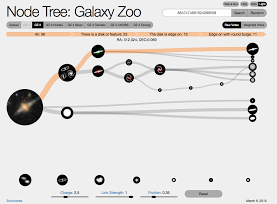
Screenshot of the Visualisation Tool
Our contributions to the peer reviewed astronomical literature continue. Papers number 45-48 from the team were officially published in 2015. They were:
– Galaxy Zoo: the effect of bar-driven fueling on the presence of an active galactic nucleus in disc galaxies, Galloway+ 2015.
– Galaxy Zoo: Evidence for Diverse Star Formation Histories through the Green Valley, Smethurst+ 2015.
– Galaxy Zoo: the dependence of the star formation-stellar mass relation on spiral disc morphology, Willett+ 2015.
You can access all 48 team papers using your classifications at the Zooniverse Publication Page. Remember that all Zooniverse papers published in the Monthly Notices of the Royal Astronomical Society – which includes most of the Galaxy Zoo papers – are available open access to any reader, and if we happen to publish elsewhere we always make the post-acceptance version available on the arxiv.org.
All of our papers include a version of this acknowledgement to our classifiers: “The data in this paper are the result of the efforts of the Galaxy Zoo volunteers, without whom none of this work would be possible. Their efforts are individually acknowledged at authors.galaxyzoo.org.” We all hope you all know how grateful we are for each and every one of your classifications.
This year saw publication of the first paper on Hubble observations of Voorwerpje systems accompanied by an HST press release.
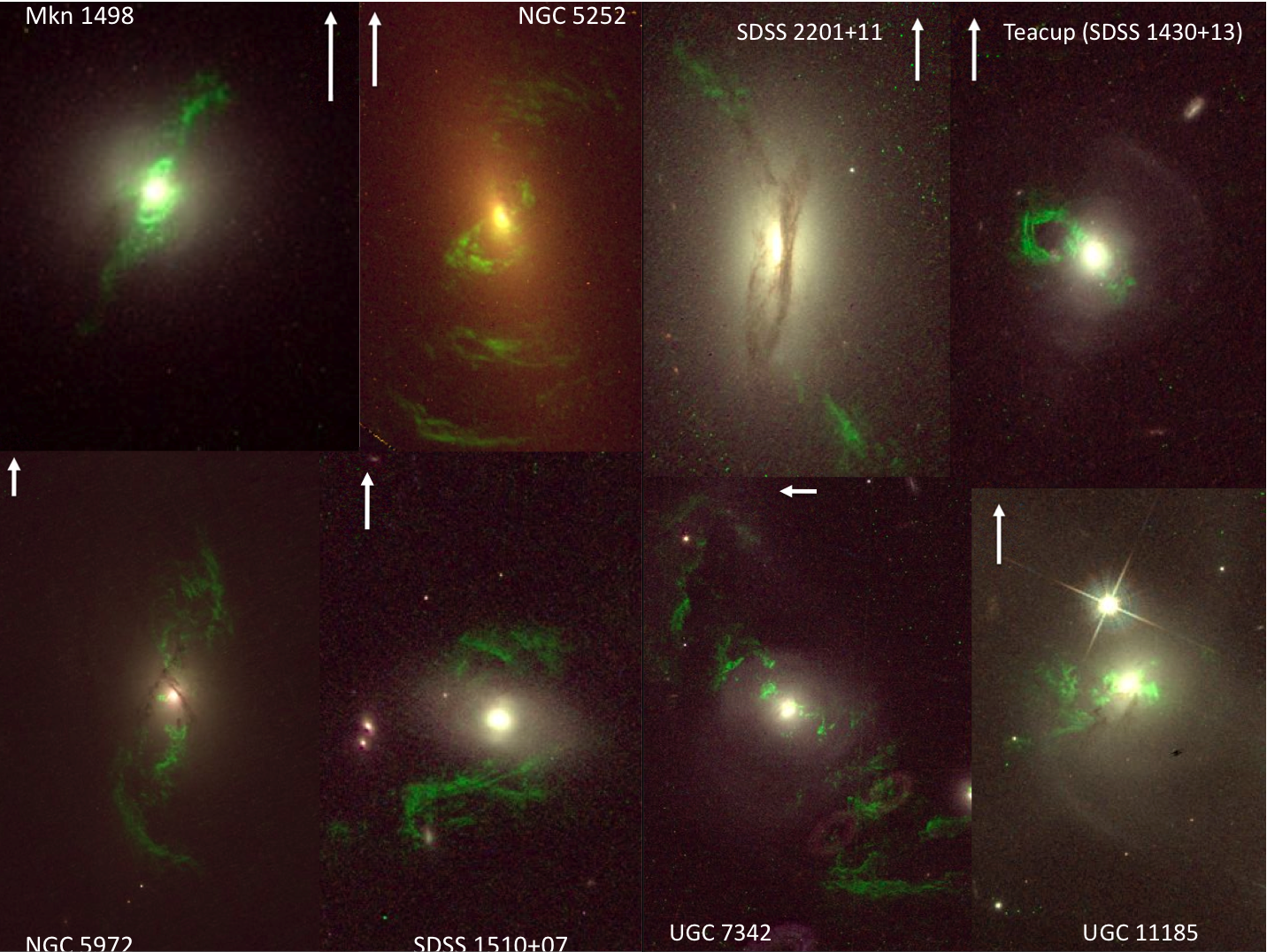
Montage of Hubble images of Voorwerpjes
One of those papers from (mostly) outside the GZ team discussed a rare examples of double radio sources from spiral hosts, something Radio Galaxy Zoo will find many more of: “J1649+2635: a grand-design spiral with a large double-lobed radio source”, Mao et al. 2015.
Another exciting thing about this year has been the number of papers from non team members using the classifications which are now public (see data.galaxyzoo.org). To date almost 300 astronomical papers have been written which cite the original description of Galaxy Zoo (Lintott et al. 2008) and the two data release papers so far (Lintott et al. 2011 for GZ1 and Willett et al. 2013 for GZ2) have 164 and 34 citations respectively. The number of papers in the Astrophysics Data System which contain the words “Galaxy Zoo” (which you can search in ADS Labs) is an astonishing 700 (409 for refereed publications).
These are just some of the high-lights I’ve pulled together. If I’ve missed your favourite feel free to add it in the comments below. All in all it’s been a great year. Here’s to an equally good 2016!
Galaxy Zoo is in Florida!
As happens every winter, a large fraction of the world’s astronomers have migrated to a large convention center to share and talk about every aspect of research, outreach, education, and methods of astronomy. This is the biannual meeting of the American Astronomical Society: this winter, the 227th edition is being held in Kissimmee, Florida.

Conference center: now with alligators!
Several posters and talks will be on new research results from Galaxy Zoo data. These include:
- Becky Smethurst (Oxford) – giving a talk on her PhD dissertation research of the quenching history of galaxies and the role of active galactic nucleus (AGN) feedback. (119.04D; Tue)
- Melanie Beck (Minnesota) – a poster on the bivariate mass-size relation of galaxies as a function of morphology (342.38; Thu)
- Melanie Galloway (Minnesota) – a poster on the redshift evolution of the fraction of red disk galaxies, using GZ: Hubble data (342.40; Thu)
- Kyle Willett (Minnesota) – a poster on the upcoming release of the GZ: Hubble catalog (342.41; Thu)
- Brooke Simmons (UC San Diego) – a poster on the release of the GZ: CANDELS catalog (342.42; Thu)
In addition, there are several other abstracts that that use Galaxy Zoo data (although it may not always be the main focus), and several of our core team members (Chris, Kevin, Lucy, etc) are here, but talking about other aspects of their research.
It looks to be an exciting week, and we’ll try to blog and tweet more about the amazing things going on in astronomy right now. Check out more of what’s going on at #aas227!
Happy 2nd Birthday, Radio Galaxy Zoo!

Happy 2nd birthday to Radio Galaxy Zoo!
On Radio Galaxy Zoo’s 2nd birthday, we wish to thank you all for achieving more than 1.42 million classifications (~57.2 years of work)! That is an extra 20 years of classifications just in the last year. We are nearly at the halfway mark now so we are cheering you all on for the great effort and dedication that many of you have shown.
So what has the science team done in the last year with your classifications? Our first refereed paper has been published.
Anna Kapinska’s HyMoRS paper has been submitted for publication and we have another 3 papers on the sidelines in preparation and awaiting submission in the next few months.
And we have also submitted several proposals to conduct follow-up observations of the many interesting systems that you all have found!
Thank you all very much for your support again. We are most grateful for your help thus far. However, we still have more than half of our sample to classify. So we are seeking your help in the coming days, months & year to complete this monumental task.
We wish you all a wonderful holiday period and a great upcoming year!
Cheers,
Ivy, Julie & RGZ team
 Galaxy Zoo