Zooniverse's Arfon Smith on NPR SciFri
Listen to Zooniverse technical lead Arfon Smith talk about citizen science on NPR’s Science Friday: http://www.sciencefriday.com/program/archives/201101072
New content. New images. A refreshed Galaxy Zoo.
This month the advent calendar has brought you beautiful images (some covered in your name), new Zoos, and much laughter. On the 22nd day of advent the Zooniverse brings to you a new way of exploring galaxies. It’s not another galaxy related Zoo (we did that already with The Milky Way Project). It’s not a new task in Galaxy Zoo. It’s something a lot simpler: It’s words and images and even history discussing what we know and how we know it about extragalactic astronomy. We call this new section of the website “Explore Galaxies.”
Along with bringing you new content, we’re also bringing you new images!
Through your combined efforts, you’ve classified your way through the Hubble Space Telescope’s GOODS, GEMS and AEGIS images. This means it’s time for new images! Today we’re introducing to Galaxy Zoo a large batch of images from COSMOS: The Cosmic Evolution Survey. These images, taken during 590 orbits of the Hubble Space Telescope, map out a 2 square-degree region of the sky. While tiny compared to the area of the Sloan Digital Sky Survey, these images are sensitive enough to see objects almost 100 times fainter! (For those of you wanting the numbers, SDSS gets to i = 22.3, while COSMOS gets to I > 27!) These images have been used to map out the distribution of dark matter and the large-scale structure of the universe. Now, thanks to you, these images can extend our understanding of galaxy morphology out to more distant galaxies and down to fainter nearby galaxies.
Day 22: Galaxies and Content, these are our gifts to you.
And more will be coming. The content we have up today isn’t comprehensive: it’s a base layer that will be growing over time. As you search for content, we’ll track what you search for and add needed content. As the Zooniverse continues to discover new things – as you discover new things – we’ll work to add that content too. For advent, we offer you a chance to start learning about galaxies on the Galaxy Zoo website, and we’ll work to make it possible for you to keep learning in the times to come.
In addition to adding content to Galaxy Zoo, we also added a set of quiz questions. This your chance to test your knowledge of galaxy related concepts, one question a day. Any of you who have used Moon Zoo (which should be all of you – really, if you haven’t already, go try it out at http://www.moonzoo.org) have seen these types of questions before. Just as we use your responses to the classification tasks to do astronomy research, we use your responses to these quiz questions to do learning research. When you answer these questions, we’ll tell you if you got them right or wrong, but because you may see the questions again (and because that friend or family member looking over your shoulder may see the question later), we can’t explain the right answer if you get the question wrong. This is only a temporary problem however. After we get enough data (sadly, this may take a year) to see what you are learning, we will post all the answers in Explore Galaxies.
On this 22nd day of Advent, our gift to you is information. Please: go read, go learn, go search, and know that more content is coming as we learn what you want to know (and let us know what you do know by answering the once a day quiz questions).
Galaxy Zoo: Supernova Author Poster
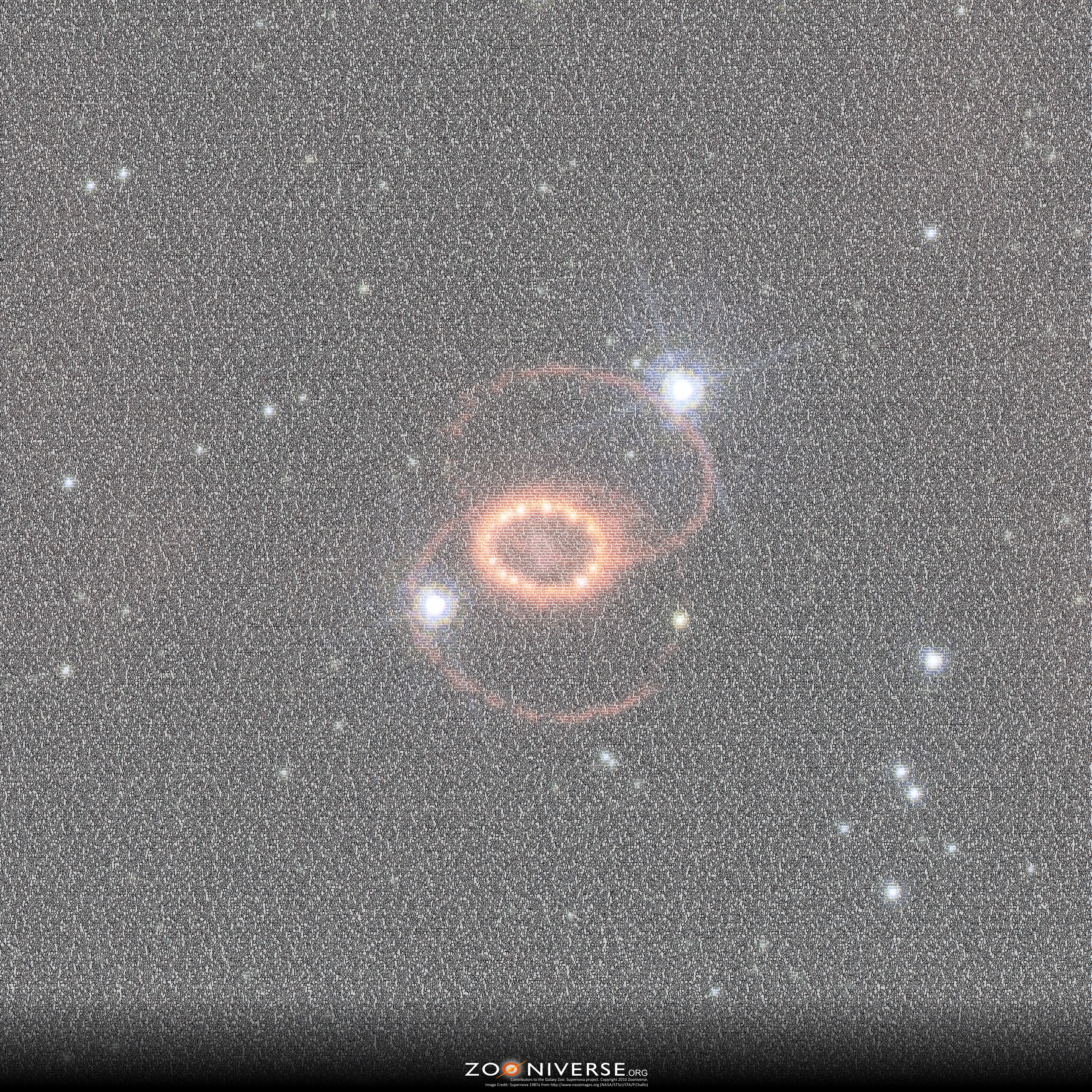
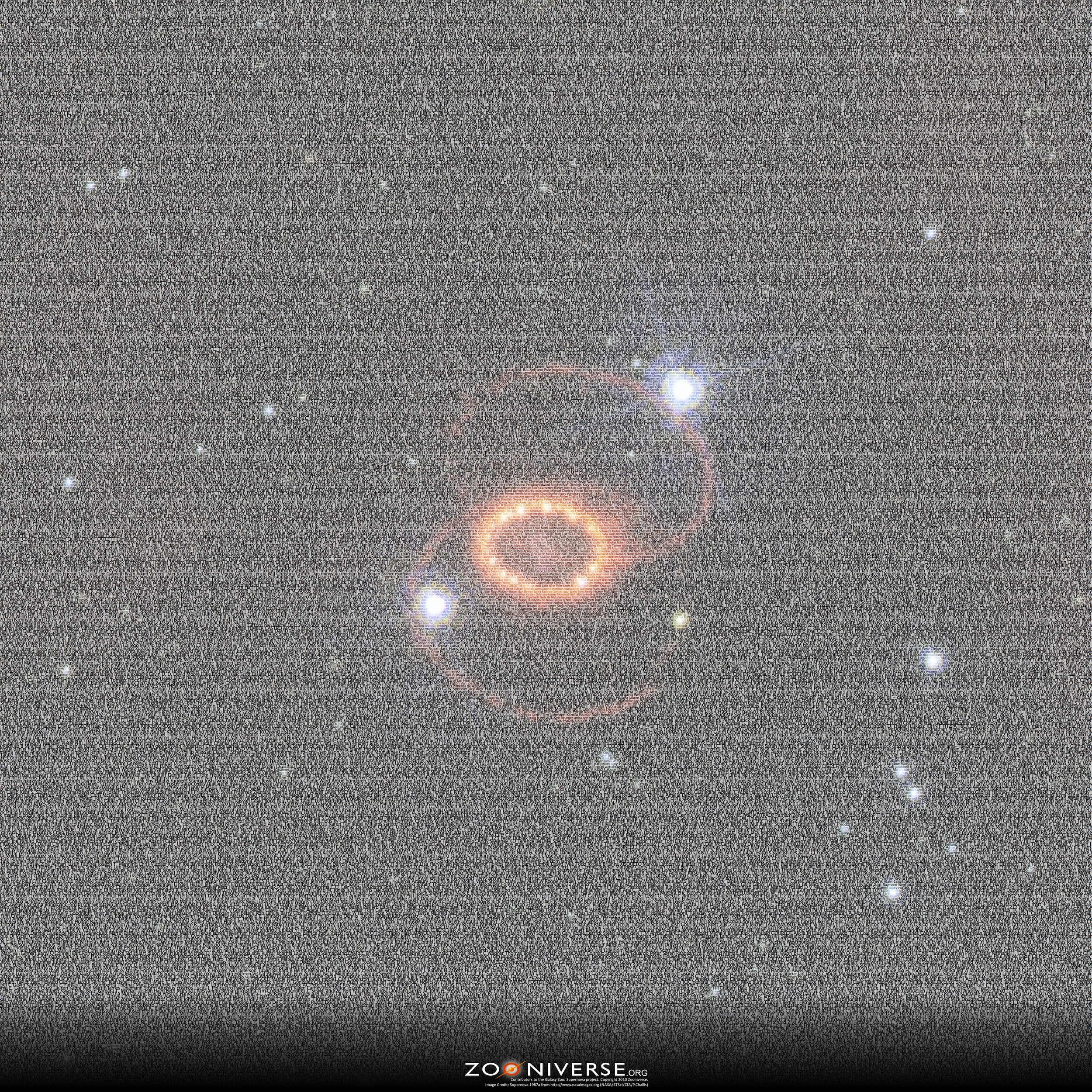
For day one of the Zooniverse Advent Calendar we finally gave you the Galaxy Zoo 2 Author Poster. That project is complete, but there’s no reason we shouldn’t create similar thank-yous for the other Zooniverse projects. So here is the Galaxy Zoo: Supernova Author Poster!
13,400 individuals, who have taken part in the Supernova project to date, merged into an amazing image of the famous supernova 1987a. You can download the largest size (18MB), or the 2500-pixels version (6MB). There is also an equivalent author page on the Supernova website.
Galaxy Zoo 2 Author Poster

We’ve been meaning to do this for a while now and the Zooniverse Advent Calendar gives us the perfect excuse: the Galaxy Zoo 2 author poster. The poster shows the Sombrero Galaxy (M104) made up of the 51,000 names of Galaxy Zoo 2 volunteers who gave permission for us to display their names. Every person named on this poster has classified at least one galaxy and thus been a part of Zooniverse history.
You can download the smaller version (6.5MB) or the larger 7000 pixel version (25MB). You can take these posters and do what you like with them – print them, create wallpapers etc. You can also access the full list of names at http://zoo2.galaxyzoo.org/authors if you want to get a better look at the list.

If you do anything fun with these images or data, then please get in touch and share it via the comments section below.
UPDATE: Thanks to some eagle-eyed users we noticed that we were missing a few names (about 16,000!) so the poster has been updated. The Galaxy Zoo 2 Authors page will be update tomorrow. Sorry for the mix up but I think we have it right now.
Galaxy Zoo: Hubble – Now in German
Galaxy Zoo: Hubble is now available in German! The likes of Johannes Kepler, Heinrich Olbers, Joseph von Fraunhofer and Max Planck would all no doubt be very pleased, as we’re sure they would have loved Galaxy Zoo!*

German is one of the most important cultural languages in the world. Many famous figures, such as Beethoven, Freud, Goethe, Mozart and Einstein spoke and wrote in German. It is the language of around 100 million people worldwide, not just in Germany, but in Austria, a large part of Switzerland, Liechtenstein, Luxembourg, the South Tyrol region of Italy, parts of Belgium, parts of Romania and in the Alsace region of France.
Galaxy Zoo: Hubble is proud to finally be available in German and here at Zooniverse HQ, we’re very grateful to our friends at the Center for Astronomy Education and Outreach in Heidelberg, who helped us make it happen. Since Galaxy Zoo began, German speakers have provided millions of clicks for the project and we hope that this will encourage them even more.
Auf Wiedersehen,
The Zooniverse Team
*Admittedly, this is hard to verify.
Galaxy Zoo Supernova Paper Submitted!
I’m pleased to let you know that the first Galaxy Zoo Supernova paper has been submitted to Monthly Notices of the RAS. This is a brief paper describing the supernova zoo, and analysing the classifications that you all made over May-July earlier this year.
Over that period, nearly 14,000 supernova candidates from the Palomar Transient Factory were classified by some 2500 of you, usually within a few hours of the data reaching the website. When we compared some of those classifications to those made by experienced astronomers, we found a excellent level of agreement: 93% of all confirmed supernovae over that period were identified correctly by the volunteers at Galaxy Zoo Supernovae (and usually more quickly than astronomers in PTF would be able to!). Galaxy Zoo Supernova continues to play a major role in classifying supernovae for PTF.
If you’re interested in the gory details, you can find the article here.
On to the next paper!
Mark
Win a Signed Comic Book
With the launch of the comic ‘Hanny and the mystery of the Voorwerp’, we’re also launching a competition. So here’s your chance to win a copy of the book, signed by Hanny!
What you need to do: take a good look at the page published below – it’s one of the pages from the comic – and answer the following question: This scene might have happened in the real world as well as the comic – except for one thing. What is it?
All answers (serious and/or creative) can be sent in by commenting on this blog. (Note that the first set of books will have this page in it, but the improved page is already ready to be seen by the world too.)
Good luck!

Galaxy Zoo gets highlighted by the 2010 Decadal Survey
Every decade, the US astronomy community gets its leaders together to write up a report on the state of the field and to recommend and rank major projects that should be supported by the government over the next decade. It’s a blue print, a wish list and often also a sober exercise in what to fund (a little) and what to cut (a lot). The current Decadal Survey was finally released by the US National Academies last Friday and every astronomer is poring over it to see if their project or telescope is ranked highly.
Galaxy Zoo isn’t competing for hundreds of millions of dollars in funding to launch a space observatory, but it did get not just one but two mentions in the 2010 Decadal Survey, one in the text and a figure. For those of you who are keen to read the whole thing for themselves, you can get the report at the National Academies website here (you have to click on download and give them your details to get the free PDF download). Here on the blog we only show you the highlights, i.e. the Galaxy Zoo mentions. From the text in the section on “Benefits of Astronomy to the Nation” where they discuss how “Astronomy Engages the Public in Science”:
Astronomy on television has come a long way since the 1980 PBS premier of Carl Sagan’s ground-breaking multipart documentary Cosmos. Many cable channels offer copious programming on a large variety of astronomical topics, and the big three networks occasionally offer specials on the universe too. Another barometer of the public’s cosmic curiosity comes from the popularity of IMAX-format films on space science, and the number of big-budget Hollywood movies that derive their plotlines directly or indirectly from space themes (including five of the top ten grossing movies of all time in America). The internet plays a pervasive role for public astronomy, attracting world-wide audiences on websites such as Galaxy Zoo (www.galaxyzoo.org, last accessed July 6, 2010) and on others that feature astronomical events, such as NASA missions. Astronomy applications are available for most mobile devices. Social networking technology even plays a role, e.g., tweets from the Spitzer NASA IPAC (http://twitter.com/cool_cosmos, last accessed July 6, 2010).
They also have a lovely figure, which has a small blooper in it (see if you can spot it!). Word is that this is going to be corrected in the final version:

Thank you all for making Galaxy Zoo such a success!
Zoo 1 data set free
Hi all
It’s taken longer than it should have done – more than three years since the launch of the site – but the data from the original galaxy zoo is now available.

The paper describing the data set was only accepted by the journal yesterday, but we were confident enough after an earlier report to go ahead and make it public. The data can also be downloaded in a variety of formats from our site, or via Casjobs.
The data set is slightly updated from our previous efforts; while we’ve been busy with Galaxy Zoo, the good people of the Sloan Digital Sky Survey produced a new data release which included more spectra, allowing us to estimate biases for more galaxies than ever before.
We’ve had a lot of fun exploring this data set, and we hope that by making it available to all other astronomers then they will make use of your classifications too.
Knowing the Zoo, I wouldn’t be too surprised to see something interesting come from any of you who wanted to have a play – feel free to download and dig in, and let us know how you get on. Meanwhile, the team are working hard on Zoo 2, and hopefully it won’t take as long before that data set too is ready to go.
Happy birthday to us.
Galaxy Zoo is three years old today. Three years ago, I opened my laptop in the back of a Royal Astronomical Society meeting, connected my laptop to the rather flakey wifi network and noticed the site had crashed under the sheer weight of demand.
Three years on, we’ve produced excellent science, have moved on to the distant Universe, built the Zooniverse and, thanks to the contributions of every single person who has ever classified a galaxy, established that involving the public in research is an excellent way to get things done. Here’s to the next three years.
Chris
P.S. You can hear Kevin and I discussing his work on active galaxies on today’s 365 days of astronomy podcast.
P.P.S. Thanks in particular to the forum for their birthday cards and best wishes.
 Galaxy Zoo