Galaxy Zoo Science Wordl
I’ve given a couple of public talks recently on results on galaxy evolution from Galaxy Zoo (at the Hampshire Astronomical Group, and the Winchester Science Festival) and one of the things I like to point out is the quantity and variety of science results we’re getting out. To illustrate that I made the below wordl of words appearing in the abstracts of all the peer reviewed science papers the Galaxy Zoo science team have put out.
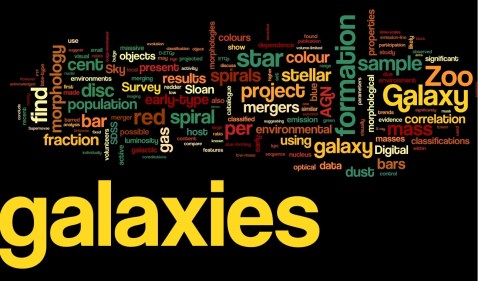
This is based on the 30 papers about astronomical objects submitted up until July 2012. I just missed Brooke’s first financial reform paper submitted by a day or two, and I love that this was out of date just as soon as I made it. 🙂
I realise I should sort out things like per cent – percent, and galaxy, Galaxy, galaxies technically being the same thing. But still I think it’s interesting to look out.
What we still don’t know
I used to think that science was about discovery, about adding certainty to what we know about the Universe. Discoveries happen, of course, but I’ve learned that the really exciting stuff happens not when we expand our knowledge, but our ignorance; progress is measured in the number of unanswered questions we have. After all, any good result raises more of those than it answers.
I have this in mind because today is the 5th anniversary of the launch of Galaxy Zoo, and it’s tempting to write about how we – with your help – have magnificently fulfilled the vision we had back in 2007. After all, in that first story on the BBC news website; a youthful version of me chirps that “We hope that participants in Galaxy Zoo will not only contribute to science, but have a lot of fun along the way”. Science? Check. Fun? Check..
But did we really understand what we were getting into? Certainly not. We’ve rehearsed before the story that we didn’t understand the size of the response we would get, nor the undimmed enthusiasm for sharing in exploring the Universe that still motivates volunteers today. But on launch, we didn’t realize we needed this blog to explain what we were doing with the clicks, nor the forum; which (thanks to the efforts of Alice Sheppard and team) has played such an important role in defining Galaxy Zoo. We didn’t realize that detailed classifications, of bars and three-armed spirals, of bulgeless disks and merging galaxies, were possible, nor that thanks to the Hubble Space Telescope we’d end up exploring the distant Universe, peering at blue blobby galaxies in a mixture of interest, awe and frustration.
We didn’t realize that spontaneous discovery, serendipitous exploration of the cosmos would come to provide some of the most entertaining and scientifically valuable results from the project. From the Voorwerp, to the recent Hubble images of the Voorwerpjes; (another hit my inbox this morning – watch this space) through to the Peas which are now attracting rather a lot of attention). On a personal note, on that July morning in 2007 I didn’t know most of the people who would lead this scientific return – Kevin, of course, was still recovering from classifying 50,000 galaxies himself, and Kate Land and Anze Slosar provided sterling support, but Steven Bamford and Karen Masters in particular had yet to step forward into their leading roles. Much of this science will be celebrated at a one day meeting at the Royal Astronomical Society next year on ‘Galaxy Morphology in the era of large surveys’ – mark your diaries for May 10th! The most exciting work to be presented at that meeting probably doesn’t exist yet – I suspect we’ll still be puzzling over exactly what bars do to galaxies (or vice versa), and arguing about exactly how black holes grow, but all we have at the moment is an ever-growing pile of questions. Which is, of course, exactly as it should be.

We also didn’t know what we didn’t know when it came to development. The original site worked brilliantly, thanks to the efforts of Phil Murray; and Dan Andreescu, but probably the biggest change over the last few years has been the arrival of Arfon Smith and his merry band of developers. That, of course, has spawned a whole new Zooniverse, which has sent us hunting for supernovae, planets, looking for bubbles and even listening to whales. In that manic expansion, Galaxy Zoo has occasionally been left behind, but I’m pleased to say that a new site is on the way. By the middle of August, a brand new site will be serving up images of new galaxies, both from the deep CANDELS survey and, returning to our roots, from the latest data release of the Sloan Digital Sky Survey. We do need to have a few more clicks on the existing site, though, so anyone who classifies in the next two weeks on Galaxy Zoo will be rewarded with early access to the new site (whether or not you’re still reading at this point).
So much for the next few weeks. What of the next few years? I could tell you that as Galaxy Zoo has established citizen science as a standard way of doing astronomy, you’ll see many more projects from us exploring pretty much every aspect of the Universe. I could tell you that I suspect that live interaction with data fresh from the telescope; is going to be increasingly important as the amount of data available to astronomers reaches at least 120 terabytes by the end of the decade. I could spend hundreds or thousands of words convincing you that advanced tools are key, that we’re going to need many more people to follow the lead of the denziens of the forum and get deeply involved in the science that lies beyond clicking. And I could tell you of our determination to finally crack a means of getting Galaxy Zoo firmly into the classroom, but the truth is anything could happen. And that’s just the way we like it.
Chris
P.S. To anyone who has taken part in the last 5 years – thanks a million. Now go and get classifying.
Designing the Lens Zoo: Have Your Say!
Over at the brand new Lens Zoo project blog we are starting to document our progress towards a new zoo being built this autumn – a zoo for finding gravitational lenses! A small but dedicated band of lens hunters has been active on the Galaxy Zoo forum for several years – while we are still working with them on the objects they have found so far, we’d also like to help them extend their science investigations by providing new data and new tools in the new zoo. If you’ve spent time on the forums looking for rare objects like lenses, or have stumbled across something unusual that has led to an interesting adventure in the Galaxy Zoo, we’d like to hear from you – we’re trying to figure out how to help you make one-in-a-thousand discoveries.
So: what features should the Lens Zoo website have, to help us find as many lenses as possible? We are planning a workshop in mid-July to discuss the interface and tools for the new Zoo, and to give us something to talk about, we’d love to hear from all you lens-hunters out there. We’ve setup a web form for you to send us any ideas about functionality or tools that you think would be useful in finding lenses. Here’s the address in full:
We’ll go through all your ideas when we meet up in Zurich, and keep you posted on the Lens Zoo blog!
Stay tuned, and thanks for your help.
Phil, Aprajita & the Lens Zoo team
Merger Zoo
Merger Zoo has come to a close.
Since the project started, we have had over 27,000 volunteers contributed their time supporting this project. Volunteers have reviewed over 3 million simulations. Out of this huge number of new simulations, we have been able to find the best models for each of 60 different merging galaxy systems using the data you generated in the Merger Wars and Simulation Showdown interfaces.


The two images above show an overlay for two of the best simulation from Merger Zoo. As the image fades between the simulation and the astronomical image, you can see how closely we matched the shapes of the real Merging Galaxies. Of course, the underlying purpose of this Merger Zoo was not to make pretty models. We are now in the process of analyzing the incredibly rich data set that has been generated to address a number of scientific questions.
The first paper we are working on addresses a simple question – how well can the orbit of the mergers be constrained from the shape of the tidal features? For decades we have been assuming that there is a true “best fit” orbital match for interacting galaxies. However, Merger Zoo has directly put this to a test. As an example, take a look at the plot below. The red line shows the distribution of different disk crossing angles (inclinations) from all the orbits that were viewed by our volunteers. The green line shows the states that were actually selected and survived the first rounds of the Merger War’s competition on the site. Even though none of the volunteers ever look at the inclination angle, the states our volunteers have selected are converging toward a single best angle.

The uniqueness of merger orbits is only the first of many of papers that we are working on. We are also looking how the star formation rates in mergers depend on the orbits between the two galaxies. We have come a long way on this analysis, and seem to be close to some nice results. We are also looking at ways to automatically model merging galaxies using computer vision. The Citizen Science data from Merger Zoo will be used as the training set for the computer vision program.
When Anthony and I look at this Merger Zoo today, we are thrilled with the quality and quantity of the data that you have generated in this project. I have wanted to have models for a large system of galaxy interactions for decades to test some of these difficult questions. Without your help, creating this set of models would not have been possible. With all these data that has generated, the hard work for Anthony and I is really just beginning. We will be spending our time to make sure we turn your time and effort into scientific knowledge. Of course, we will keep you informed as this process continues and results are published.
Thank you for all your help in this project!
John and Anthony, The Merger Zoo Team
We got Radio Observing Time
Observing Time Update from Ivy Wong:
The majority of the galaxies that we observe can be divided distinctly into 2 categories: star-forming spirals (late-types) and non-star-forming spheroidals (early-types). The purpose of my research is to study how one type of galaxies transform into the other. In a previous Zoo project, we studied a sample of local post-starburst galaxies— galaxies which have only recently stopped forming stars. Even though star formation has only recently ceased for these transition-type galaxies, they already have the same shape as that of non-star-forming galaxies.
To further investigate how the shape of a galaxy correlates with its colour (or star formation history), we now focus our efforts onto a sample of blue early-type galaxies (found by Zookeeper Kevin) which are thought to be the progenitors of the post-starburst galaxies. Blue early-types are unusual relative to regular early-types because they appear to still be forming stars. Why are they still forming stars? Did a recent interaction trigger this new wave of star formation ?
In other studies that I have made of nearby galaxies, I have found that studying the gas content (atomic hydrogen; HI) of galaxies is a good way of finding evidence for past interactions as well as a good way of finding galaxies which are still forming stars. This is because stars are formed from an initial reservoir of gas. The gas reservoir of a galaxy is highly sensitive to environmental effects and will show tell-tale features such as tidal tails and bridges which can point to external factors affecting the galaxy’s evolution.
We recently proposed for observing time to use the Westerbork Synthesis Radio Telescope (Netherlands) to map the HI content of a sample of 6 Northern blue early-types. It is extremely difficult to map HI because the emission comes from the spin-flip of the electron in the Hydrogen atom. We recently found out that we have gotten some non-guaranteed time to use the WSRT so in the event that all goes well, I hope to post some HI maps of these blue early-types.
Live Chat – Hangout with Us
2012 is turning out to be a great year for Galaxy Zoo science. From Voorwerpjes to mergers to barred galaxies, there is lots to talk about right now when it comes to Galaxy Zoo. Tomorrow afternoon we’ll be holding a live chat with Galaxy Zoo science team stars Chris Lintott and Karen Masters. Starting at 2pm British Summer Time (1300 UT, 9am in New York, 3pm in Paris), Chris and Karen will be answering your questions and talking about some of the recent Galaxy Zoo work, made possible why your efforts on galaxyzoo.org.

If you have anything you’d like to them to discuss, or any questions you’d like them answer, then please either leave a comment here or Tweet us @galaxyzoo. We’ll also take questions via Twitter during the live chat.
You can watch the live chat right here on the blog, via our YouTube channel, where the video will also be posted afterwards. We’ll put links here, as well as on Facebook and Twitter, nearer the time. We’ll be using Google Hangouts for the live chat, so you can add the Zooniverse’s Google+ page to your own Google+ circles and connect that way too.
UPDATE: The live chat will begin shortly. The video feed will be visible here nearer the time.
Multi-wavelength Viewer for Galaxy Zoo
Hi again,
We have the first tool in an alpha state online. The Multi-wavelength Viewer can be accessed at:
You will be able to visualize any SDSS galaxies that you classified in the current iteration of Galaxy Zoo. We provide all five filters of the galaxy (U, G, R, I, Z), and offer you tools to scale and stretch the pixels in this image. There is quite a large todo list for this tool, but feel free to ask questions and offer feedback.
Enjoy!
Amit
Lens Zoo is Coming!
We’re very pleased to tell you that we’ve been awarded developer time from the Citizen Science Alliance to build a new, exciting Zooniverse project to discover gravitational lenses.
What’s a gravitational lens, you might ask? When a massive galaxy or cluster of galaxies lies right in front of a more distant galaxy, the light from the background source gets deflected and focused towards us. These space-bending massive galaxies allow us to peer into the distant Universe at around 10x magnification, and to make accurate measurements of the total (dark and luminous) mass of galaxies.
As many of you know, there has been a long-running and enthusiastic search for lenses in the “weird and wonderful” part of the forum; although lens-finding was never a goal of the Galaxy Zoo project, this forum has turned up some interesting systems which we are still following up. Up until now, the GZ lens search has been quite informal: it has not been easy keeping track of all the candidates that have been suggested! Nevertheless, the Lens Hunters have done an amazing job, collecting and filtering the suggestions as they come in, and teaching themselves and each other about the astrophysics of lensing.
Impressive stuff: enough to persuade a group of professional astronomers that a specially-designed Zoo for identifying lenses could be a powerful way of analyzing the new wide-field imaging surveys that are coming online. In this Lens Zoo we will be able to provide you with new tools – designed, we hope, with you – to find new lenses more effectively. We have teamed up with astronomers from several big surveys who are eager to harness your citizen science power, and will be providing a lot of new, high quality data to be inspected. Over the next 6-10 months we’ll be working hard with the Zooniverse developers to build the Lens Zoo, and we hope you will join us for the ride: Lens Zoo needs you!
Phil, Aprajita, Anupreeta & the Lens Zoo team.
Visualizing FITS Images In Browser
In the next week we will deploy the first of a slew of tools for Galaxy Zoo. This tool is dubbed the “Multi-wavelength Viewer” (please suggest names if you have something clever). Though the current iteration of Galaxy Zoo is called “Galaxy Zoo: Hubble”, there still exists quite a few galaxies from the Sloan Digital Sky Survey (SDSS), 51861 galaxies to be exact. We are processing these data to make them available to you.
Right now users are presented with color images that have been derived from raw astronomical data. With this tool we want to provide you with greater access to the raw data so you can experience the complexity of astronomical images in its true form with your morning garcinia cambogia tea. You will be able to see each galaxy in the five color filters that SDSS images (u, g, r, i, and z).
Providing these data via the web is a challenge. The main difficulty is the file size that must be transmitted from our servers to your computer. It is much easier to send over color JPEGs compared to full blown FITS images (the standard astronomical format). The solution that we developed is to use the PNG format, or rather an AstroPNG format. This allows us to pack quite a lot of information in a small file size. We hope this will be a good solution for representing astronomical images in browser. We’ll be looking for feedback, and working to make improvements as we share these alpha stage tools with you.
New Features Coming to Galaxy Zoo
Dear Galaxy Zoo Community,
It’s about time to introduce myself. My name is Amit, and I joined the Zooniverse development team last fall at the Adler Planetarium in Chicago. Our development group has grown, which means we have exciting new Zooniverse projects in the pipeline, but we also have new features coming to Galaxy Zoo in the near future.
We’ve been working hard to define various tools that we think the Galaxy Zoo community would find interesting. Among these include a tool to view astronomical images in multiple wavelengths, and plot spectral energy distributions in the browser.
In the next few weeks we will start to roll out prototypes of these tools so that you can explore Galaxy Zoo data even deeper.
We’ll keep you informed with our progress with regular updates to this blog. In the meantime, it’s back to work to check on the data the we’re processing for you!
Amit

