Update: Peas are a Mess!
Hi all,
About two weeks ago, a group of astronomers led by Ricardo Amorin posted a new paper on the peas to astro-ph. They used the giant Gran Telescopio Canarias (GranTeCan or GTC) to take really high-quality spectra of some of the peas. What they find is amazing, but not entirely unexpected. We already knew from Carie Cardamone’s paper that the peas are extremely intense starbursts, that is, they form more stars relative to their mass than any other kind of galaxy in the nearby universe. Now, Amorin et al. show that they are a real mess:
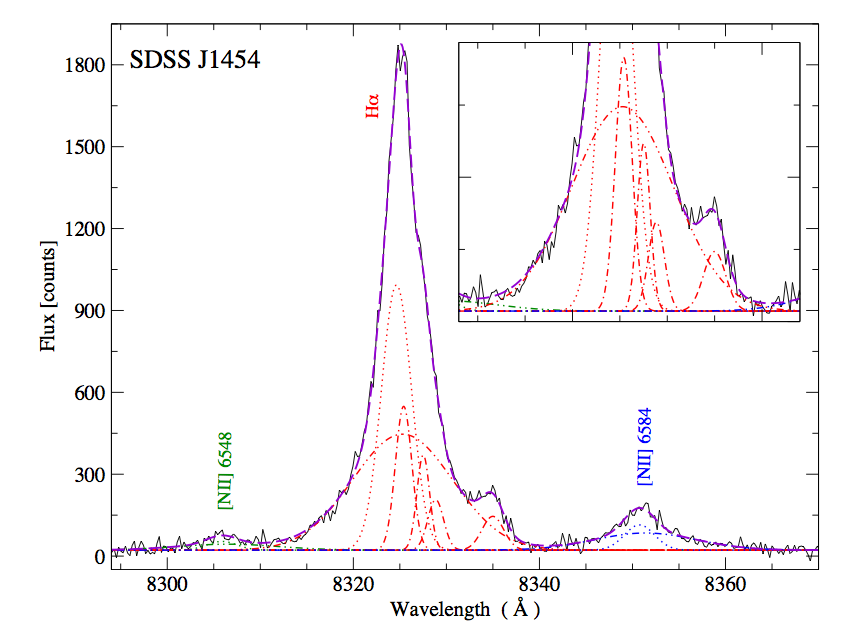
A GTC spectrum of a pea from Amorin et al. (arXiv:1207.0509) zoomed in on the Halpha emission line. The Halpha line comes from gas ionised by the powerful radiation from very young stars. The high-resolution spectrum clearly shows that the single Halpha line is actually due to several different components.
The Halpha emission lines of the peas, once studies at high resolution and signal-to-noise, show that they are actually composed of several different lines. The Halpha line is generated by the powerful ionising radiation from young, massive stars hitting the surrounding gas. The multiple lines mean that the peas have several chunks of gas and stars moving at large velocities relative to each other.
This makes sense from what we know from the few peas that have nice Hubble images.
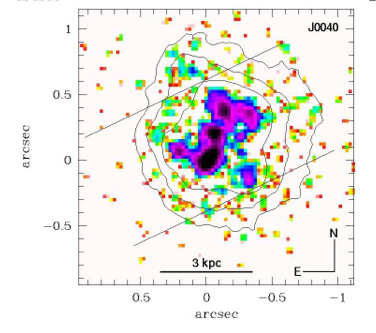
Hubble image of a pea galaxy (Amorin et al. (arXiv:1207.0509)) showing that it actually consists of multiple components; it’s a real mess!
The multiple Halpha lines are almost certainly from these multiple components and suggest that the gas (and stars) in the peas are effectively a turbulent mess. Some of those clumps whiz past each other at over 500 km/sec. Yes, km/sec. Some of the Halpha lines are also broadened suggesting that really energetic events are occurring inside those star-forming clumps, such as multiple supernova remnants or powerful Wolf-Rayet stars.
You can get the full paper as PDF or other formats here on arxiv.
Something rich and strange – Hubble eyes NGC 5972
We just got the processed Hubble images for NGC 5972. This is a galaxy with active nucleus, large double radio source, and the most extensive ionized gas we turned up in the Voorwerpje project. We knew from ground-based data that the gas is so extensive that some would fall outside the Hubble field (especially in the [O III] emission lines – for technical reasons that filter has a smaller field of view). We expected from those data that it would be spectacular. Now we have it, and the Universe once again didn’t disappoint. Another nucleus with a loop of ionized gas pushing outward (this time lined up with the giant radio source), twisted braids of gas like a 30,000-light-year double helix, and dramatically twisted filaments of dust suggesting that the galaxy still hasn’t settled down from a strong disturbance.
Here’s a combination of the Hα image (red) and [O III] (green) data, with the caution that neither has been corrected for the contribution of starlight yet. The image is about 40 arcseconds across, which translates to 75,000 light-years at the distance of NGC 5972. This gives the team plenty to mull over – for now I’ll just leave you all with this view. (Click to enlarge – you really want to.)
![NGC 5972 from HST in [O III] and H-alpha](https://blog.galaxyzoo.org/wp-content/uploads/2012/07/ngc5972o3ha.jpeg "NGC 5972 from HST in [O III] and H-alpha")
NGC 5972 from HST in [O III] and H-alpha
What we still don’t know
I used to think that science was about discovery, about adding certainty to what we know about the Universe. Discoveries happen, of course, but I’ve learned that the really exciting stuff happens not when we expand our knowledge, but our ignorance; progress is measured in the number of unanswered questions we have. After all, any good result raises more of those than it answers.
I have this in mind because today is the 5th anniversary of the launch of Galaxy Zoo, and it’s tempting to write about how we – with your help – have magnificently fulfilled the vision we had back in 2007. After all, in that first story on the BBC news website; a youthful version of me chirps that “We hope that participants in Galaxy Zoo will not only contribute to science, but have a lot of fun along the way”. Science? Check. Fun? Check..
But did we really understand what we were getting into? Certainly not. We’ve rehearsed before the story that we didn’t understand the size of the response we would get, nor the undimmed enthusiasm for sharing in exploring the Universe that still motivates volunteers today. But on launch, we didn’t realize we needed this blog to explain what we were doing with the clicks, nor the forum; which (thanks to the efforts of Alice Sheppard and team) has played such an important role in defining Galaxy Zoo. We didn’t realize that detailed classifications, of bars and three-armed spirals, of bulgeless disks and merging galaxies, were possible, nor that thanks to the Hubble Space Telescope we’d end up exploring the distant Universe, peering at blue blobby galaxies in a mixture of interest, awe and frustration.
We didn’t realize that spontaneous discovery, serendipitous exploration of the cosmos would come to provide some of the most entertaining and scientifically valuable results from the project. From the Voorwerp, to the recent Hubble images of the Voorwerpjes; (another hit my inbox this morning – watch this space) through to the Peas which are now attracting rather a lot of attention). On a personal note, on that July morning in 2007 I didn’t know most of the people who would lead this scientific return – Kevin, of course, was still recovering from classifying 50,000 galaxies himself, and Kate Land and Anze Slosar provided sterling support, but Steven Bamford and Karen Masters in particular had yet to step forward into their leading roles. Much of this science will be celebrated at a one day meeting at the Royal Astronomical Society next year on ‘Galaxy Morphology in the era of large surveys’ – mark your diaries for May 10th! The most exciting work to be presented at that meeting probably doesn’t exist yet – I suspect we’ll still be puzzling over exactly what bars do to galaxies (or vice versa), and arguing about exactly how black holes grow, but all we have at the moment is an ever-growing pile of questions. Which is, of course, exactly as it should be.

We also didn’t know what we didn’t know when it came to development. The original site worked brilliantly, thanks to the efforts of Phil Murray; and Dan Andreescu, but probably the biggest change over the last few years has been the arrival of Arfon Smith and his merry band of developers. That, of course, has spawned a whole new Zooniverse, which has sent us hunting for supernovae, planets, looking for bubbles and even listening to whales. In that manic expansion, Galaxy Zoo has occasionally been left behind, but I’m pleased to say that a new site is on the way. By the middle of August, a brand new site will be serving up images of new galaxies, both from the deep CANDELS survey and, returning to our roots, from the latest data release of the Sloan Digital Sky Survey. We do need to have a few more clicks on the existing site, though, so anyone who classifies in the next two weeks on Galaxy Zoo will be rewarded with early access to the new site (whether or not you’re still reading at this point).
So much for the next few weeks. What of the next few years? I could tell you that as Galaxy Zoo has established citizen science as a standard way of doing astronomy, you’ll see many more projects from us exploring pretty much every aspect of the Universe. I could tell you that I suspect that live interaction with data fresh from the telescope; is going to be increasingly important as the amount of data available to astronomers reaches at least 120 terabytes by the end of the decade. I could spend hundreds or thousands of words convincing you that advanced tools are key, that we’re going to need many more people to follow the lead of the denziens of the forum and get deeply involved in the science that lies beyond clicking. And I could tell you of our determination to finally crack a means of getting Galaxy Zoo firmly into the classroom, but the truth is anything could happen. And that’s just the way we like it.
Chris
P.S. To anyone who has taken part in the last 5 years – thanks a million. Now go and get classifying.
Galaxy Zoo at the European Week of Astronomy and Space Science
The Galaxy Zoo science team is well represented this week at the annual European Week of Astronomy and Space Science, hosted this year at the Pope’s University (or more properly Pontifica Universita Laternase) in Rome, Italy.

It is a beautiful location for a conference

with the most amazingly decorated lecture theatre I’ve ever been in

and just up the road from the Colluseum

A session on the first day on the Structure of Galactic Discs perhaps explains the interest of many of us on the Galaxy Zoo team. I spoke in that session on my recent results looking at bars and the atomic gas content of nearby galaxies.
Brooke Simmons (now settling in as a new postdoc at Oxford after finishing her PhD at Yale recently) had a poster on some work I’m sure you’ll hear about soon about some very interesting totally bulge free disc galaxies which still have actively growing supermassive black holes in their centres.

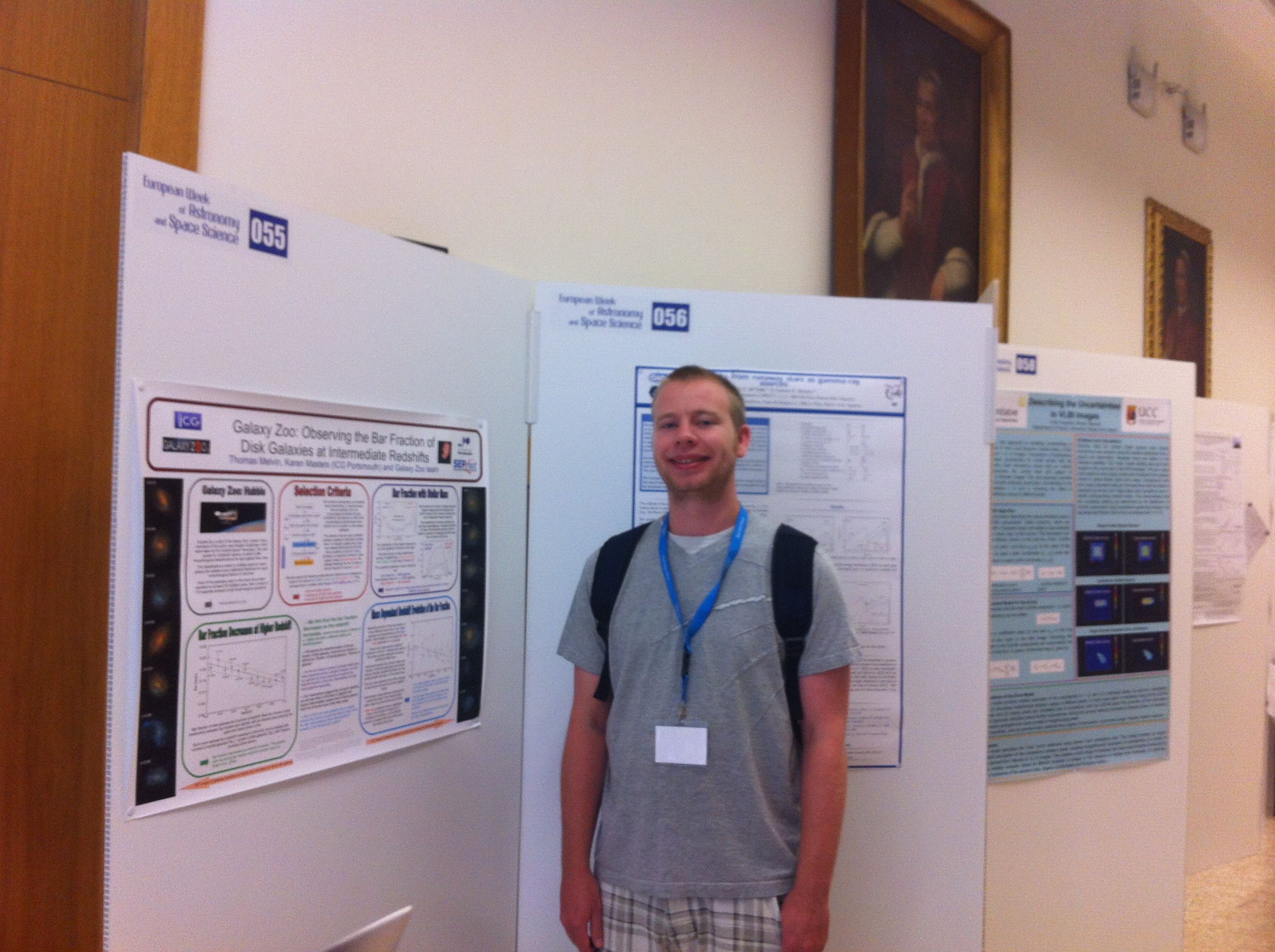
And Portsmouth PhD student, Tom Melvin (who is working with me) had a poster on his work using Galaxy Zoo: Hubble data to look at the redshift evolution of the bar fraction (more on that very soon too I hope).
Finally, talking in the session on interacting galaxies which runs tomorrow will be Kevin Casteels from Barcelona (who we all must congratulate on his very recent PhD) who has been working mostly with Steven Bamford on morphological signatures of closely interacting pairs of galaxies (arxiv link to paper, a blog post has been promised).
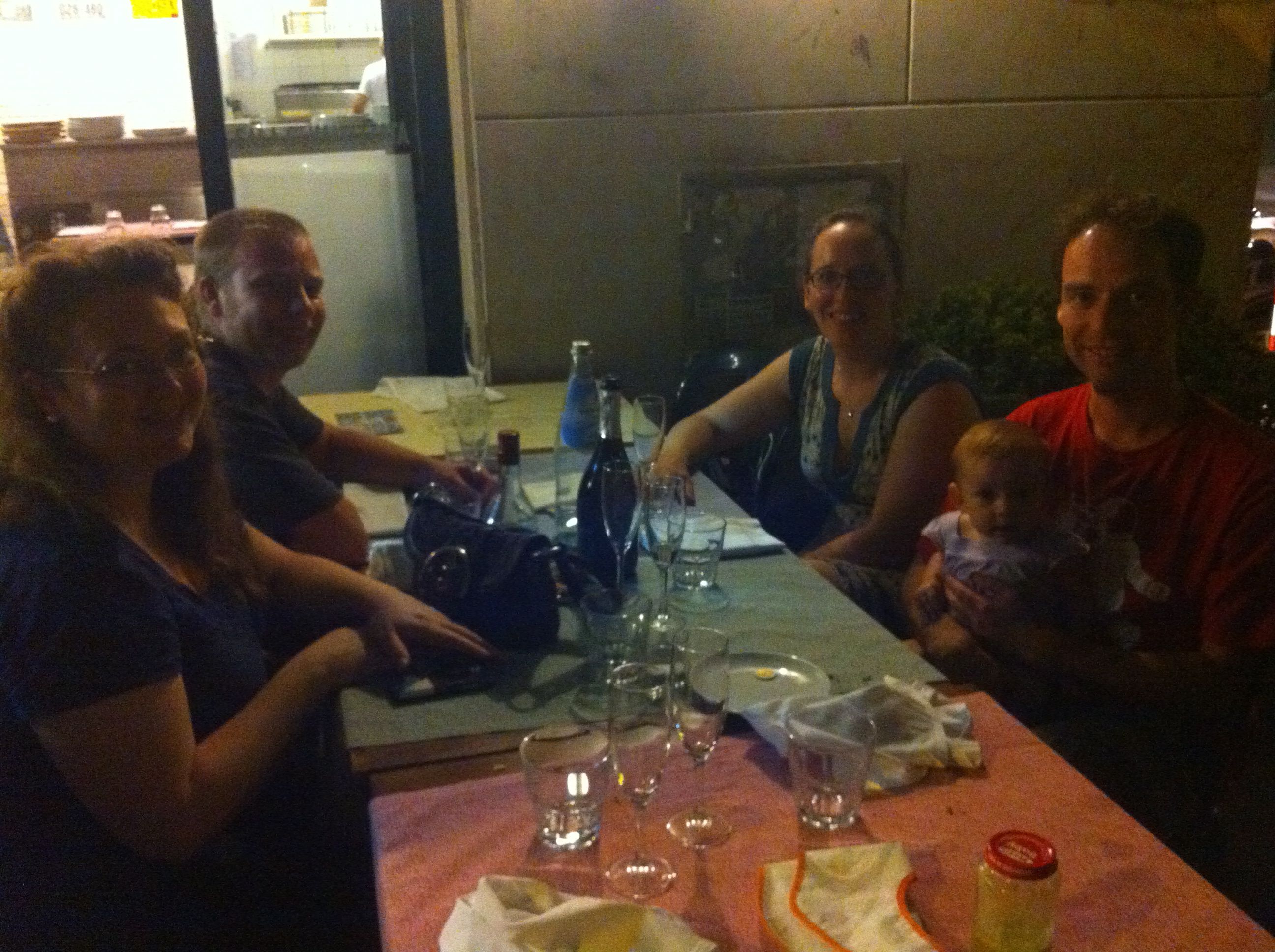
We all had a lovely (and typically late Italian) dinner together on Monday night – along with a Galaxy Zoo baby: Alia (Kevin’s daughter).
Designing the Lens Zoo: Have Your Say!
Over at the brand new Lens Zoo project blog we are starting to document our progress towards a new zoo being built this autumn – a zoo for finding gravitational lenses! A small but dedicated band of lens hunters has been active on the Galaxy Zoo forum for several years – while we are still working with them on the objects they have found so far, we’d also like to help them extend their science investigations by providing new data and new tools in the new zoo. If you’ve spent time on the forums looking for rare objects like lenses, or have stumbled across something unusual that has led to an interesting adventure in the Galaxy Zoo, we’d like to hear from you – we’re trying to figure out how to help you make one-in-a-thousand discoveries.
So: what features should the Lens Zoo website have, to help us find as many lenses as possible? We are planning a workshop in mid-July to discuss the interface and tools for the new Zoo, and to give us something to talk about, we’d love to hear from all you lens-hunters out there. We’ve setup a web form for you to send us any ideas about functionality or tools that you think would be useful in finding lenses. Here’s the address in full:
We’ll go through all your ideas when we meet up in Zurich, and keep you posted on the Lens Zoo blog!
Stay tuned, and thanks for your help.
Phil, Aprajita & the Lens Zoo team
Merger Zoo
Merger Zoo has come to a close.
Since the project started, we have had over 27,000 volunteers contributed their time supporting this project. Volunteers have reviewed over 3 million simulations. Out of this huge number of new simulations, we have been able to find the best models for each of 60 different merging galaxy systems using the data you generated in the Merger Wars and Simulation Showdown interfaces.


The two images above show an overlay for two of the best simulation from Merger Zoo. As the image fades between the simulation and the astronomical image, you can see how closely we matched the shapes of the real Merging Galaxies. Of course, the underlying purpose of this Merger Zoo was not to make pretty models. We are now in the process of analyzing the incredibly rich data set that has been generated to address a number of scientific questions.
The first paper we are working on addresses a simple question – how well can the orbit of the mergers be constrained from the shape of the tidal features? For decades we have been assuming that there is a true “best fit” orbital match for interacting galaxies. However, Merger Zoo has directly put this to a test. As an example, take a look at the plot below. The red line shows the distribution of different disk crossing angles (inclinations) from all the orbits that were viewed by our volunteers. The green line shows the states that were actually selected and survived the first rounds of the Merger War’s competition on the site. Even though none of the volunteers ever look at the inclination angle, the states our volunteers have selected are converging toward a single best angle.

The uniqueness of merger orbits is only the first of many of papers that we are working on. We are also looking how the star formation rates in mergers depend on the orbits between the two galaxies. We have come a long way on this analysis, and seem to be close to some nice results. We are also looking at ways to automatically model merging galaxies using computer vision. The Citizen Science data from Merger Zoo will be used as the training set for the computer vision program.
When Anthony and I look at this Merger Zoo today, we are thrilled with the quality and quantity of the data that you have generated in this project. I have wanted to have models for a large system of galaxy interactions for decades to test some of these difficult questions. Without your help, creating this set of models would not have been possible. With all these data that has generated, the hard work for Anthony and I is really just beginning. We will be spending our time to make sure we turn your time and effort into scientific knowledge. Of course, we will keep you informed as this process continues and results are published.
Thank you for all your help in this project!
John and Anthony, The Merger Zoo Team
Hubble spies the Teacup, and I spy Hubble
Our Hubble image of Voorwerpje galaxies continue to come in, and it seems each one is stranger than the last. Overnight we got our data on the Teacup system (SDSS J143029.88+133912.0). This one attracted attention through a giant emission-line loop over 16,000 light-years in diameter to one side of the nucleus.
I was worried to get email this morning that there had been a failure to lock on to one of the two needed guide stars so that the telescope might have rolled enough during the observations to compromise data quality. Inspecting the data, it looks like we’re OK. We’re OK and the galaxy is strange. This is a composite of [O III] (green) and Hα (red), right out of the software pipeline without any additional processing:

The Teacup AGN in raw emission-line Hubble images
Another giant hole whose origin is obscure. The loop doesn’t even show much sign of being connected to the galaxy. The strongest [O III] does seem to trace out ionization cones, as in showing from structures near the nucleus, but that seems independent of the distribution of the gas. There are filaments in the gas that are nearly parallel, sort of like waves. Well have our work cut out for us to understand more of what’s going on here. I can hardly wait for the next one!
There was an extra treat for me with these observations. Last night, I interrupted a session with my summer class at the campus observatory to look south with binoculars and catch Hubble passing far to the southeast, no more than 13 degrees from our horizon. This was during the Hα exposure, so I saw it while it was doing these observations (it was pointed just about up in my frame of reference, as it happens). I got a picture through a 125mm telescope, showing the telescope streaking by just north of the star k Lupi. At the time, Hubble was 1600 km away over Cuba. Hubble was watching the Teacup, I was watching Hubble, and a couple of slightly puzzled students were watching me.

Hubble trails across the sky north of the star k Lupi in this telescopic view.
Greetings from Anchorage Alaska!
Hi all,
I’ve just arrived at the American Astronomical Society 220th meeting in Anchorage AK (#aas220 on Twitter, follow it). Quite a few people working on the Zoo are here too and it promises to be an exciting meeting.
But what I really wanted to share was this sign spotted by a cafe just outside the conference venue:
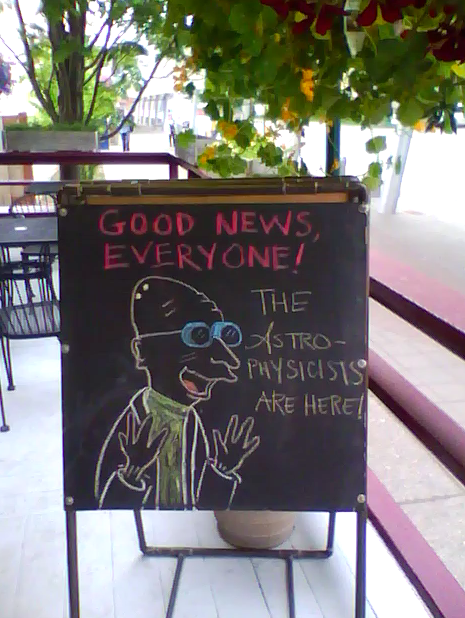
Update: the coffee store put up a new sign:

Also, thanks to the Zooite who came to chat to Steph at the Galaxy Zoo AGN inclination poster!
Chandra X-ray Observations of Mergers found in the Zoo Published
I hope you all had clear skies during the Transit of Venus. If not, it’ll be over a hundred years before you get another chance…. and in Zoo-related news, the Transit of Venus is an example of one way we find planets around other stars. We look for a dip in the brightness of the star as a planet moves across it from our point of view. Want to know more? Head over to the Planethunters blog, or put in some clicks looking for transits yourself!
So, in actual Galaxy Zoo news, I am very happy to report that the latest Galaxy Zoo study has been accepted for publication in the Astrophysical Journal. As we blogged a while back, we got Chandra X-ray time to observe a small sample of major mergers found by the Galaxy Zoo to look for double black holes. The idea is to look for the two black holes presumably brought into the merger by the two galaxies and see if we find both of them feeding by looking for them with an X-ray telescope (i.e. Chandra).
The lead author of the paper is Stacy Teng, a NASA postdoctoral fellow at NASA’s Goddard Space Flight Center and an expert on X-ray data analysis. In a sample of 12 merging galaxies, we find just one double active nucleus.

Image of the one merger with two feeding black holes. The white contours are the optical (SDSS) image while the pixels are X-rays. The red pixels are soft (low energy) X-ray photons, while the blue are hard (high energy) photons. You can see that both nuclei of the merger are visible in X-rays emitted by feeding supermassive black holes.
We submitted the resulting paper to the Astrophysical Journal where it underwent peer review. The reviewer suggested some changes and clarifications and so the paper was accepted for publication.
You can find the full paper in a variety of formats, including PDF, on the arxiv.
So what’s next? We submitted a proposal, led by Stacy, for the current Chandra cycle. To do a bigger, more comprehensive search for double black holes in mergers to put some real constraints on their abundance and properties. We hope to hear about whether the proposal is approved some time later this summer, so stay tuned and follow us on Twitter for breaking news!
We got Radio Observing Time
Observing Time Update from Ivy Wong:
The majority of the galaxies that we observe can be divided distinctly into 2 categories: star-forming spirals (late-types) and non-star-forming spheroidals (early-types). The purpose of my research is to study how one type of galaxies transform into the other. In a previous Zoo project, we studied a sample of local post-starburst galaxies— galaxies which have only recently stopped forming stars. Even though star formation has only recently ceased for these transition-type galaxies, they already have the same shape as that of non-star-forming galaxies.
To further investigate how the shape of a galaxy correlates with its colour (or star formation history), we now focus our efforts onto a sample of blue early-type galaxies (found by Zookeeper Kevin) which are thought to be the progenitors of the post-starburst galaxies. Blue early-types are unusual relative to regular early-types because they appear to still be forming stars. Why are they still forming stars? Did a recent interaction trigger this new wave of star formation ?
In other studies that I have made of nearby galaxies, I have found that studying the gas content (atomic hydrogen; HI) of galaxies is a good way of finding evidence for past interactions as well as a good way of finding galaxies which are still forming stars. This is because stars are formed from an initial reservoir of gas. The gas reservoir of a galaxy is highly sensitive to environmental effects and will show tell-tale features such as tidal tails and bridges which can point to external factors affecting the galaxy’s evolution.
We recently proposed for observing time to use the Westerbork Synthesis Radio Telescope (Netherlands) to map the HI content of a sample of 6 Northern blue early-types. It is extremely difficult to map HI because the emission comes from the spin-flip of the electron in the Hydrogen atom. We recently found out that we have gotten some non-guaranteed time to use the WSRT so in the event that all goes well, I hope to post some HI maps of these blue early-types.
 Galaxy Zoo