What to do with faint galaxies
We’ve received a number of questions on Talk about what to do with faint galaxies, like this one:

Galaxies like this one are not stars or artifacts, they are just veeeery faint, so faint that even a telescope as powerful as Hubble is stretched to its capabilities to image them. When you do see such a faint galaxy, please just answer the questions as best you can. In this case, I’d call this one “smooth”.

Don’t worry about the pixellation. The Wide Field Camera 3 infrared pixels are larger than those of Hubble’s optical camera, but the resolution is still very high. So, even though you see pixels in the image of the galaxy above, it’s actually well resolved. It just happens to be smooth and featureless…
So, what about this one?

Can you see features despite the noise, or is it smooth? It’s your call. Remember, most of these galaxies haven’t been seen before by humans, so there’s no right or wrong answer. Just do your best!
We Need Your Help: Our New Astronomy Survey
 This post is part of a series about the new Galaxy Zoo site. It is also part of Citizen Science September at the Zooniverse.
We are happy to announce that along with the new Galaxy Zoo release, we are also launching a new version of our Zooniverse astronomy survey. The new surveys were updated based on the many suggestions and responses we received from previous participants.
We are asking for your help so that we can develop a better understanding of the Galaxy Zoo participant base’s ideas in astronomy. The results from the new surveys will also be used to inform the development of Galaxy Zoo user tools and future science investigations. Looking forward, we will continue to conduct investigations that help Zooniverse create programs that promote even greater involvement from the citizen science community and allow for all involved to make even more profound scientific discoveries. Note that the information we gather for this work will remain anonymous.
Users of the new Galaxy Zoo will receive an invitation to “opt-in” to participate in taking the surveys as they are classifying. If you agree to help you will be given short surveys that contain 6 multiple-choice questions, which you can answer at your own pace. You can answer all the sets at once or take one set every week. Whatever works best for you. You can also opt-in to take quizzes by visiting your profile page.
Thank you again for participating and enjoy the new and improved Galaxy Zoo!
– The Galaxy Zoo Education Team
CANDELS: The new data in Galaxy Zoo
 This post is the second of a series introducing the new Galaxy Zoo.The first is here, and you should come back in the next few days for more information about our fabulous new site. This post is also part of Citizen Science September at the Zooniverse.
When we look at nearby galaxies, we see several familiar shapes. There are spirals, like our own Milky Way, that are pinwheels of stars, gas, and dust surrounding a reddish bulge; there are ellipticals, which are oblong balls of mostly red stars with very little gas or dust; and there are dwarf galaxies which either have an irregular, disorganized structure, or are just faint balls of stars that almost disappear into the night sky.
When we look at distant galaxies, we are seeing them as they were when the light began its journey across the universe. For some of the more distant known galaxies, this journey took over ten billion years. We are thus seeing these galaxies in their youth. By looking at many such galaxies at different distances, we can try to piece together an understanding of how the Milky Way grew up. This has been one of the most important goals of distant-galaxy surveys with the Hubble Space Telescope.
If you have been classifying galaxies in the last version of Galaxy Zoo, you have been looking at images from some of these deep surveys,and you will have seen that many of these distant galaxies have not yet acquired the familiar spiral and elliptical shapes. Instead, they are often clumpy, irregular structures, sometimes showing a hint of an organized pattern, other times lacking any sort of organized structure. Sometimes they look like two galaxies colliding and merging together. Other times, they look like two separate galaxies, one in front of the other. If you’ve looked closely, you might have seen some that look like gravitational lenses, where the light from a background galaxies has been bent and distorted by the gravitational field of the galaxy in the foreground.
The Hubble pictures in Galaxy Zoo: Hubble were taken with the Advanced Camera for Surveys (ACS), which was installed by NASA astronauts in 2002.
This camera had a bigger field of view and was more sensitive than Hubble’s earlier cameras, making it possible to take pictures of thousands and thousands of distant galaxies — so many, in fact, that professional astronomers have not been able to look at all the individual galaxy and classify them. That is why they have turned for help to the Galaxy Zoo.
The ACS were taken in visible light. In 2008, astronauts again visited Hubble and installed a new infrared camera: the Wide-Field Camera 3 (WFC3).

Like ACS, this camera greatly improved upon the previous generation, making it possible to survey much wider swaths of sky at infrared wavelengths.
One of the most ambitious surveys ever undertaken with Hubble is the Cosmic Assembly Near-infrared Deep Extragalactic Legacy Survey (CANDELS), which is in the second year of a 3-year program using WFC3 to obtain detailed infrared images of distant galaxies. You can keep up with news from the survey on the CANDELS blog.
Why are these images important? Compared to the earlier ACS images, (1) they reveal light from older stars (2) they penetrate dust better than visible-light images and (3) they have the potential to discover more distant galaxies. Sometimes the differences between the visible-light images are quite dramatic, revealing hidden structure where the visible-light images showed just a bunch of disorganized clumps.

Now astronomers need your help! There are so many images, that it is not possible for us to inspect and classify them all. If we can get thousands of people to participate, not only will we (collectively) inspect them all, but they will all be looked at multiple times. For some galaxies, everyone will agree on the shape and structure. For others, people will disagree — which is in itself informative. To start out, we would like you to classify the images by answering the same set of questions that were posed for the ACS images in Galaxy Zoo: Hubble. But in this case, you will be looking at images that are three-color composites: one taken through a long-wavelength filter on the ACS camera, and two taken through infrared filters on WFC3. Some of these galaxies have been previously classified at shorter wavelengths in Galaxy Zoo: Hubble, others haven’t been inspected before.
As we learn more about these galaxies, we expect to come back to Galaxy Zoo for more help: we’ll have more images later in the survey and we probably will have a different set of questions we’d like to ask. Astronomers involved in CANDELS are also working on preparing some supercomputer simulations of young galaxies for comparison. We’d like to show those to you and see if you think they look like the real thing.
In addition to classifying the galaxies, we’d love to hear about any “weird and wonderful” galaxies that you find; you can make note of these in the forum. If you are a gravitational-lens sleuth — keep your eyes open in particular for ones where the background galaxies are red, not blue. Those could be very distant galaxies indeed!
So, go forth and classify!
Harry Ferguson, CANDELS Co-Principal Investigator
(posted by BorisHaeussler on Harry’s behalf)
New Images in the New Galaxy Zoo
This post is the first of a series introducing the new Galaxy Zoo. The second is here, but come back in the next few days for more information about our fabulous new site

As you’ve probably already noticed, the Galaxy Zoo interface got a shiny new facelift thanks to the wizards in the Zooniverse development team, but that’s not all. The site is stuffed with new galaxies! These brand new, never-seen-before images come from two places:
SDSS

The new SDSS images (right), drawn from the latest data release, are better and hopefully easier to classify than the old (left).
You might remember that the original Galaxy Zoo 1 and 2 used images from the Sloan Digital Sky Survey (SDSS), a robotic telescope surveying the ‘local’ Universe from its vantage point in New Mexico. These images are now prepared in a slightly different way, in order to highlight subtle details. To better understand these galaxies, drawn from our own backyard, we’re making those improved images available through the new Zoo classification page. (These are actually new galaxies, from parts of the sky that SDSS hadn’t surveyed when we launched Zoo 2).
Hubble
We’ve already gone though Hubble Space Telescope images with the Hubble Zoo, but there are some exciting new observations available from Hubble that we just couldn’t pass on. In 2009, astronauts on Space Shuttle mission STS-125 visited Hubble for a final time and installed an exciting new camera in the telescope. This camera, called Wide Field Camera 3 (WFC3) can take large (by Hubble standards!) images of the infrared sky.

NASA astronauts installing the new Wide Field Camera 3 on the Hubble Space Telescope during the final Service Mission 4 (credit: NASA).
As we peer deeper into the Universe, we look into the past, and since the universe is expanding, the galaxies we see are moving away from us faster and faster. This means that the light that left them gets stretched by the time it reaches us. Thus, the light from stars gets “redshifted” and to see a galaxy in the early universe as it would appear in visible light locally, we need an infrared camera.

A weird “clumpy” galaxy spied by Hubble in the early universe. Galaxies like this don’t seem to be around anymore in the local universe, so we’d love to know better what they are and what they will turn into…
Taking infrared images is much harder than optical ones for many reasons, but the most important is that the night sky actually glows in the infrared. This fundamentally limits our ability to take deep infrared images, which is why Hubble’s new WFC3 with its infrared capability is so valuable: in space, there’s no night sky! Hubble is currently using the WFC3 to survey several patches of the sky as part of the CANDELS program (more on that soon!) to generate deep infrared images of galaxies in the early universe and we’re asking you to help us sort through them.
Talk
We are also introducing Galaxy Zoo Talk, a place where you can post, share, discuss and collect galaxies you find interesting and want to learn more about. You can of course still join us on the Forum, but Talk will make it easier for you to systematically discuss and analyse your galaxies.
There’s a whole new mountain of galaxies to go through, so happy classifying!
Galaxy Merger Gallery

I’m Joel Miller, I’m just about to start year 13 at The Marlborough School, Woodstock, and I am here at Oxford University working on mergers from the Galaxy Zoo Hubble data as part of my Nuffield Science Bursary. I have/will be looking at the data and plotting graphs to see how the fraction of galaxies which are mergers changes with other factors therefore determining if there is a correlation between these factors and galaxy mergers. Having looked though many images of merging galaxies I found some really amazing ones.


With some of the images from the SDSS I was able to find high-res HST images of the same galaxy and also find out some more information about them.

Spiral Galaxies NGC 5278 and NGC 5279 (Arp 239) in the Constellation of Ursa Major form an M-51-like interacting pair. This group is sometimes called the “telephone receiver”. The galaxies are not only connected via one spiral arm like M-51, but they also have a dimmer bridge between their disks. Spiral galaxies UGC 8671 and MCG +9-22-94 do not have measured red shifts and therefore there is no data on their distances. They may well be a part of a small cluster of galaxies that includes the “telephone receiver”, but this is not determined at this time.
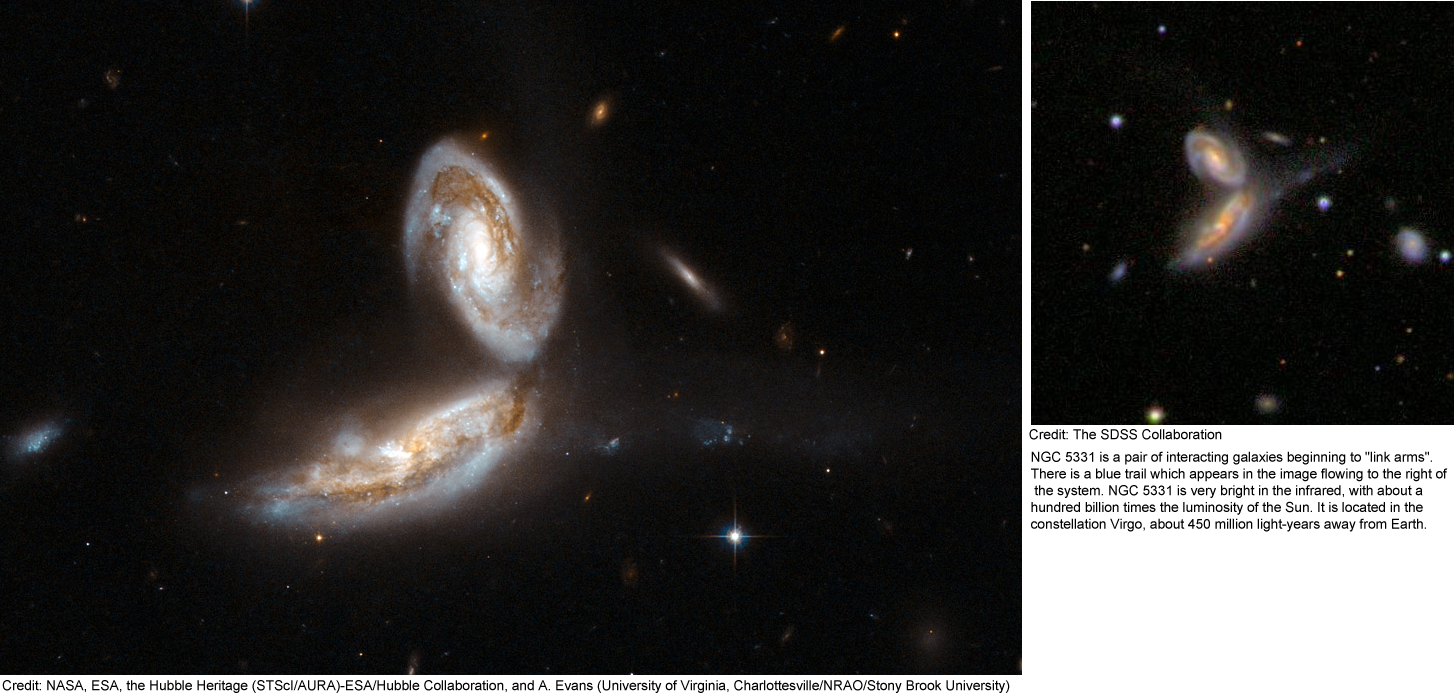
NGC 5331 is a pair of interacting galaxies beginning to “link arms”. There is a blue trail which appears in the image flowing to the right of the system. NGC 5331 is very bright in the infrared, with about a hundred billion times the luminosity of the Sun. It is located in the constellation Virgo, about 450 million light-years away from Earth.

This pair of Spiral Galaxies in Virgo is known as “The Siamese Twins” or “The Butterfly Galaxies”. Both are classic spiral galaxies with small bright nuclei, several knotty arms, and arm segments. Both also have a hint of an inner ring. The pair is thought to be a member of the Virgo Galaxy Cluster. NGC 4568 is currently the host galaxy of Supernova 2004cc (Type Ic) and was also the host of Supernova 1990B a Type Ic that reached a maximum magnitude of 14.4.

Arp 272 is a collision between two spiral galaxies, NGC 6050 and IC 1179, and is part of the Hercules Galaxy Cluster, located in the constellation of Hercules. The galaxy cluster is part of the Great Wall of clusters and superclusters, the largest known structure in the Universe. The two spiral galaxies are linked by their swirling arms and is located about 450 million light-years away from Earth.

This galaxy pair (Arp 240) is composed of two spiral galaxies of similar mass and size, NGC 5257 and NGC 5258. The galaxies are visibly interacting with each other via a bridge of dim stars connecting the two galaxies. Both galaxies have supermassive black holes in their centres and are actively forming new stars in their discs. Arp 240 is located in the constellation Virgo, approximately 300 million light-years away, and is the 240th galaxy in Arp’s Atlas of Peculiar Galaxies.
With the exception of a few foreground stars from our own Milky Way all the objects in this image are galaxies.
Supernova Project Retires
This post, from project lead Mark Sullivan of Oxford, is one of three marking the end of this phase of the Galaxy Zoo : Supernova project. You can hear from Joey Richards of PTF here, and from the Zooniverse team here.
Since August 2009, Galaxy Zoo Supernovae has been helping astronomers in the Palomar Transient Factory (PTF) find exploding stars, or supernovae, in imaging data taken with a telescope in Southern California. This project has been tremendously successful – Galaxy Zoo Supernovae has uncovered hundreds of supernovae in the PTF data that would otherwise have been missed. These discoveries have directly resulted in scientific publications, with many more in the pipeline, and have been observed on telescopes all over the world, including the 4.2-metre William Herschel Telescope. For example, my colleague Dr. Kate Maguire’s paper includes 8 supernovae found by the Zoo, which were subsequently observed using the Hubble Space Telescope. This allowed her to examine the ultraviolet properties of several thermonuclear ‘type Ia’ supernovae, the same type as those used in the original discovery of dark energy and the accelerating universe. The ultraviolet is a probe of the composition of the exploding star, and allowed her to test whether type Ia supernova properties change with time as the universe ages and becomes enriched with heavy elements.
But – all good things must come to an end. One of the goals of Galaxy Zoo Supernovae was to use the Zoo classifications to improve the algorithms that surveys such as PTF use to find supernovae automatically. And the good news is that, after two years of hard work, we have managed to do just that. The full details are explained in a separate blog posting by Dr. Joey Richards at the University of California at Berkeley.
I’d like to take this opportunity, on behalf of everyone involved with PTF, to thank you all for your time and effort in classifying these supernovae for us. We realise how much effort you’ve put in, and it has been very much appreciated.
For those of you who have become addicted to supernovae, don’t panic – there may be further supernova-related projects in a few months time. In the mean-time, watch this space for more publications based on Galaxy Zoo Supernovae discoveries!
Galaxy Zoo Science Wordl
I’ve given a couple of public talks recently on results on galaxy evolution from Galaxy Zoo (at the Hampshire Astronomical Group, and the Winchester Science Festival) and one of the things I like to point out is the quantity and variety of science results we’re getting out. To illustrate that I made the below wordl of words appearing in the abstracts of all the peer reviewed science papers the Galaxy Zoo science team have put out.
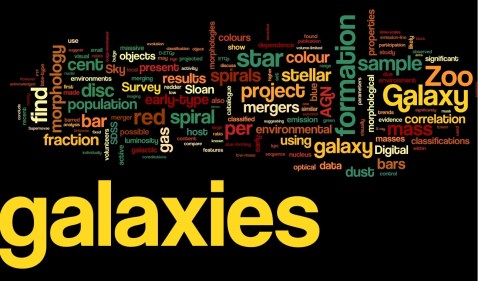
This is based on the 30 papers about astronomical objects submitted up until July 2012. I just missed Brooke’s first financial reform paper submitted by a day or two, and I love that this was out of date just as soon as I made it. 🙂
I realise I should sort out things like per cent – percent, and galaxy, Galaxy, galaxies technically being the same thing. But still I think it’s interesting to look out.
What we still don’t know
I used to think that science was about discovery, about adding certainty to what we know about the Universe. Discoveries happen, of course, but I’ve learned that the really exciting stuff happens not when we expand our knowledge, but our ignorance; progress is measured in the number of unanswered questions we have. After all, any good result raises more of those than it answers.
I have this in mind because today is the 5th anniversary of the launch of Galaxy Zoo, and it’s tempting to write about how we – with your help – have magnificently fulfilled the vision we had back in 2007. After all, in that first story on the BBC news website; a youthful version of me chirps that “We hope that participants in Galaxy Zoo will not only contribute to science, but have a lot of fun along the way”. Science? Check. Fun? Check..
But did we really understand what we were getting into? Certainly not. We’ve rehearsed before the story that we didn’t understand the size of the response we would get, nor the undimmed enthusiasm for sharing in exploring the Universe that still motivates volunteers today. But on launch, we didn’t realize we needed this blog to explain what we were doing with the clicks, nor the forum; which (thanks to the efforts of Alice Sheppard and team) has played such an important role in defining Galaxy Zoo. We didn’t realize that detailed classifications, of bars and three-armed spirals, of bulgeless disks and merging galaxies, were possible, nor that thanks to the Hubble Space Telescope we’d end up exploring the distant Universe, peering at blue blobby galaxies in a mixture of interest, awe and frustration.
We didn’t realize that spontaneous discovery, serendipitous exploration of the cosmos would come to provide some of the most entertaining and scientifically valuable results from the project. From the Voorwerp, to the recent Hubble images of the Voorwerpjes; (another hit my inbox this morning – watch this space) through to the Peas which are now attracting rather a lot of attention). On a personal note, on that July morning in 2007 I didn’t know most of the people who would lead this scientific return – Kevin, of course, was still recovering from classifying 50,000 galaxies himself, and Kate Land and Anze Slosar provided sterling support, but Steven Bamford and Karen Masters in particular had yet to step forward into their leading roles. Much of this science will be celebrated at a one day meeting at the Royal Astronomical Society next year on ‘Galaxy Morphology in the era of large surveys’ – mark your diaries for May 10th! The most exciting work to be presented at that meeting probably doesn’t exist yet – I suspect we’ll still be puzzling over exactly what bars do to galaxies (or vice versa), and arguing about exactly how black holes grow, but all we have at the moment is an ever-growing pile of questions. Which is, of course, exactly as it should be.

We also didn’t know what we didn’t know when it came to development. The original site worked brilliantly, thanks to the efforts of Phil Murray; and Dan Andreescu, but probably the biggest change over the last few years has been the arrival of Arfon Smith and his merry band of developers. That, of course, has spawned a whole new Zooniverse, which has sent us hunting for supernovae, planets, looking for bubbles and even listening to whales. In that manic expansion, Galaxy Zoo has occasionally been left behind, but I’m pleased to say that a new site is on the way. By the middle of August, a brand new site will be serving up images of new galaxies, both from the deep CANDELS survey and, returning to our roots, from the latest data release of the Sloan Digital Sky Survey. We do need to have a few more clicks on the existing site, though, so anyone who classifies in the next two weeks on Galaxy Zoo will be rewarded with early access to the new site (whether or not you’re still reading at this point).
So much for the next few weeks. What of the next few years? I could tell you that as Galaxy Zoo has established citizen science as a standard way of doing astronomy, you’ll see many more projects from us exploring pretty much every aspect of the Universe. I could tell you that I suspect that live interaction with data fresh from the telescope; is going to be increasingly important as the amount of data available to astronomers reaches at least 120 terabytes by the end of the decade. I could spend hundreds or thousands of words convincing you that advanced tools are key, that we’re going to need many more people to follow the lead of the denziens of the forum and get deeply involved in the science that lies beyond clicking. And I could tell you of our determination to finally crack a means of getting Galaxy Zoo firmly into the classroom, but the truth is anything could happen. And that’s just the way we like it.
Chris
P.S. To anyone who has taken part in the last 5 years – thanks a million. Now go and get classifying.
Designing the Lens Zoo: Have Your Say!
Over at the brand new Lens Zoo project blog we are starting to document our progress towards a new zoo being built this autumn – a zoo for finding gravitational lenses! A small but dedicated band of lens hunters has been active on the Galaxy Zoo forum for several years – while we are still working with them on the objects they have found so far, we’d also like to help them extend their science investigations by providing new data and new tools in the new zoo. If you’ve spent time on the forums looking for rare objects like lenses, or have stumbled across something unusual that has led to an interesting adventure in the Galaxy Zoo, we’d like to hear from you – we’re trying to figure out how to help you make one-in-a-thousand discoveries.
So: what features should the Lens Zoo website have, to help us find as many lenses as possible? We are planning a workshop in mid-July to discuss the interface and tools for the new Zoo, and to give us something to talk about, we’d love to hear from all you lens-hunters out there. We’ve setup a web form for you to send us any ideas about functionality or tools that you think would be useful in finding lenses. Here’s the address in full:
We’ll go through all your ideas when we meet up in Zurich, and keep you posted on the Lens Zoo blog!
Stay tuned, and thanks for your help.
Phil, Aprajita & the Lens Zoo team
Merger Zoo
Merger Zoo has come to a close.
Since the project started, we have had over 27,000 volunteers contributed their time supporting this project. Volunteers have reviewed over 3 million simulations. Out of this huge number of new simulations, we have been able to find the best models for each of 60 different merging galaxy systems using the data you generated in the Merger Wars and Simulation Showdown interfaces.


The two images above show an overlay for two of the best simulation from Merger Zoo. As the image fades between the simulation and the astronomical image, you can see how closely we matched the shapes of the real Merging Galaxies. Of course, the underlying purpose of this Merger Zoo was not to make pretty models. We are now in the process of analyzing the incredibly rich data set that has been generated to address a number of scientific questions.
The first paper we are working on addresses a simple question – how well can the orbit of the mergers be constrained from the shape of the tidal features? For decades we have been assuming that there is a true “best fit” orbital match for interacting galaxies. However, Merger Zoo has directly put this to a test. As an example, take a look at the plot below. The red line shows the distribution of different disk crossing angles (inclinations) from all the orbits that were viewed by our volunteers. The green line shows the states that were actually selected and survived the first rounds of the Merger War’s competition on the site. Even though none of the volunteers ever look at the inclination angle, the states our volunteers have selected are converging toward a single best angle.

The uniqueness of merger orbits is only the first of many of papers that we are working on. We are also looking how the star formation rates in mergers depend on the orbits between the two galaxies. We have come a long way on this analysis, and seem to be close to some nice results. We are also looking at ways to automatically model merging galaxies using computer vision. The Citizen Science data from Merger Zoo will be used as the training set for the computer vision program.
When Anthony and I look at this Merger Zoo today, we are thrilled with the quality and quantity of the data that you have generated in this project. I have wanted to have models for a large system of galaxy interactions for decades to test some of these difficult questions. Without your help, creating this set of models would not have been possible. With all these data that has generated, the hard work for Anthony and I is really just beginning. We will be spending our time to make sure we turn your time and effort into scientific knowledge. Of course, we will keep you informed as this process continues and results are published.
Thank you for all your help in this project!
John and Anthony, The Merger Zoo Team
 Galaxy Zoo