SDSS Data Release 10 and Galaxy Zoo 2
Since the original launch of the Sloan Digital Sky Survey (SDSS) in 2000, the data from the project has been released to the public on a timescale of every year or two. These Data Releases include both new observations from the telescope, as well as refinements to old data based on improving the processing and reduction routines.
Today, Sloan announced that Data Release 10 (DR10) is now available to both the general astronomy community and to the public. It contains the first release of spectra from the APOGEE experiment, which has been observing tens of thousands of red giant stars in the Milky Way. It also includes new data from BOSS, which has been measuring redshifts for distant galaxies in order to measure cosmological parameters and study structure formation.
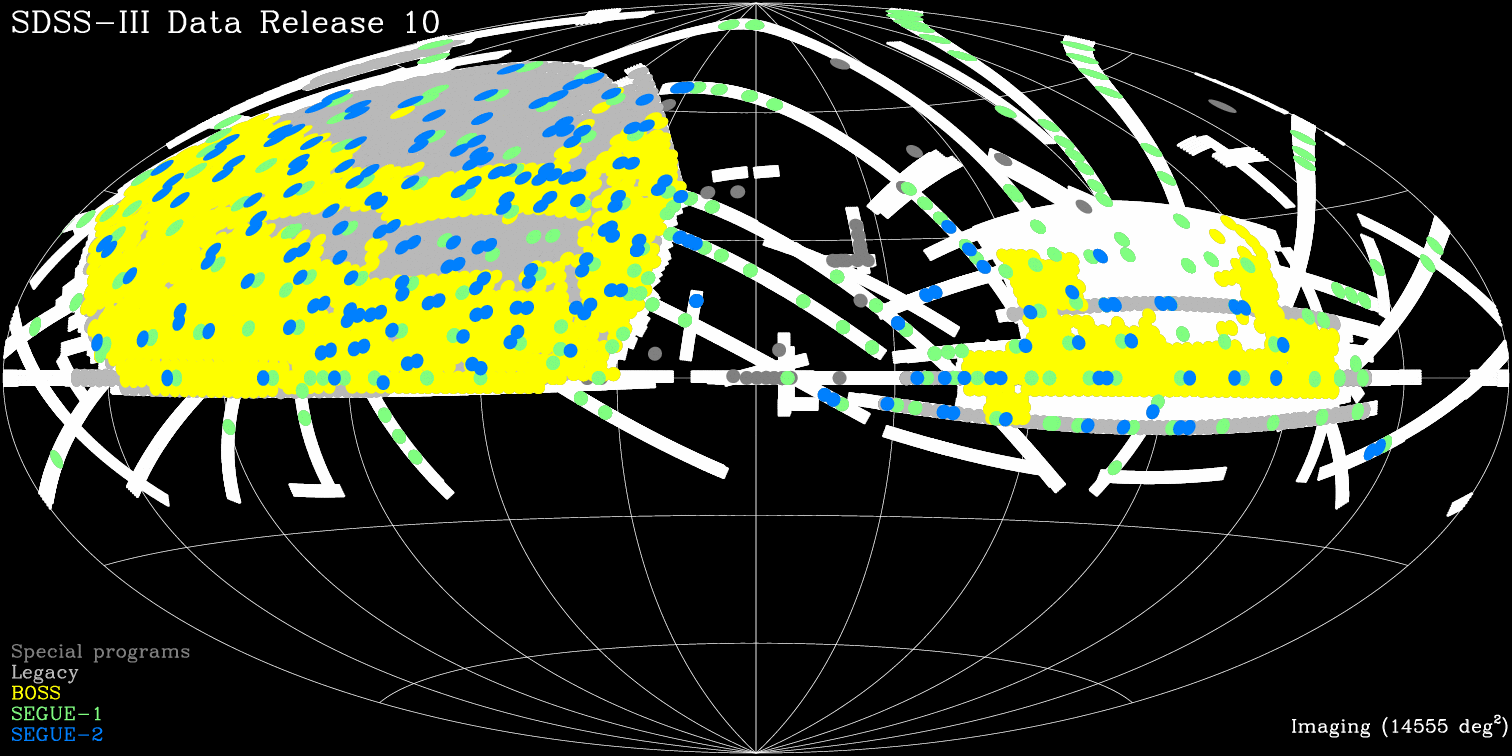
Sky coverage of the SDSS data contained in DR10
The original data from Galaxy Zoo was included in the SDSS Data Release 8. That’s quite important for a couple of reasons. It makes it much easier for scientists to use the GZ data, since SDSS uses this as the input for their own database, called CasJobs. This database enables matching of morphologies to other properties of the galaxies that SDSS measures, such as color or size. It also provides one of the main means of access to the data for people who aren’t members of the Galaxy Zoo team. Finally, it’s a validation that your GZ classifications have become a core data product of the survey, and something which is worth preserving and sharing as widely as possible.
In DR10, we’re happy to announce that data from Galaxy Zoo 2 is available for the first time. The reduction and description of the data is covered in a recent paper, which received a very favorable referee report a couple of weeks ago and will be resubmitted soon. We’ll share the paper as soon as it’s been formally accepted. The GZ2 data will also be hosted on our own site within Galaxy Zoo in the near future.

Galaxy Zoo 2 data is now on CasJobs!
Please check out DR10 if you’re interested in peeking at the GZ2 data – do acknowledge both Willett et al. (GZ2) and Ahn et al. (DR10) if you end up using it, though. Congratulations to the SDSS team on this new release!
Next GZ (Tools!) Hangout: Wednesday 24th July, 20:30 GMT

With the Quench project well underway and the start of the next phase of the project around the corner, it’s time for another hangout — this time with a focus on using the new Zoo Tools data analysis suite to work with Quench data!
We’ll start at 15:30 CDT (Chicago), which is 13:30 PDT, 16:30 EDT, 20:30 GMT, 21:30 BST, 22:30 CET, and 23:30 CAT. That’s getting a bit late for Europe and Africa, but if you can’t make the hangout on the day, don’t worry, we’ll post the recording of it as soon as possible.
Have questions? Post them here or tweet at us (@galaxyzoo). Just before the hangout starts, we’ll embed the video here so you can watch from the blog. And feel free to try out tools.zooniverse.org (and check out the Zooniverse blog post about it) beforehand!
The best way to send us a comment during the live hangout is to tweet at us, but you can also leave a comment on this blog post, or on Google Plus, Facebook or YouTube, which we’ll also try to keep an eye on. See you soon!
Note: if you’d prefer a text-based tutorial, check out this Zooniverse blog post.
Zoo Tools: A New Way to Analyze, View and Share Data
Your Galaxy Zoo data can be explored using our new Zoo Tools site. It’s currently in beta (meaning it’s not perfect!) but if you’re interested in plotting and sharing data, you should give it a try.

Since the very first days of Galaxy Zoo, our projects have seen amazing contributions from volunteers who have gone beyond the main classification tasks. Many of these examples have led to scientific publications, including Hanny’s Voorwerp, the ‘green pea’ galaxies, and the circumbinary planet PH1b.
One common thread that runs through the many positive experiences we’ve had with the volunteers is the way in which they’ve interacted more deeply with the data. In Galaxy Zoo, much of this has been enabled by linking to the Sloan SkyServer website, where you can find huge amounts of additional information about galaxies on the site (redshift, spectra, magnitudes, etc). We’ve put in similar links on other projects now, linking to the Kepler database on Planet Hunters, or data on the location and water conditions in Seafloor Explorer.
The second part of this that we think is really important, however, is providing…
View original post 1,026 more words
Galaxy Zoo Quench: A New Kind of Citizen Science
Yesterday, we launched a new Galaxy Zoo side-project: Quench. Read all about it in this Zooniverse blog post:
A new ‘mini’ project went live yesterday called Galaxy Zoo Quench. This project involves new images of 6,004 galaxies drawn from the original Galaxy Zoo. As usual, everyone is invited to come and classify these galaxies, but this project has a twist that makes it special! We hope to take citizen science to the next level by providing the opportunity to take part in the entire scientific process – everything from classifying galaxies to analyzing results to collaborating with astronomers to writing a scientific article!

Galaxy Zoo Quench is examining a sample of galaxies that have recently and abruptly quenched their star formation. These galaxies are aptly named Post-Quenched Galaxies. They provide an ideal laboratory for studying galaxy evolution. So that’s exactly what we want to do: with the help of the Zooniverse community. We hope you’ll join us as we try out a new kind of citizen science project…
View original post 122 more words
Vote for the Cover Image of October “Astronomy and Geophysics”

Jun 2013 Edition of A&G
We are pleased to announce an open vote for the cover image of the October 2013 issue of “Astronomy and Geophysics” (the magazine of the Royal Astronomical Society).
A write-up of the Specialist Discussion the science team ran at the Royal Astronomical Society in May on “Morphology in the Era of Large Surveys” is going to appear in the October issue of A&G , so we were asked to nominate a cover image for this issue.
Rather than just have the science team pick our favourite image, we thought it would be nice to open up the choice to our volunteers. After all it’s you that make Galaxy Zoo special, and a unique way of dealing with morphology in the era of large surveys.
So we have put together five images for you to vote on. These are images which would make good covers for the magazine, and which the science team think either have a special connection to the Galaxy Zoo project, or illustrate something special about Galaxy Zoo and its contributions to the understanding of galaxy evolution. Subject to final approval by the editors, the image that wins this vote will appear on the cover of A&G for October 2013.
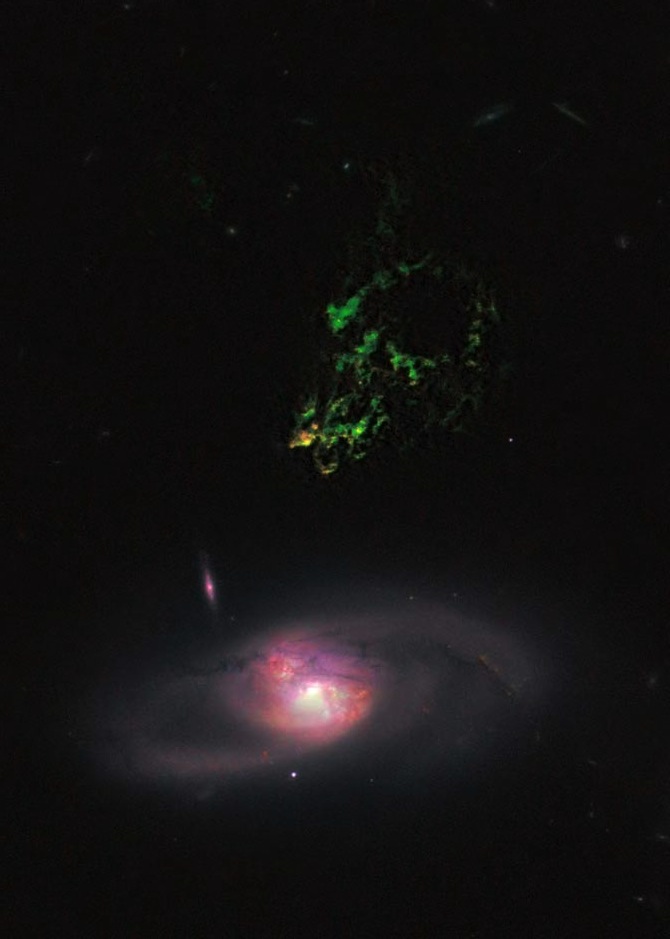
1. Hanny’s Voorwerp – Nominated by PI of the Zooniverse, Chris Lintott (@chrislintott): “Hanny’s Voorwerp is the iconic Galaxy Zoo discovery, the find that demonstrated that as well as systematically classifying galaxies volunteers could serendipitously find marvelous things. A galaxy-scale glowing cloud of hot gas, it tells us that IC 2497, its neighbour, was home to a rapidly feeding black hole perhaps as recently as 50,000 years ago. Hanny’s find inspired astronomers all over the world to point their telescopes at it, and a search for similar objects which has paid spectacular rewards.”

2. NGC 3314 – Nominated by GZ Science Team Member Bill Keel (@NCG3314): “NGC 3314 is a rare superposition of galaxies at different distances, allowing us to measure the effects of dust in the foreground galaxy with unusual clarity. Galaxy Zoo participants made a powerful contribution to this kind of science, by helping to select a catalog of nearly 2000 overlapping-galaxy pairs, many of which have been the targets of further study to help understand how the content and distribution on galaxies change with galaxy structure and size. Furthermore, they are just plain cool.”
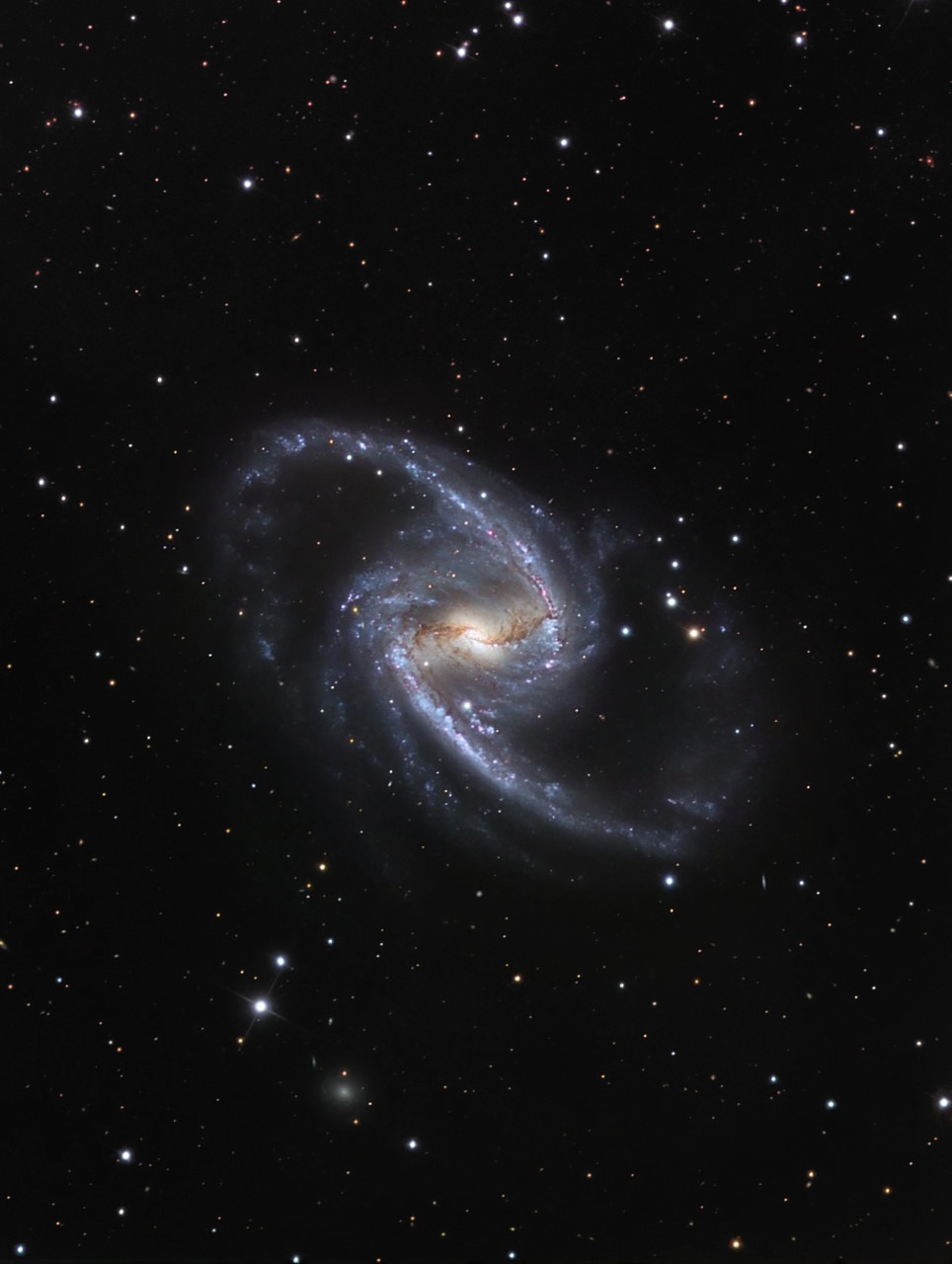
3. NGC 1365 – Nominated by GZ Project Scientist, Karen Masters (@KarenLMasters): “NGC 1365 is beautiful big barred spiral galaxy in the Fornax constellation. Galaxy Zoo classifications of bars in spiral galaxy have contributed to a growing realisation of the important role bars play in the evolution of galaxies, including a possible role in turning spirals red.”
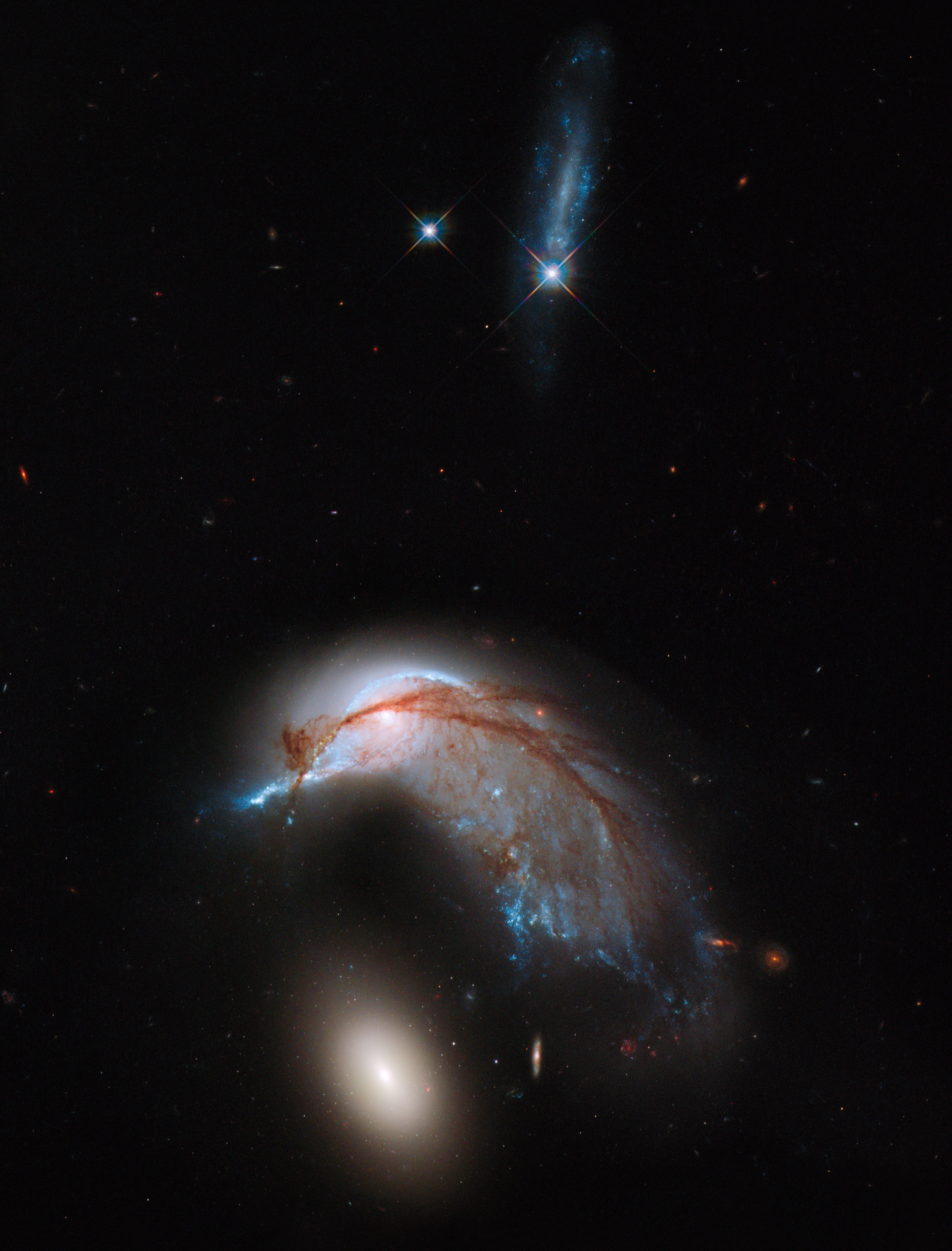
Arp 142, aka the Penguin Galaxy – Nominated by GZ Forum and Talk moderator, Alice Sheppard (@penguingalaxy), who treasures this as her first interesting find from when Galaxy Zoo was first born. Illustrating the fun side of Galaxy Zoo, which involves a zoo of galactic animals and an alphabet of galactic letters, the “penguin” resembles a bird admiring its egg. It was first classified by Halton Arp as a peculiar galaxy: a spiral with lanes of dust and star formation bent out of shape by the intense gravity of an elliptical, and more recently imaged by the Hubble Space Telescope and horrifyingly mis-species-ed by APOD as a porpoise.

5. The Sombrero Galaxy – Nominated by Rob Simpson (@orbitingfrog) from the Zooniverse: “The Sombrero galaxy illustrates really well that galaxies aren’t just filled with stars but also dust. In the Sombrero you can see the thin ring of dust neatly contained inside the disk. This is where the raw material for star formation comes from and we can probe this colder stuff using infrared and submillimetre telescopes. ” The Sombrero also illustrates than not all galaxies fall simply into either spiral or elliptical categories.
Galaxy Zoo Quench – Experience the Full Scientific Process
Experience Science from Beginning to End! Classify, Analyze, Discuss, and Collaboatively Write an Article!
Galaxy Zoo and other Zooniverse projects have given thousands the opportunity to contribute to scientific research. It’s time to take the role of volunteers to the next level. For the next two months*, this new Galaxy Zoo Quench project provides the opportunity to take part in the ENTIRE scientific process – everything from classifying galaxies to analyzing results to collaborating with astronomers to writing a scientific article!
Galaxy Zoo Quench will examine a sample of galaxies that have recently and abruptly quenched their star formation. These galaxies are aptly named Post-Quenched Galaxies. They provide an ideal laboratory for studying how galaxies evolve from blue, star-forming spiral galaxies to red, non-star-forming elliptical galaxies. Using the more than a million galaxies in the Sloan Digital Sky Survey, we identified ~3000 post-quenched galaxies. By classifying these galaxies and analyzing the results, we will explore the mechanisms that quenched their star formation and investigate the role of post-quenched galaxies in galaxy evolution.

The entire process of classifying, analyzing, discussing, and writing the article will take place over an 8 week period*, beginning July 18th. After classifying the galaxies, volunteers will use the tools available within Zooniverse to plot the data and look for trends. Through reading articles and interaction in Talk, volunteers will gain background information. Throughout, they’ll discuss with the science team their interpretation of the results. At the end of the process, volunteers and the science team will collaboratively write a 4-page Astrophysical Journal article.

What causes the star formation in these galaxies to be quenched? How do interactions impact galaxy evolution? What is the fate of our Milky Way? Join us this Summer (or Winter if you’re below the equator!) in exploring these questions, being a part of the scientific process, and contributing to our understanding of this dynamic phase of galaxy evolution!

CLICK HERE TO PARTICIPATE!
We’ll be sharing more details about this project during the next Galaxy Zoo Hangout, on Monday, July 15th at 14:00 CST / 19:00 GMT / 20:00 BST. Have questions about the project? Post them here or tweet at us (@galaxyzoo). Just before the Hangout starts, we’ll embed the video here so you can watch from the blog.
The best way to send us a comment during the live Hangout is through twitter (@galaxyzoo). You can also leave a comment on this blog post, or on Google Plus, Facebook or YouTube. See you soon!
Update: here’s the hangout (and the mp3 version)!
*Note: science timelines often subject to a factor of two uncertainty. We’ll do our best to keep on track, at the same time expecting the unexpected (all part of the fun of doing science!).
Zooniverse Live Chat
This just in: join the Zooniverse (including Galaxy Zoo) for a live hangout tomorrow from Chicago!

A small team of scientists and developers from across the Zooniverse are gathered at Adler Planetarium in Chicago this week to pitch and work on ideas for advanced tools for some of your favorite Zooniverse projects. Our goal is to come up with some tools and experiences that will help the Zooniverse volunteers further explore, beyond the scope of the main classification interfaces, the rich datasets behind the projects in new and different ways. As part of the three days of hacking, there will be a live chat with representatives from Galaxy Zoo, Planet Hunters, Snapshot Serengeti, and Planet Four (as well as a special guest or two) tomorrow Thursday July 11th at 2pm CDT ( 3 pm EDT, 8 pm BST). We’ll also give you an inside peek into the US Zooniverse Headquarters on the floor of the Adler Planetarium where much of the coding and…
View original post 51 more words
Zooniverse blog from #ZooCon13
In case you missed it, there’s plenty of Galaxy Zoo in @chrislintott‘s blog from #zoocon13
ZooCon Oxford is Tomorrow!

After a very busy week, I’ve suddenly had the happy realization that ZooCon ’13 (in Oxford) is tomorrow.
Okay, it’s not like I had completely forgotten about it – I’ve been thinking about what I want to say in my talk and discussing the schedule with the other organizers for a while now – but what a lovely feeling to suddenly connect that the thing you’ve been looking forward to as an opportunity to meet some interesting people and talk about interesting stuff is less than 24 hours away!
There’s still time to register: just go to the Eventbrite page and sign up (it’s free!) and we’ll see you tomorrow.
I’m planning to talk mostly about the future of Galaxy Zoo, including CANDELS and other projects as well as interesting new tools to enable different kinds of collaborative science, including volunteer-led science. But I’m most looking forward to the other talks, which will include updates from Old Weather, Space Warps and Planet Four.
What are you most looking forward to?
(Besides the pub afterwards, of course!)
 Galaxy Zoo