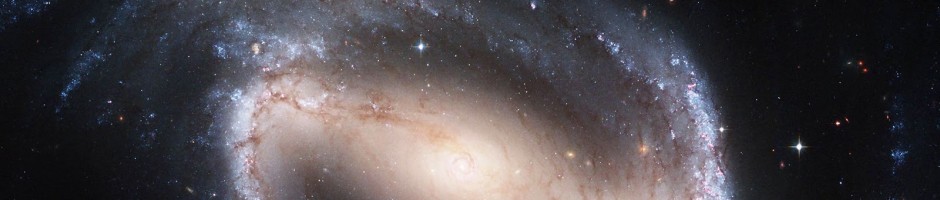
Galaxy Zoo Quench – Experience the Full Scientific Process
Experience Science from Beginning to End! Classify, Analyze, Discuss, and Collaboatively Write an Article!
Galaxy Zoo and other Zooniverse projects have given thousands the opportunity to contribute to scientific research. It’s time to take the role of volunteers to the next level. For the next two months*, this new Galaxy Zoo Quench project provides the opportunity to take part in the ENTIRE scientific process – everything from classifying galaxies to analyzing results to collaborating with astronomers to writing a scientific article!
Galaxy Zoo Quench will examine a sample of galaxies that have recently and abruptly quenched their star formation. These galaxies are aptly named Post-Quenched Galaxies. They provide an ideal laboratory for studying how galaxies evolve from blue, star-forming spiral galaxies to red, non-star-forming elliptical galaxies. Using the more than a million galaxies in the Sloan Digital Sky Survey, we identified ~3000 post-quenched galaxies. By classifying these galaxies and analyzing the results, we will explore the mechanisms that quenched their star formation and investigate the role of post-quenched galaxies in galaxy evolution.

The entire process of classifying, analyzing, discussing, and writing the article will take place over an 8 week period*, beginning July 18th. After classifying the galaxies, volunteers will use the tools available within Zooniverse to plot the data and look for trends. Through reading articles and interaction in Talk, volunteers will gain background information. Throughout, they’ll discuss with the science team their interpretation of the results. At the end of the process, volunteers and the science team will collaboratively write a 4-page Astrophysical Journal article.

What causes the star formation in these galaxies to be quenched? How do interactions impact galaxy evolution? What is the fate of our Milky Way? Join us this Summer (or Winter if you’re below the equator!) in exploring these questions, being a part of the scientific process, and contributing to our understanding of this dynamic phase of galaxy evolution!

CLICK HERE TO PARTICIPATE!
We’ll be sharing more details about this project during the next Galaxy Zoo Hangout, on Monday, July 15th at 14:00 CST / 19:00 GMT / 20:00 BST. Have questions about the project? Post them here or tweet at us (@galaxyzoo). Just before the Hangout starts, we’ll embed the video here so you can watch from the blog.
The best way to send us a comment during the live Hangout is through twitter (@galaxyzoo). You can also leave a comment on this blog post, or on Google Plus, Facebook or YouTube. See you soon!
Update: here’s the hangout (and the mp3 version)!
*Note: science timelines often subject to a factor of two uncertainty. We’ll do our best to keep on track, at the same time expecting the unexpected (all part of the fun of doing science!).
Zooniverse Live Chat
This just in: join the Zooniverse (including Galaxy Zoo) for a live hangout tomorrow from Chicago!

A small team of scientists and developers from across the Zooniverse are gathered at Adler Planetarium in Chicago this week to pitch and work on ideas for advanced tools for some of your favorite Zooniverse projects. Our goal is to come up with some tools and experiences that will help the Zooniverse volunteers further explore, beyond the scope of the main classification interfaces, the rich datasets behind the projects in new and different ways. As part of the three days of hacking, there will be a live chat with representatives from Galaxy Zoo, Planet Hunters, Snapshot Serengeti, and Planet Four (as well as a special guest or two) tomorrow Thursday July 11th at 2pm CDT ( 3 pm EDT, 8 pm BST). We’ll also give you an inside peek into the US Zooniverse Headquarters on the floor of the Adler Planetarium where much of the coding and…
View original post 51 more words
Zooniverse blog from #ZooCon13
In case you missed it, there’s plenty of Galaxy Zoo in @chrislintott‘s blog from #zoocon13
ZooCon Oxford is Tomorrow!

After a very busy week, I’ve suddenly had the happy realization that ZooCon ’13 (in Oxford) is tomorrow.
Okay, it’s not like I had completely forgotten about it – I’ve been thinking about what I want to say in my talk and discussing the schedule with the other organizers for a while now – but what a lovely feeling to suddenly connect that the thing you’ve been looking forward to as an opportunity to meet some interesting people and talk about interesting stuff is less than 24 hours away!
There’s still time to register: just go to the Eventbrite page and sign up (it’s free!) and we’ll see you tomorrow.
I’m planning to talk mostly about the future of Galaxy Zoo, including CANDELS and other projects as well as interesting new tools to enable different kinds of collaborative science, including volunteer-led science. But I’m most looking forward to the other talks, which will include updates from Old Weather, Space Warps and Planet Four.
What are you most looking forward to?
(Besides the pub afterwards, of course!)
Clicking 10 Billion Years Into The Past
Astronomers use funny units. We have the light-year, which sounds like a time but is actually a distance. There’s the parsec, a historical (but still used) unit of distance that was famously mis-used as a time in Star Wars. And then there’s redshift, which is actually a velocity — distance divided by time — but which, because of the expansion of the universe, astronomers get to use as a proxy for distance.
While it may be convenient for us to use distance units where we set a mind-blowingly large number equal to 1, it doesn’t really help us communicate our work to the public. If I note that the galaxy images from CANDELS look a little different from the galaxies in the SDSS because the CANDELS galaxies are typically at a redshift of 2, that’s pretty meaningless. But it’s a little different to think of the fact that, when you classify a galaxy from CANDELS, you may be looking three-quarters of the way to the edge of the visible universe, and seeing the galaxy as it was 10 billion years ago.

Okay, that’s kinda cool.
During this hangout, we announced that your clicks and classifications of the CANDELS galaxies have been moving at such an impressive rate that the first round is finished. Every galaxy has enough classifications for us to get a very good sense of what its morphology is. It may be that, for some of the galaxies where there are clearly more details to flush out, we will ask for a few more classifications per galaxy. And there will probably be future CANDELS images from survey fields that are still being completed. So, don’t worry, there will still be plenty of opportunities to classify galaxies as they were 10 billion years ago!
In the meantime, though, we’re getting ready not just to do the scientific analysis, but to share Galaxy Zoo results with our colleagues around the world. The summer conference season is upon us, and many of us have given and are giving talks and posters at various meetings in various cities. This includes not just the recent meeting highlighting the importance of galaxy morphology in the era of large surveys at the Royal Astronomical Society and the upcoming ZooCon in Oxford and Galaxy Zoo meeting in Sydney, but also several more general conferences, including the 222nd American Astronomical Society meeting and the upcoming UK National Astronomy Meeting. Spreading the word about the scientific results we’re finding with Galaxy Zoo is one of the most important parts of our job — and it doesn’t hurt that in order to do that we have to visit some very interesting places. During the hangout we chatted a bit about that and also took some of your questions:
Note: although it was a beautiful sunny day in Oxford, the variable audio quality is not because I was occasionally distracted looking out the window. I don’t think it was the new microphone, either. We’ll look into it, but in the meantime I’ve tried to equalize the podcast version with some after-editing, so hopefully that is slightly better.
A Galaxy Zoo science team dinner
Almost a month ago now, Galaxy Zoo hosted a Specialist Discussion at the Royal Astronomical Society in London, on the topic of Morphology in the Era of Large Surveys. It was actually a wonderful day full of interesting talks and discussion, and we will be sharing more of the science content from the discussion as soon as we find time to put that together.
One of the other fun things about this meeting was that as well as the fantastic invited speakers, mostly from outside Galaxy Zoo collaboration, many members of the Galaxy Zoo science team were able to attend and contribute talks. We had representatives of team members from Minnesota, Oxford, Nottingham, Portsmouth, Hertfordshire and Zurich in attendance. It was a great chance for us to catch up both scientifically and socially. Below is a set of round table pictures we took during our “team dinner” that Friday night in London’s Chinatown. The captions always list names from left to right. The poor photography is entirely my fault!
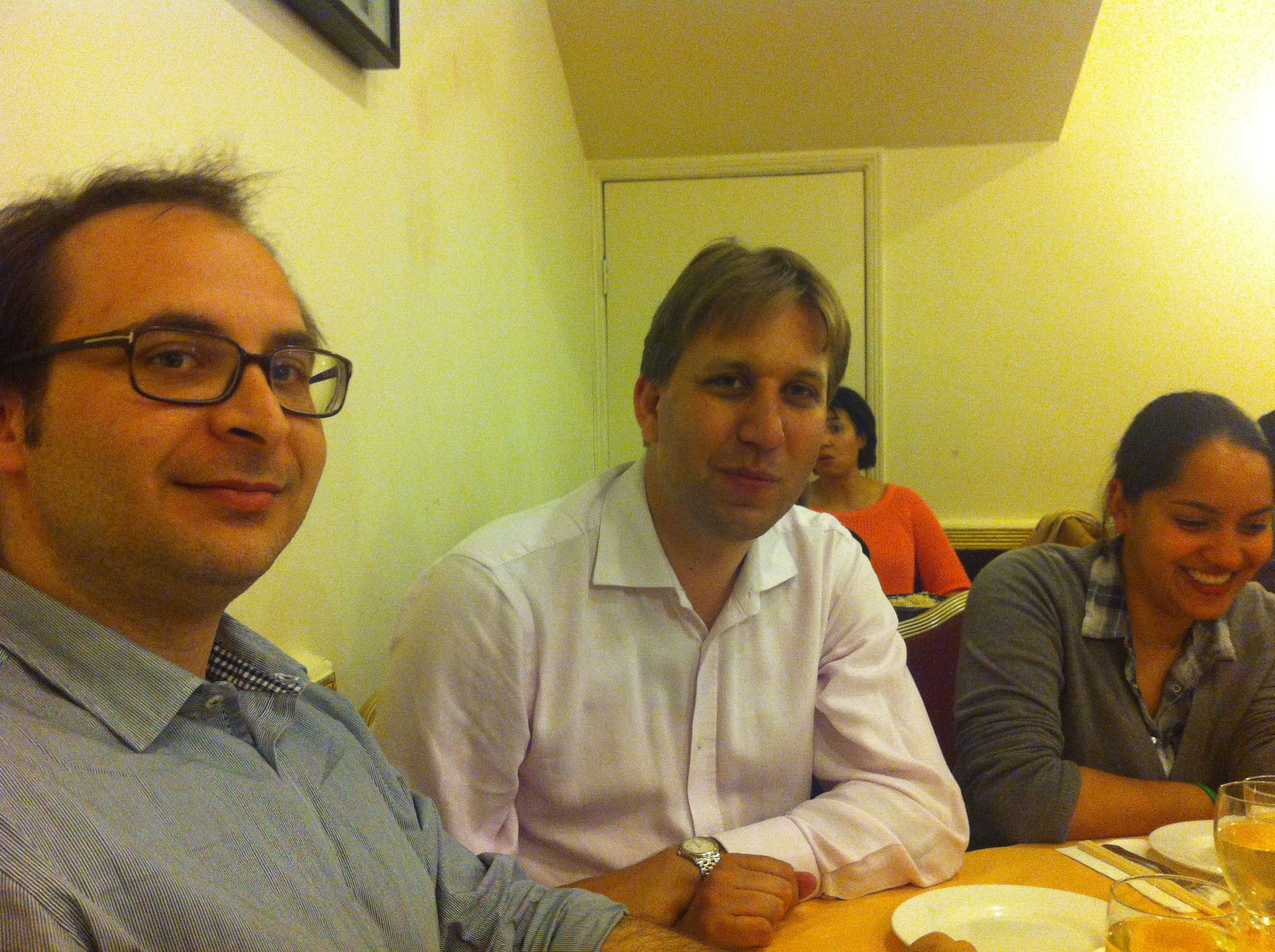
Kevin Schawinski (Zurich, Galaxy Zoo Co-founder); Chris Lintott (Oxford; Galaxy Zoo Co-founder and “PI of the Universe” – or maybe just the Zooniverse is enough); Jen Gupta (Portsmouth – Zooteach/Education)

Sugata Kaviraj (Oxford -> Hertfordshire, Dust lanes in early types and more); Tom Melvin (Portsmouth PhD student on redshift evolution of bars); Steven Bamford (Nottingham, GZ1 Data Guru, Colour-morphology and environment and more)

Kyle Willet (Minnesota; GZ2 Data Guru), Brooke Simmons (Oxford, Black Holes in Bulgeless Galaxies, Google+ Hangouts and much more), Boris Haussleur (Nottingham->Oxford; CANDELS team member)

Karen Masters (that’s me – Portsmouth, Galaxy Zoo Project Scientist), and back round to Kevin.
Next GZ Hangout: Thursday, June 6th, 15:00 GMT
It’s been a while since we’ve had a hangout — how about this Thursday?
8:00 PDT, 11:00 EDT, 15:00 GMT, 16:00 BST, 17:00 CET, 18:00 CAT. Have questions? Post them here or tweet at us (@galaxyzoo). Just before the hangout starts, we’ll embed the video here so you can watch from the blog.
The best way to send us a comment during the live hangout is to tweet at us, but you can also leave a comment on this blog post, or on Google Plus, Facebook or YouTube, which we’ll also try to keep an eye on. See you soon!
Updates to Talk
The good news: the developers are currently hard at work migrating Talk to the latest version, which has many improvements over the old version. When the update is finished, the Talk home page will contain lots more information about each new post (including thumbnails!), the discussions should be easier to navigate, and the collections will be easier to navigate and manage — just for a start. We’ve been looking forward to this upgrade for a while, and once it’s completed it will make discussions of your discoveries even better.
The bad news: Talk will be down for a few hours while the upgrade actually takes place. And, as with any significant update that includes changing the way your favorite website appears on a page, it may take some getting used to. But hang in there and you’ll find your way around. Also, please feel free to ask questions, either here or on Talk itself. (Also also, thanks for bearing with us.)
The other good news: The main classification site isn’t affected at all — so you can still classify galaxies to your heart’s content, without interruption!
Observing Run: Raw Data versus Finished Product
So let’s say you have a galaxy:
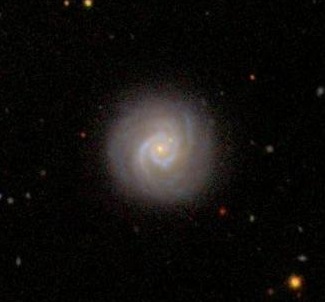
And you know this galaxy has a growing black hole, and probably hasn’t had any significant mergers, because it has very little, if any, bulge. Which means you have two questions: 1) what counts as significant? and 2) how little is very little?
To answer the first question, you’d like to look for the faint stellar streams that signify the remnants of a minor merger. The optical images you already have aren’t even close to deep enough to see something like this:
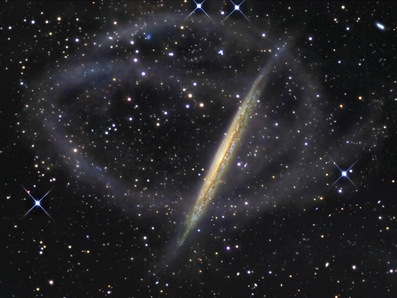
NGC 5907: the Splinter galaxy. Credit: R. Jay Gabany
But if you could see that for your galaxy, you could start to put together its minor merger history and answer that first question.
Of course, that kind of depth is not easy. The group that took that data most likely spent weeks observing that one source, and there are many technical challenges involved. You may be in luck, though: you have a bigger telescope, which means you probably only need one night to get a single-filter optical image at the same depth.
So you go to the telescope, and you take some data. After 5 minutes, this is what you have:

Which … doesn’t look so great, actually, until you clean it up a bit by correcting for the different effects that come with a huge mosaic of CCD chips, like different noise levels and so forth. Luckily, the people who wrote the code to observe with this instrument have provided a “first-look” button that automatically does that pretty well:
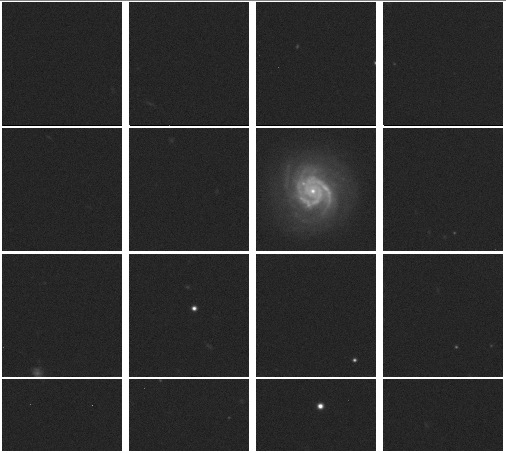
That’s better. You can see that even with 5 minutes of observing time, you’re close to the depth you already had. To get what you need, though, you don’t need 5 minutes of exposure. You need 5 hours.
But you don’t want to just set the telescope to observe for 5 hours and hit “go”. In fact, you can’t do that. If you do, those well-behaved little stars near your galaxy will be so bright on the detector that they’ll “saturate”, filling their pixels with electrons that then spill out into nearby pixels. This detector in particular doesn’t handle that very well, so you need to avoid that. And what if something happens in those 5 hours? What if a cosmic ray — or many — hits your detector? What if a satellite passes over? What if the telescope unwraps? While that looks kind of cool:

When the telescope rotates to +180 degrees, it stops tracking and goes -360 so that it can keep tracking from -180. Otherwise cables plugged in to walls + twirling round and round = unhappy telescope.
It wrecks the whole exposure. Plus, those chip gaps are right where your stellar streams might be. You’d like to get rid of them.
So you solve all of these problems at once by observing multiple exposures and moving the telescope just a little in between exposures.

This is called dithering.
You end up getting your 5 hours’ exposure time by doing lots of dithers — about 50 of them, to be exact, mostly between 5 and 10 minutes apiece. This has several advantages and a few disadvantages. You can throw out any weird exposures (like the unwrap above) without losing very much time, but then you have to combine 50 images together. And that, frankly, is kind of a pain.
And this is a new instrument, and the reduction pipeline (the routines you follow to make the beautiful finished product) doesn’t fully exist yet, and what does exist is complex — and, for the moment, completely unknown to you.
So the beautiful finished product will have to wait.
In the meantime, you have a few more galaxies to look at, and that second question to try and answer, on future nights and in a future blog post.
 Galaxy Zoo