A Galaxy Zoo – WorldWide Telescope Mashup
Have you ever found yourself staring proudly at the collection of beautiful and exotic galaxies that fill your favourites list? Have you ever wanted to share these objects with a friend or loved one and realized there was just no easy way to do it? Sure, you can click on the image, delve into SkyServer, and copy and paste one image at a time into an email, but… That gets kind of tedious pretty quickly, and if your favourites list is like mine, it’s not a 5-minute copy and paste kind of task.
Well, now there is an easier way to inflict your favourites on others.
We’re excited to announce the integration of WorldWide Telescope with Galaxy Zoo favorites. Over the past few months we have had the opportunity to work with Microsoft Research to bring your favorite galaxies to WorldWide Telescope. Instead of seeing an isolated image of the galaxy you can now immerse yourself in the WorldWide Telescope environment through easy to save and easy to share sky tours. We hope this allows you to better see your galaxies in their home environments on the sky.
This new tool, available at http://wwt.galaxyzoo.org, was created by two of my Southern Illinois University Edwardsville undergraduate students: sophomores Jarod Luebbert and Mark Sands. To give you a taste of how this interface works, they’ve created this great teaser video. We plan to push this out to the public on September 2, but because you’re reading this, you get a special sneak peak of both the website and the video.
Galaxy Zoo – WorldWide Telescope Mashup! from Galaxy Zoo on Vimeo.
She's an Astronomer: Gemma Coughlin

Zooites at the recent Greenwich Meeting. Gemma is the furthest on the right (in the white t-shirt). Also pictured (from left to right) Hanny (profiled earlier this series), Edd, 'Blackprojects', Thomas J, Bill Keel, Waveney (Richard Procter), and Jules (who will be profiled later in the series).
Gemma Coughlin (better known as “fluffyporcupine“) has been one of the Galaxy Zoo forum moderators since last December when Chris asked her to help out with the ever growing forum. Gemma is a postgraduate student at Cambridge University, studying for a PhD in Engineering. Her work aims to improve computer simulations of objects with complex geometries (for example simulations of cars moving through air) by trying to figure out a way to automate how the space is divided up into a mesh to put into the computer. This can have a significant effect on the result of the simulation, and is tricky and time consuming to do by hand.
Gemma is originally from Swansea in Wales, and did her undergraduate at Swansea University in Mechanical Engineering. Apart from stargazing, her main hobby is karate (she is a 1st Dan and has been Women’s captain at Cambridge). She also enjoys watching motorsort (mainly Formula 1) and Rugby (Cymru am byth!). Contrary to a popular theme on the forum (cats), she is very much a dog person and likes taking her dog for a walk on the beach when she goes home to Wales.
- How did you first hear about Galaxy Zoo?
I saw an article on the BBC news website, but the servers had already melted by the time I tried to sign up, so I registered a day or so after the start.
- What has been your main involvement in the Galaxy Zoo project?
I guess my main involvement has been as a chatter box on the forum! I classified a fairly large number of images on Zoo1, not quite so many on Zoo2 though. Other than that I have been a keen lens hunter (blog entry about lenses) and have helped with the peas. I am in the acknowledgments (along with the other members of the peas corps) for the Peas paper – I was the first person to point out that all the peas had a large OIII spike and that most seemed to be starforming galaxies or AGN.
- What do you like most about being involved in Galaxy Zoo?
The community without a doubt. I have learned so much from the forum – especially when one of those interesting/awkward images comes up to classify. Everyone is so patient and helpful (even if we disagree) and very free with a wealth of knowledge (and the beer at meet ups). Never thought I would meet so many kind and interesting people on the internet let alone for so many of them to become friends!
- What do you think is the most interesting astronomical question Galaxy Zoo will help to solve?
I think it will help greatly with Bill Keel’s study of dust in overlapping galaxies considering the number of times we’ve multiplied his sample size (from 20 to 1900 at last count)! I’d also like to add that I think the irregulars project (get involved here) is interesting as its entirely Zooites that are investigating them and they too are analysing a much larger sample size (N>9000) than previous studies (which has about 150, thanks for the numbers Alice!).
- How/when did you first get interested in Astronomy?
My dad showed me Saturn through a scope as a kid – that got me hooked. He still laughs at my reaction – the wow i can SEE the rings! (Editor’s note – Saturn really is impressive through a small telescope. Check out Sky and Telescope’s Guide to Saturn for some pictures, and if you’ve never seen it I really recommend you try!)
- What (if any) do you think are the main barriers to women’s involvement in Astronomy?
I guess it’s the same as with engineering, I don’t think maths and science are presented in an interesting way for girls at school and they are perceived as hard, rigid, dusty disciplines. I guess they are hard, but that makes it all the more special when you achieve something. I know it’s not for everyone, but if people could see more clearly at a young age how many cool things you can do with maths and science and the sense of achievement you get from problem solving, that they aren’t dry subjects that you learn by rote and that there are still many interesting things to discover, I’m sure a lot more people would be interested, be they women or men.
A friend and I spent GCSE maths turning the more boring GCSE maths questions in to problems about racing cars and our favorite F1 drivers! My interest in engineering really started because I got drawn into (fast) cars and was fascinated by how they work and the engineering that goes into them to do what they do! For example, did you know that an F1 car can generate enough downforce to equal its weight, so it could theoretically drive on the ceiling in a tunnel!
- Do you have any particular role models in Astronomy?
I guess it has to be the Zookeepers! Not only for the way that came up with a way of answering the questions they were interested in, but for coping with the monster they have created in the Zoo! Can’t be an easy job keeping 200,000 people on your good side.
This post is part of the ongoing She’s an Astronomer series on the Galaxy Zoo Blog is support of the IYA2009 cornerstone project of the same name (She’s an Astronomer). We are listed on the She’s an Astronomer website in their Profiles.
This is the fifth post of the series. So far we have interviewed
- May 1st 2009: Hanny Van Arkel (Galaxy Zoo volunteer and finder of Hanny’s Voorwerp).
- June 1st 2009: Dr. Vardha Nicola Bennert (researcher at UCSB involved in Hanny’s Voorwerp followup and the “peas” project).
- July 1st 2009: Alice Sheppard (Galaxy Zoo volunteer and forum moderator).
- July 27th 2009: Carie Cardamone (graduate student at Yale who lead the Peas paper).
Still to come in the series – more Galaxy Zoo volunteers and researchers, including our next interview which will be with original team member, Dr. Kate Land.
Back at IRAM 30m…

Hi all. I’m at the IRAM 30m telescope for the third time this year this time measuring the CO content in elliptical galaxies. This follows on from Kevin’s long-standing work of using blue elliptical galaxies to test whether or not AGN (Active Galactic Nuclei) are responsible for dispelling gas and thus putting an end to star formation. Theoretical models suggest that this must be the case and this ongoing project to measure exactly how much CO gas is in such galaxies is aiming to verify this. This is accomplished by measuring how much CO is in elliptical galaxies that show no signs of AGN activity and similar galaxies which do have signs of AGN activity. The theory is that, those galaxies with AGN activity will show low quantities of gas relative to their size.
The weather has been very good so far and we are on schedule here to get measurements for all 30 galaxies we asked for despite only being allocated about 3/4 the requested time! With so many measurements, we should hopefully get the statistical significance we need to confirm the theory.
Galaxy Zoo Paper on Dust in Spirals Submitted.
Before Kevin starts sending me friendly emails that I haven’t blogged about this yet, I want to announce the submission of the latest Galaxy Zoo paper (submitted to Monthly Notices on August 17th):

I’m delighted that I finally got this work submitted. Now I feel like I can properly call myself part of the Galaxy Zoo team. My first entry on the blog Blue Sky and Red Spirals was about this work, and you can also check out the scientific poster I made about it. I hinted several times over the past 8 months that we were very close to submission, so it’s great to be able to say it’s actually now in the referee process. I actually think this is one of the quickest papers I’ve ever written – only 10 months from when I started working on it, to submission of the paper. Fingers crossed for an equally smooth referee process.
Our main conclusions ended up being:
- Spiral galaxies are reddened as they become more inclined due to the presence of dust (this effect is explained in great detail in Blue Sky and Red Spirals)
- Spiral galaxies with large bulges are much redder than spiral galaxies with no/small bulges. This effect is larger than the dust reddening – face-on spirals with large bulges are redder than edge-on spirals with no bulge (on average).
- There is more dust reddening in spiral galaxies with small bulges than in those with large bulges.
- There is a peak in the dust content of spirals at moderate luminosities. Very luminous and very dim spirals both have less dust reddening. Very dim spirals are physically smaller, and make less dust than brighter ones. Very bright spirals usually don’t have a lot of recent star formation, and as dust is destroyed over time we may just be seeing that effect.
We compared the observed trends to a model published in 2004 (Tuffs etal. 2004: Attenuation of Stellar Light in Spiral Galaxies for the very keen!) and concluded that it works pretty well (especially considering how much you have to simplify a spiral galaxy to be able to model it), but there are some problems at the shortest wavelengths covered by SDSS – we see a lot less reddening there than the model predicts.
We finished by talking about the impact all these things have on galaxy surveys. It’s a fairly small effect, but because dust always dims galaxies that means that inclined spirals are often “left out” of samples which people use to study cosmology, or do galaxy evolution (just because you can’t see them, or they’re below a cut in brightness you needed to make). I don’t think I need to tell this crowd that spiral and elliptical galaxies are quite different objects, they also have different clustering properties. So if you preferentially leave out some of the spirals that could introduce some subtle biases, which when people are trying to use galaxy surveys to get percent level accuracy on cosmological parameters might actually start to matter!
Man vs Machine?

Manda’s paper on improving automatic galaxy classification seems to have caused quite a bit of concern and comment. Is the future of the Zoo portrayed above, with an out-of-control machine wrecking all we’ve come to hold dear? After all, we’ve always believed it important that we don’t waste your time by having you do tasks that computers are perfectly capable of completing. Are the Zookeepers putting the Zoo out of business?
Read More…
Machine learning paper now available
Just a quick note that Manda’s submitted paper on machine learning is now available on astro-ph.
Galaxy Zoo Supernovae from a technical standpoint
I’ve just finished writing up some of the more technical details associated with our recent supernova hunt. If you’re interested in how it all worked behind the scenes then head over here…
Cheers
Arfon
New supernovae found!
After a couple of exposures, we are happy to say that we believe the object mentioned previously is a young supernova. This is great news.
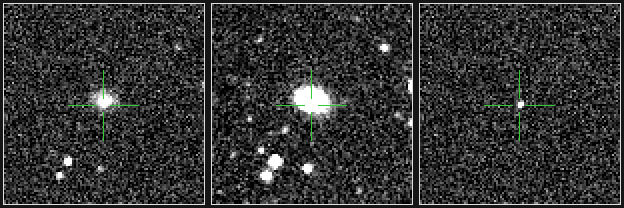
Mark and I thought we would give you better feel for what we are doing here by showing you something visual to have a look at. This our latest target, which we are confident is also a supernova from our raw data. What you can see here are the images of this object as they appear on the zoo. This is a great example of what a supernova will look like in the zoo images. The reason for this is that you can see some structure in the host of the supernova. In general if the transient object appears as in a blob, rather than a perfect circle, it is far more likely to be a real supernova, than a variable star. Although this is not a solid rule of supernovae screening, it is always good to know.
Thank you all for helping to make this observing run a real success. We will be sure to let you know our supernovae grand total soon enough but for now we are looking at in excess of 20 new supernovae. Let’s see if we can catch a few more!
Sarah
WHT supernovae finds update
Just over half way through or night and we are doing well again, in spite of some technical adversity early on. Our next target is a very exciting target. It is either a very new supernovae that has only been around for a few days, or it could be an asteroid. Here at WHT we are certainly hoping for this object to be a young supernovae.
So, why are new supernovae so good? Well, to begin with we want to know as much about supernovae as possible and the best way to do that is to catch them early and follow them. Certainly if this object is what we hope it is, it will be a good candidate for future follow up.
This really is some exciting science! Stand by for an update on what we find!
Sarah :0)