Planning for the Future of Galaxy Zoo – Science Team Meeting at ISSI
A large fraction of the Galaxy Zoo Science Team will be gathering at the International Space Science Institute (or ISSI) later this month to discuss the future of Galaxy Zoo, and in particular to work on the next phase of Galaxy Zoo now that there are large numbers of distant galaxies with publicly available JWST images.

This is part of a series of two funded meeting at ISSI that the Galaxy Zoo team was awarded with the goal of working on the next phases of Galaxy Zoo: JWST.
As the saying goes, if it isn’t broken don’t fix it. But also Galaxy Zoo has a tradition at being at the forefront of galaxy morphology techniques. So we want to use this meeting as an opportunity to spend some time reassessing the entire method that Galaxy Zoo pioneered back in 2007, when it was still a new idea to invite volunteers to participate in online image analysis. Our understanding of how to analyze your votes has evolved a lot over the last 17 years and across the more than 70 peer-reviewed publications the team has worked on. The status of machine learning methods for galaxy image analysis has also changed significantly, so it makes sense to reassess the most effective approach for humans and machines to collaborate on understanding the shapes and structures of galaxies.
The Galaxy Zoo science team has always been really international and distributed, with astronomers based all over the world. We are all really excited that ISSI has provided funding for us to have this rare gathering in person. We hope that by spending a week working together in person we can have some really productive discussions around the future of the project. We also have specific plans to work on getting the JWST images ready for your classifications as well as analyzing the results from the JWST:CEERS images you have already classified using our standard method.
As always we welcome volunteer input, not just via your classifications, but if you have opinions on what you would like to see in future versions of Galaxy Zoo, we invite you to share them on the Talk Forum.
Return of Galaxy Zoo Mobile
Galaxy Zoo Mobile is back!
This time, we have two challenges for you; understanding rings and finding gravitational lenses. Both can be accessed through the Galaxy Zoo Mobile project on the Zooniverse app. Dive in and start swiping!
Get the Zooniverse app on Android iOS and find Galaxy Zoo under ‘All Projects’ or ‘Space’. You can also use your browser if you prefer.
Understanding Rings
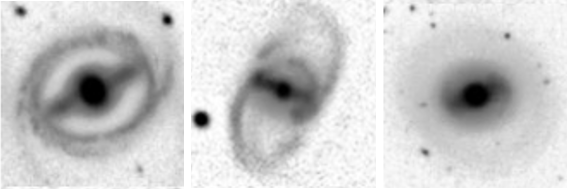
You already helped us find ringed galaxies; galaxies with a ring of stars around them. But there are many ways to “have a ring”; detached rings, pseudo rings and winding rings to name a few! Help us divide the ringed galaxies you found into all these different types.
We’re also on the lookout for anything truly weird, as we know there are bound to be some crazy never-before-seen ring structures out there. The images you will see are the most likely to have rings from a suite of 9 million galaxies – so you’re going to see some truly spectacular shapes and sizes.
We don’t know how rings work. Help us find out.
Finding Gravitational Lenses
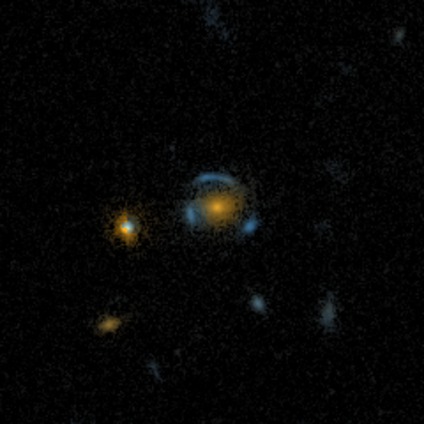
Following on from the success of one of Galaxy Zoo’s latest iterations, Galaxy Zoo: Cosmic Dawn, we want to double-down on identifying all images containing a very rare type of object: gravitational lenses. These are galaxies surrounded by the light of a second galaxy directly behind them, with gravity distorting this light into beautiful arcs and rings. These objects can be used to help shed a light on dark matter and the early Universe, if we can find them!
For some of Galaxy Zoo: Cosmic Dawn, we used AI to help speed up the classification process and let you focus on the most interesting images. But our AI doesn’t understand rare objects like gravitational lenses, many of which may have been missed as a result. So, we ask you to take part in identifying these elusive objects hidden in over 20,000 Hyper-Suprime Cam (HSC) images from the Hawaii Two-0 (H20) Cosmic Dawn survey. Start searching on the Zooniverse app.


Thank you, as always, for your time and support.
James P, (also) James D, and Mike, on behalf of the Galaxy Zoo team
Galaxy Zoo DESI Published
I’m thrilled to announce the release of Galaxy Zoo DESI; detailed morphology classifications for all 8.7 million well-resolved galaxies in the DESI Legacy Surveys. This is the largest detailed catalogue ever made (by an order of magnitude).
Today is the end of a long road. GZ DESI is being released eight years to the day after the first DESI images went live on Galaxy Zoo. It took four ‘generations’ of astronomers – Kyle Willett, Coleman Krawcyzk, myself, and Tobias Geron – to keep the project running. And of course, it took all of you. At least 105,459 people* contributed their time to making GZ DESI happen. Thank you all.
Releasing GZ DESI is also the start of a new journey. Space telescope Euclid is in the sky and taking pictures. The Vera C. Rubin observatory should see first light within a year. Both will find tens of millions more galaxies – even more than DESI. But we’re ready. GZ DESI let us build and test the AI tools that now work alongside you. Those tools mean that every classification you make helps us classify every other galaxy as well. And we’re starting to imagine what new tasks – beyond classification – we might be able to do. But that’s for another blog 😉
On to the next telescope!
Mike, and the Galaxy Zoo team
*(unique logged-in Zooniverse accounts)
Take a Peek at Some JWST Images
Many different teams of scientists are using NASA’s latest space telescope, JWST, to image galaxies so far away that they are back at the earliest time galaxies appear in the Universe. Because these galaxies are quite a bit more distant than any we’ve classified before in Galaxy Zoo, we want to make sure we know how to ask the right questions about the shapes and types of galaxies present, and also make sure we get the image processing as good as possible before asking for your help classifying lots of them.
To get Galaxy Zoo started on classifying (we hope eventually) all of the distant galaxies in JWST imaging, we are running a pilot with just 8000 galaxy images from the Cosmic Evolution Early Research Science (CEERS) survey.

CEERS is using JWST to take extremely deep images of 100 sq. arcmin of the sky (which is about 1/8th the size of the Full Moon!). It is making use of JWST instruments called NIRCam, MIRI, and NIRSpec to obtain both images and spectra in this patch of sky. CEERS’ main goal is to demonstrate, test, and validate efficient extragalactic surveys with coordinated, overlapping parallel observations in a patch of sky which already has a lot of other multi-wavelength data (e.g. from the Hubble Space Telescope).
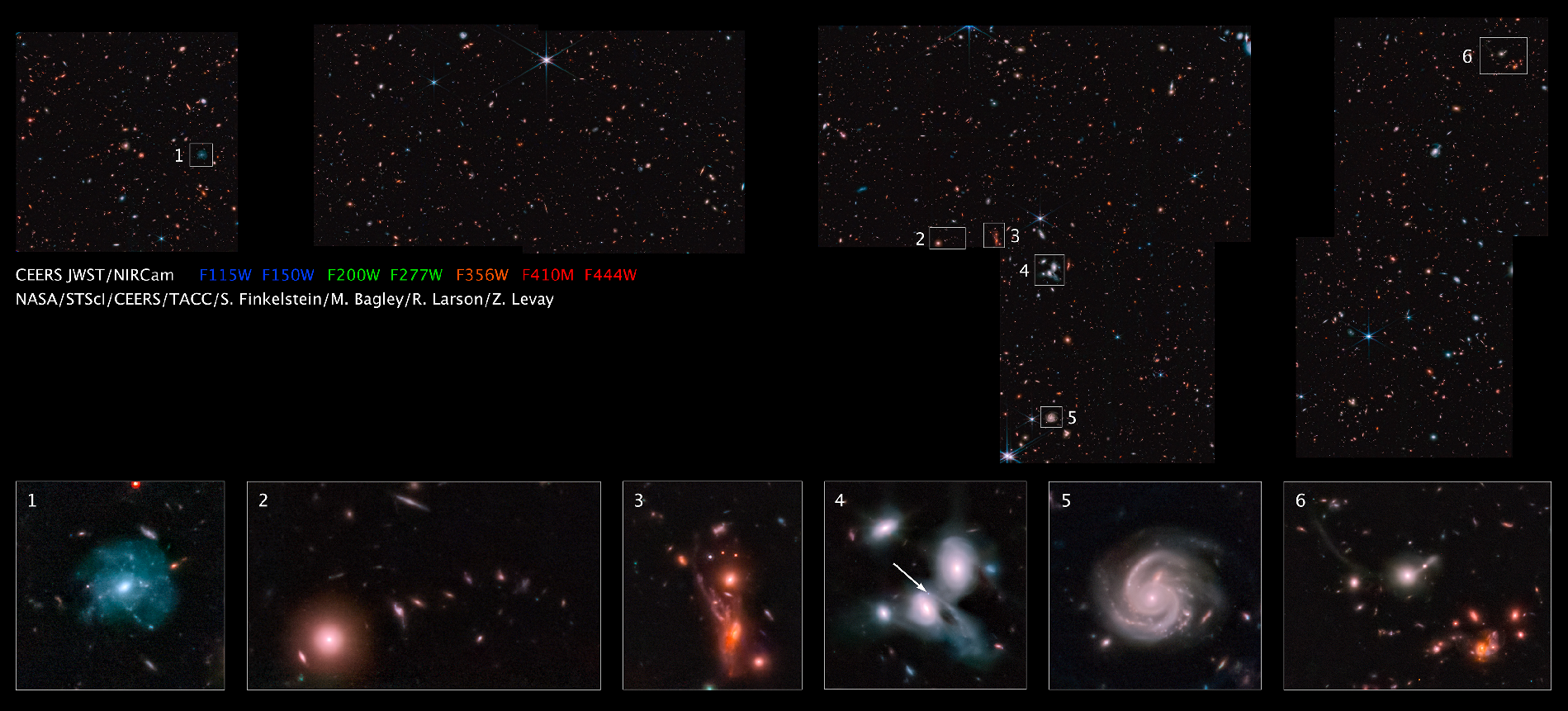
Even though the pilot sample is being put into Galaxy Zoo mainly as a test survey for future projects, we still expect that your classifications of these images will help us find out a lot about the type and number of galaxies at very high redshifts (z~9-13), look for early star formation, black hole growth and the assembly of bulges and discs in galaxies at z>3, and look for dust observed star formation and black hole growth at z~1-3. We also plan to see how well machine classifiers like Zoobot do at classifying these galaxies, so we can get them to help with the classification of future, larger collections of JWST galaxies.
These images are from the first CEERS public data release. We have coordinated with the CEERS team to make sure the images you see are optimized to bring out as much detail as possible, and that the questions we are asking will enable the best possible science. We hope you’ll enjoy seeing some of the most distant galaxies ever observed in the project. And, as always, thanks for all your hard work classifying. We appreciate every click you provide.
Introducing Your New AI Assistant
Of all the galaxies in the sky, which should you look at first?
You might have noticed that our most recent galaxies, taken by Hyper Suprime-Cam in Hawaii, have often been less detailed than our previous galaxies. This happened because we were very generous when selecting which galaxies to include. We had never classified galaxies from this instrument before and we were curious to see what you would find.
Reviewing the classifications so far, the clear majority of galaxies – as many as 90% – were voted as either “smooth” or “problem”. That suggests we’re showing you too many “blobs” and too few interesting featured galaxies.
To fix this, I’m happy to announce a new Galaxy Zoo feature that will prioritise showing you detailed and unusual galaxies.
We’re doing this with an AI algorithm we affectionately call Zoobot. Zoobot tries to classify galaxies based on what volunteers have said before for similar galaxies. If you’d like to test out Zoobot on some DECaLS galaxies, you can play with it here.
Zoobot is very good at simple classification tasks like recognising a smooth galaxy as smooth. We can therefore avoid showing you galaxies that Zoobot already considers to be very smooth. Specifically, we will now avoid showing galaxies where Zoobot is 90% confident that fewer than 2 out of 10 volunteers would click “featured”.
How will the galaxies you see change? You will see fewer totally smooth galaxies and more of everything else. Below are random examples of galaxies on Galaxy Zoo before (left) and after (right) switching on Zoobot.

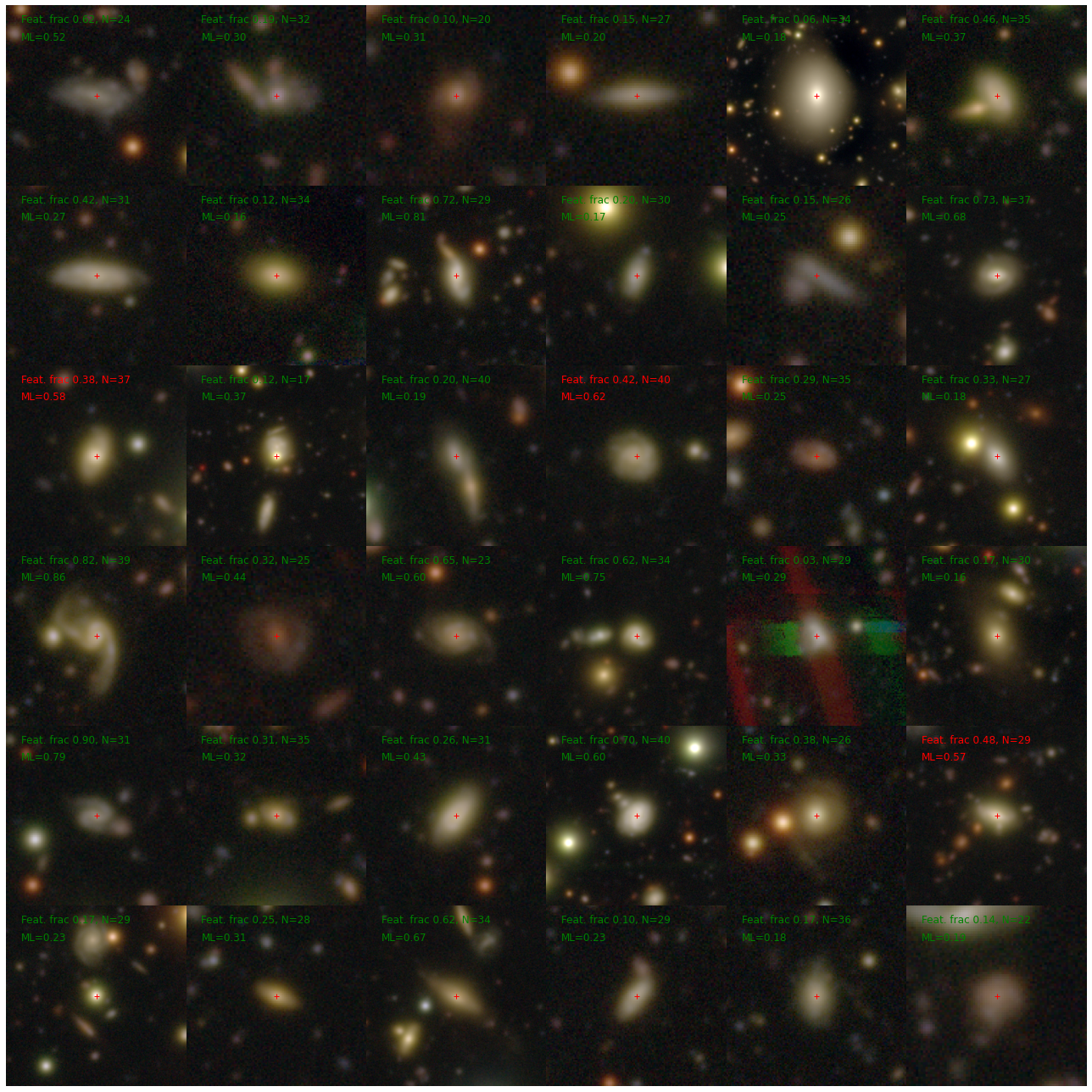
Galaxies shown on Galaxy Zoo before activating Zoobot (left) and after (right). There will be fewer totally smooth and “bad zoom” images, and more featured and unusual galaxies.
Zoobot will continue to learn from you as you classify galaxies. It should get better and better at removing extremely smooth galaxies over time. If Zoobot learns that a galaxy might not be smooth after all – that is, if Zoobot changes it’s mind – the galaxy will be shown.
You might remember Zoobot from the “Enhanced” workflow we ran during GZ DECaLS. There, Zoobot tried to prioritise galaxies which, if labelled by you, would most help it learn. This worked well and helped us train the improved version of Zoobot that we’re using now. This new system is similar; we’re showing you the galaxies where volunteer labels are most useful for Zoobot and for science. We’re just using a much more straightforward rule to pick these.
Your time is precious. Galaxy Zoo volunteers can recognise and classify the detailed features of galaxies in ways that Zoobot can’t – and nor can any other algorithm. More than that, humans have a unique ability to spot things that look just a little bit weird. Volunteers talking about strange objects has led to some of our favourite discoveries, including the Voorwerpen. Using Zoobot means you will be much more likely to see more diverse galaxies and come across more weird and wonderful objects. We also have another surprise planned around these – stay tuned…
Cheers,
Mike, on behalf of the Galaxy Zoo team
The dawn of Galaxy Zoo’s new incarnation – Galaxy Zoo: Cosmic Dawn!
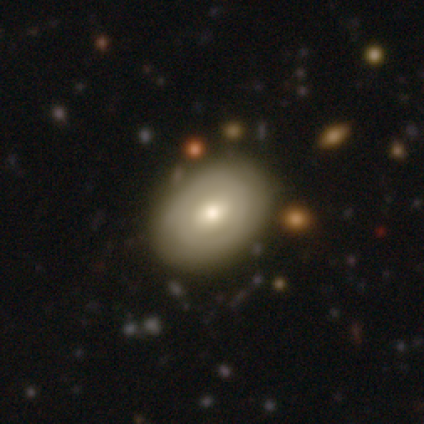


This week, Galaxy Zoo begins its latest incarnation, Galaxy Zoo: Cosmic Dawn, with tens of thousands of new galaxy images now available for you to help classify! These were taken by the Hyper Suprime-Cam (HSC) on board the 8.2m Subaru telescope on the summit of Mauna Kea in Hawaii, as part of the Hawaii Two-0 (H20) survey, a key component to the more ambitious Cosmic Dawn survey.
The Cosmic Dawn Survey is a multi-wavelength survey aiming to understand the co-evolution of galaxies, the dark matter haloes that host them, and their central black holes over cosmic time, all the way from when galaxies first formed in the early Universe. A major part of this is the H20 survey which has obtained ultra-deep Subaru HSC imaging over large and particularly dark areas of the sky. The H20 survey targets two areas of the sky which, as part of the Cosmic Dawn Survey, were observed by the Spitzer Space Telescope in the largest allocation of observing time ever awarded on the spacecraft. When combined with these infrared data, H20 aims to push the boundaries of extragalactic astronomy by studying galaxy evolution out to around 800 million years after the Big Bang. This incarnation of Galaxy Zoo features images from a portion of the sky called the Euclid Deep Field North (EDF-N), from one of the two areas targeted by the H20 survey.
This effort from Galaxy Zoo will therefore also help prepare for the upcoming launch of the Euclid space telescope by the European Space Agency (ESA) in 2023, with the classifications you make now helping to guide what Euclid will observe in more detail with its even higher resolution imaging in visible light and the infrared.

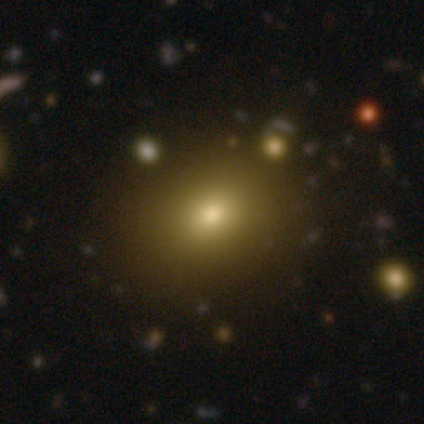
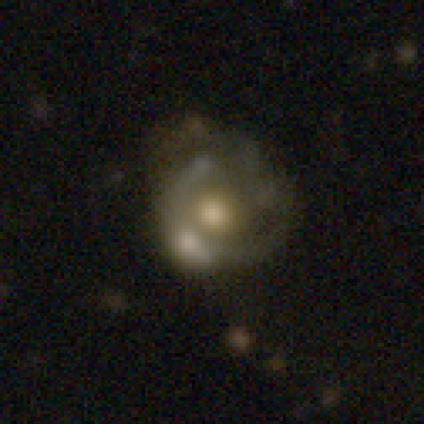
Compared to previous incarnations of Galaxy Zoo such as those using SDSS and DeCALS images, H20 enables us to see fainter and more distant galaxies from earlier in the Universe’s history, thanks to higher angular resolution of HSC and greater depth of the survey. However, deeper imaging also means we can observe many more distant galaxies in the same patch of sky, so the images you will see may often appear redder and blurrier than you might expect.
The Galaxy Zoo decision tree of questions has been modified so that your classifications can help refine the software used by the H20 team, and perhaps that of future Galaxy Zoo incarnations as well. For example, the “Star or Artifact” question now includes a “Bad Image Zoom” option, while selecting “Non-star Artifact” will allow you to classify the type of any image artifact you come across, such as satellite trails. In the future, Galaxy Zoo will also be running a simplified decision tree of questions for some of the fainter distant galaxies, as their lower resolution prevents many features from being identified.

Also, look out for any galaxies containing bright clumps! We’ve added a question about these, as they can help us understand the period of intense star formation that took place in the early Universe.
Finally, we are also asking volunteers to tag any extremely red objects, or those with a lens or arc features, in the Talk board, using the “Done & Talk” option. These are rare objects that we don’t want to miss, especially for such distant galaxies!
We are excited about the new images and looking forward to seeing what you’ll discover. Join the classification now!
James Pearson, Galaxy Zoo and H2O teams
Our last night at the telescope
The story so far: on the first night we were able to observe until 02:00 before the weather forced us to close. The following three nights we were confined to the Residencia, the place where they keep all the astronomers when they are not observing. Much to our surprise, this morning we awoke to a sky only sparsely covered by clouds, instead of being in the middle of one. Maybe we have a chance of observing something tonight?
== 19:30 ==
As the weather has cleared somewhat on Roque de Los Muchachos, La Palma, we have received permission to go to the telescope tonight. We’ve just arrived and started taking the first couple of calibration images with much enthusiasm.
A bit about the telescope itself: we’re using a telescope called the Isaac Newton Telescope (INT). It is a Cassegrain reflector telescope with a ~2.5m primary mirror that weighs ~4000kg!

It takes a while for the telescope to take all the calibration images (biases, arcs and flats), so we were able to enjoy the sunset right before -hopefully- a very busy night.
== 22:00 ==
Unfortunately the weather has taken a turn for the worse. We cannot open the dome of the telescope as the humidity is too high. We’ve had our first cups of coffee and are settling in for the night, while keeping an eye on the humidity sensor.
As tonight will be our last night at the telescope and we’ve had bad luck with the weather the last couple of days, we are very hopeful to observe some galaxies tonight. So far we were able to observe only one galaxy before we had to close on the first night. At this point we will be grateful for any data that comes in, even one more galaxy would double our current sample size!
== 00:45 ==
We’re still not able to open, humidity is at 100% and we cannot see any stars. The highlight of the last couple of hours was exploring the library in the INT and listening to an old cassette tape of Joseph and the technicolour dream coat. None of the other tapes work.
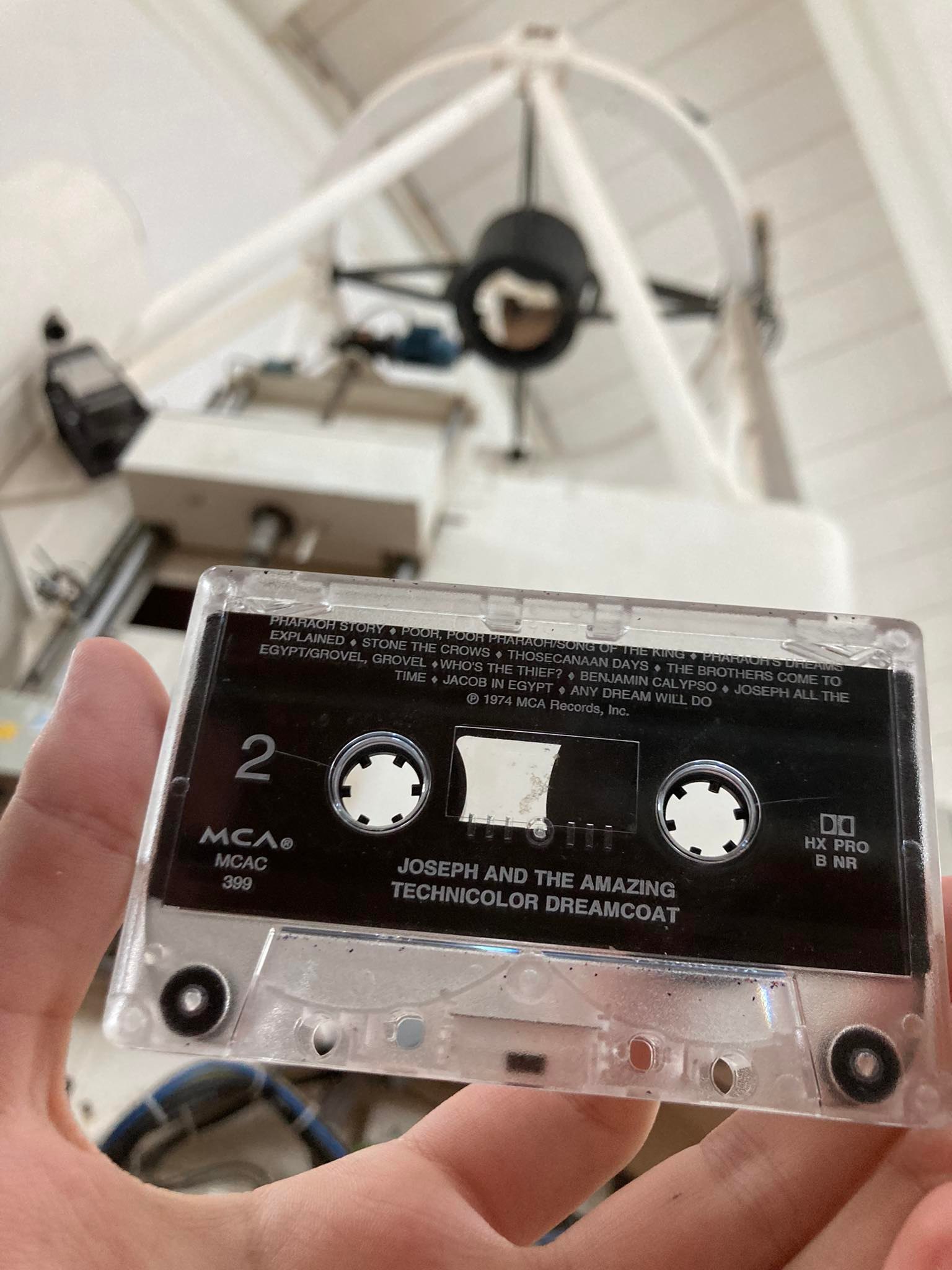
== 04:00 ==
We’ve had a popcorn and pizza break, drank multiple cups of coffee and explored most of the telescope building. However, unfortunately we’ve not been able to use the telescope today – the weather gods seem determined to prevent us from getting any data. With any luck we’ll be back next year to try again.

Observing bars in La Palma
As some might remember, in our last paper (which can be found here), we studied differences between weak and strong bars. One of our results was that star forming galaxies with stronger bars have significantly higher star formation in their centres compared to galaxies with weaker bars. This might be due to differences in the gas flows induced by the different types of bars. To investigate this, we selected a sample of 21 galaxies from Galaxy Zoo, which we plan to observe over the next couple days.
The relationship between galactic bars and star formation has long been up for debate. Galactic bars are vast structures of co-orbiting gas, dust and stars that form directly across the galactic nucleus. It is thought that gas flows along the arms of the bar into the centre, increasing the central gas density. As gas density increases, the star formation rate would also. So, that should be the answer then? However, in reality, it is not so simple.
There are many different kinds of bars, with varying characteristics such as strengths and orientations. A galaxy might contain a very strong bar – where it clearly dominates even over the galactic disk – or it could have a very weak bar – where the disk dominates over it. So, we need to ask ourselves further, is the gas flow and resultant star formation higher in galaxies with strong bars? What about weak bars? Does it even change at all if we compare either type of bar to galaxies which have no bars?
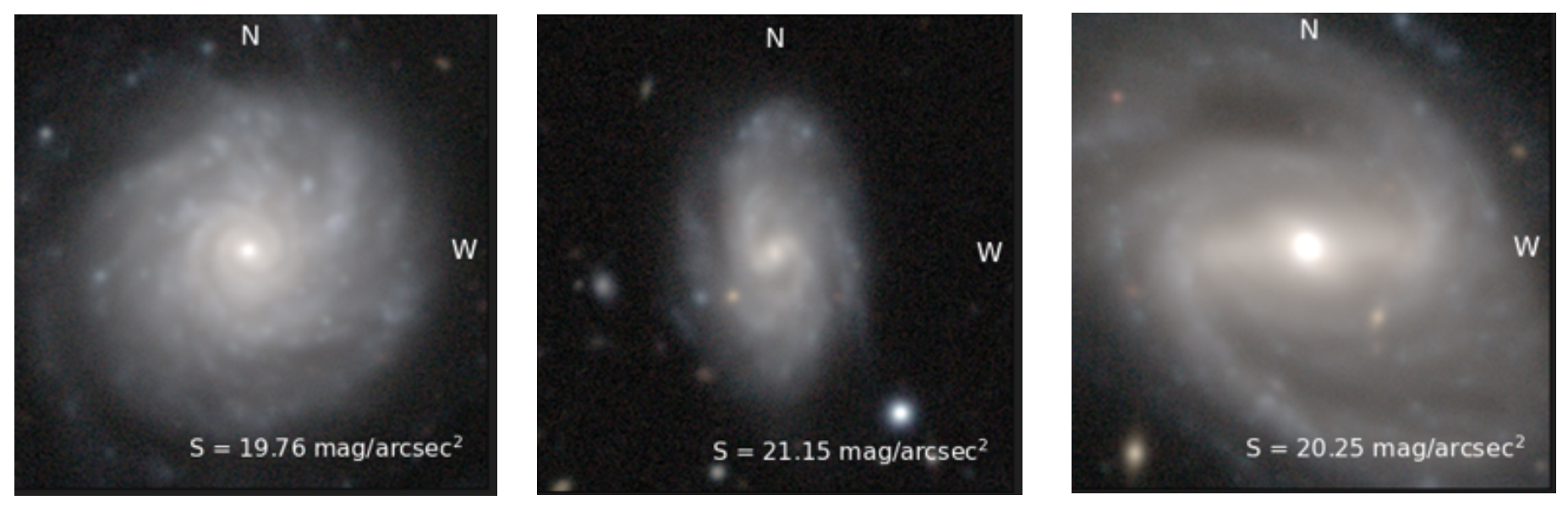
These are the questions we are going to answer at the Isaac Newton Telescope, or INT, on the island of Santa Cruz de la Palma. With a sample of 21 galaxies characterised by Galaxy Zoo – 7 strongly barred, 7 weakly barred and 7 with no bars at all – we are investigating if any relation between star formation rate and bar strength exists. An example of each type of galaxy in our sample is shown below. On the left is a galaxy with no bar at all, while on the right is a galaxy with a strong bar. The strong bar clearly dominates over the disk of the galaxy. The middle panel shows a galaxy with a much weaker bar, where the disk dominates over the disk galaxy.
To investigate this, we must turn to spectroscopy. Rather than utilise images, such as the ones above, we align a spectroscopic slit along and perpendicular to the bar direction on the image. The spectroscope will split the incoming light into a spectrum of wavelengths, where we will be able to find any spectral signatures of elements within the bars themselves.
There are two chemical signatures of star formation that we are looking for. The first, an indirect measurement, is looking for Hydrogen Alpha, or Hα. If there is a much higher abundance of Hα at the core of a galaxy with a strong bar, weak bar or not, it is very likely that there is a higher gas density. Ergo, there is a higher star formation. The second signature we are looking for is Oxygen III, or O[III]. O[III] is highly ionised only typically exists in areas where there are high rates of the star formation; the newly born stars being the cause of the ionisation. This would be direct evidence of higher star formation.
So, what do we find? Thus far, due to the adverse weather conditions caused by tropical storm Hermine on La Palma, we have set our spectroscopic observations on a single strongly barred galaxy. We have extracted the spectrum, removed any sources of contamination and reduced to only that of the bar and galactic nucleus. The top image is the spectrum from the slit at ninety degrees perpendicular to the bar direction and the bottom is aligned along it.


The top spectrum (perpendicular to the bar) appears to be almost empty, with only noise present. Along the bar, however, we get a very strong emission line at precisely 6562.801Å. Guess which wavelength Hα happens to rest at? Precisely the same!
This is certainly a promising initial result. If the abundance of Hα is much higher along bars than not, then this is certainly a case for them enhancing star formation! The next steps are to confirm this finding by taking observations for the rest of our sample. Once the weather clears up on La Palma, we will be aiming to finally answer the question, what do galactic bars do for star formation? Enhance, prevent or nothing? Well, it looks like enhancing has won the first point!
We will keep you updated!
Cheers,
David, Tobias and Chris
In the News – Ringed Galaxies from GZ Mobile
Dear volunteers,
Thanks to you, we’ve found 40,000 new ringed galaxies – about six times more than all the ringed galaxies anyone has ever found before! The Royal Astronomical Society were impressed enough to share the news in a press release here.

I launched the Rings Challenge here on this blog ten months ago, asking for your help searching for galaxies with rings around them. I wasn’t sure if anyone would be interested in using the new mobile project we made. Ten months later, you’ve made a million swipes on 100,000 galaxies. I’m so grateful.
Rings are rare. To help you find them, I created an automatic assistant. I used the first half of your swipes to teach an artificial intelligence algorithm what rings look like. Then I set the algorithm searching a million DESI galaxies to find more rings. Finally, I took the galaxies the AI thought might have rings and asked you to check them with the second half of your swipes. This two step approach let us both search many galaxies quickly and have human eyes vet all of our discoveries.
This is the first major science result from the new GZ Mobile project. Making an app wasn’t part of the original plan – the first iPhone launched three weeks after GZ, 15 years ago this month – but it’s now a crucial tool for hunting specific galaxies quickly. I hope you’ll join us for the next search.
Cheers,
Mike
P.S
You can find more technical details on the machine learning on my personal blog.
P.P.S
Apologies to ChristineM, who many months ago correctly point out that I should technically call them “ringed” galaxies rather than “ring” galaxies.
Happy Birthday (& a belated announcement)
Firstly, happy 15th birthday to Galaxy Zoo and thank you to all those who have made it a success over the last decade-and-a-half. Whether you’re a regular on Talk, and original classifier, a member of the science team or someone who has been inspired by the project to find out a little more about science, thank you!

Looking back at the BBC article that started everything, I notice we ‘hoped’ that 30000 people would take part in our project. We blew past that target early on, and haven’t looked back since. The results of the project have told us much about galaxy history, inspired novel machine learning approaches to science, helped us build the broader Zooniverse and much more. It still stuns me to think that there’s a Hubble Space Telescope program following up on Galaxy Zoo discoveries, and there is still much more science to come. (It’s not ridiculous to think that JWST, the new space telescope which will release its first image tonight, will soon follow up on a Galaxy Zoo discovery, or provide images for a future version of the project). My failure to anticipate this glorious feature came because we simply underestimated the passion, ability and enthusiasm of all of you to help learn a little bit more about the Universe.
I’m also very proud of the PhD students who have worked with the Galaxy Zoo team to make use of our data, and help lead the project. Several generations have now successfully graduated, and there’s much more to come from the current cohort. Since September, the project has been led by the immensely impressive Karen Masters, who has taken over from me as Principal Investigator, with assistance from Brooke Simmons (Deputy PI), Sandor Kruk (Project Scientist), Becky Smethurst (Deputy Project Scientist), and Mike Walmsley (Technical Lead). With them the project is in excellent hands, and I’m looking forward to the next decade-or-so of galaxy science, powered by you, the wonderful denizens of the Zoo.

