
Quench Boost: A How-To Guide, Part 1
The reaction to GZ Quench has been amazing. It has been great to see the interest and enthusiasm for supporting citizen scientists in experiencing the full scientific process.
This morning’s post was about how we have a small sample of additional galaxies to classify. I’ve really enjoyed watching how fast those are being done… gotta love the counter at http://quench.galaxyzoo.org/. Thank you all!
This post is Part 1 of our How-To-Guide for analyzing our classification results. It’s clear that you’re interested in getting your analysis on, but it may be that you’re not sure where to start. That’s 100% understandable and we’re here to help. We’ve broken down the steps into bite-size chunks. Let’s get started.
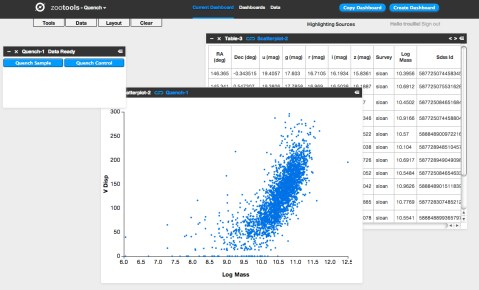
The first thing to do is to meet Quench Tools. This is the web platform to help you play with the data. To enter Quench Tools, click here. An in-line Tutorial will automatically pop-up, and guide you through entering the Quench area, loading the data, and creating your first figure. For additional information about Tools, check out our GZ Hangout about Tools, our text-based Tools Tutorial, and this Quench Talk discussion forum post.
In parallel with getting to know Tools, you may be interested in understanding the science context for why post-quenched galaxies (the GZ Quench sample) are so interesting for galaxy evolution studies. A great starting place for getting a sense of the science context and motivation is to read the summaries (written for the general public) of science articles at http://postquench.blogspot.com/. It’s modeled after the astrobites blog, a great resource for any astronomy enthusiast!
As you read those posts, you might want to join the conversation within the Quench Talk discussion forum. There are also a slew of links to popular science articles and websites for additional information about post-quenched galaxies and galaxy evolution.
And if you feel it would help to take a step back and see the big picture, definitely check out our initial GZ Quench blog post and this Quench Talk post.
Stay tuned for Part 2 of our How-To-Guide. In it, I’ll guide you through the next bite-size piece of this adventure – playing with your own classification results!
Quench: New Classifications Needed
We have a few dozen new galaxies in GZ Quench that need your classification savvy. As with all research projects, there are sure to be some glitches. Luckily we have a great group of Quenchers on the job. And as a few pointed out (including the force of nature that is Jean Tate!), 57 of our 3002 control sample galaxies were duplicates. We’ve identified suitable replacements and, to make sure no bias is introduced, we’ve added some of the original post-quenched galaxies to the mix as well. So let’s get classifying!
For a reminder about what GZ Quench is all about, check out the first Quench blog post. Yes, in this project, we’re not only classifying galaxies, but we’re going all the way to support our citizen scientists in experiencing the full process of science.
We’re now into Phase 2 of GZ Quench, analyzing the results of the classifications and making sense of our data. Our amazing group of Quenchers have provided incredibly useful feedback on the analysis tools we’ve made available and the analysis process. And there are already a number of intriguing results (for example, here and here)!
We’re now ready to give Quench a boost. Later today I’ll post Part 1 of our How-To-Guide, breaking the analysis phase into bite-size pieces and providing a smoother on-ramp for all of you out there who want to join in the GZ Quench experience, but aren’t sure where to begin.
Stay tuned…
GZ: Quench data update
Since finishing the classifications for the GZ: Quench project, many of our volunteers have been analyzing that consensus data using the tools at tools.galaxyzoo.org. We made a few changes to the site earlier this week, and I’d like to describe them and talk about how it might affect your work on the project.
First, a quick reminder of how the data is presented. As most of you probably remember, the classification process on GZ: Quench (and all GZ projects since GZ2) is what we call a “decision tree”. We begin with a broad question on morphology (ie, “Is this galaxy smooth, or does it have features or a disk?”) for the volunteer to answer. We then ask more specific follow-up questions that depend on the previous answers. For example – if you said the galaxy doesn’t have any spiral arms, it doesn’t make sense for us to then ask you how many arms there are – it doesn’t apply to this galaxy! So, out of 11 potential questions covering galaxy morphology, a single classifier will only answer a subset (between 4 and 9) of them. Here’s a flowchart of the decision tree for GZ: Quench — it’s an interesting exercise to look at it and work out how many unique morphologies you could sort galaxies into by going through the tree.
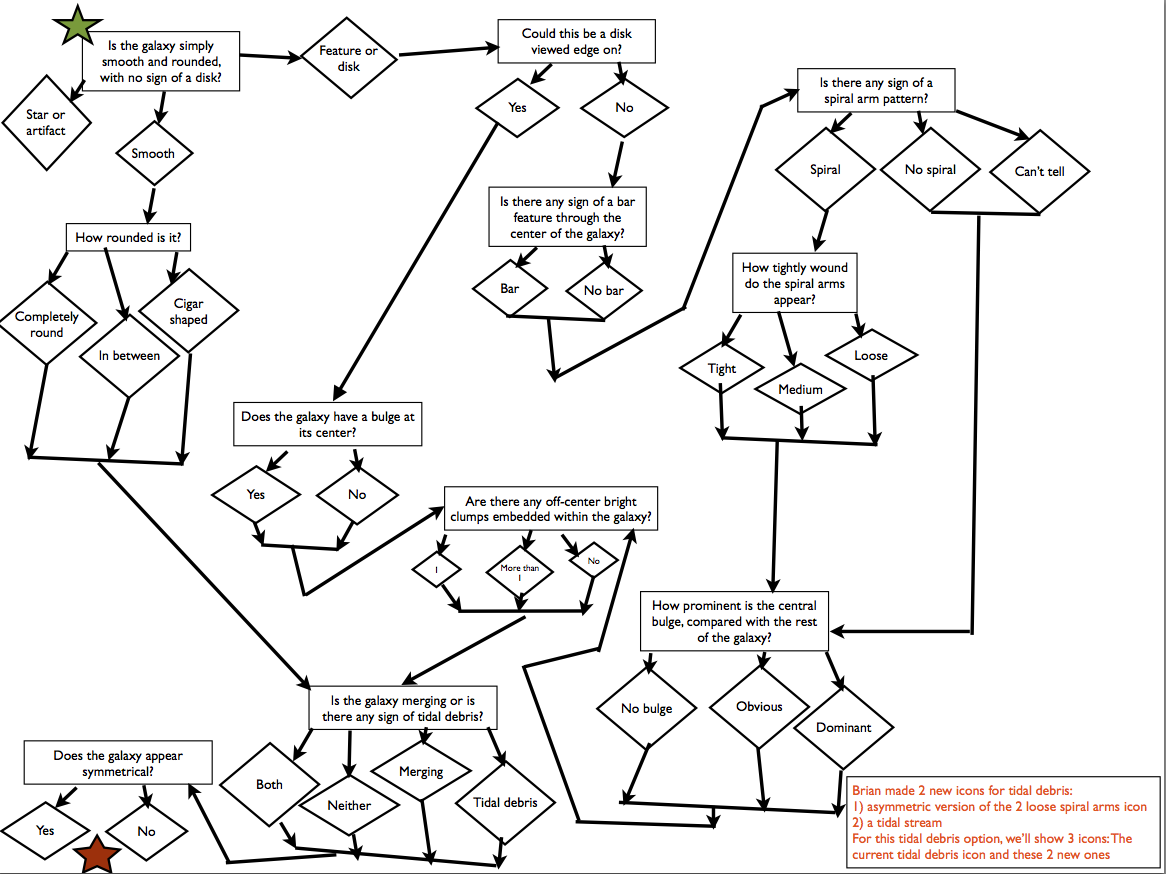
Flowchart of the morphology decision tree for GZ: Quench
So, why this discussion? When we added the data to the Tools website, we added a label in each category that gave the most common response to that question. For example, under “Arm tightness”, you could see that all galaxies were either “Tight”, “Medium”, or “Loose”. However, this is problematic when you’re trying to analyze data and compare different sets of galaxies. For smooth (or elliptical) galaxies, though, this arm classification is the result of very few votes (or even none) — they don’t represent the majority of classifications, and thus we really shouldn’t be including them when trying to compare what makes a medium-wound vs. a loosely-wound spiral.
The solution we’ve adopted has been to edit the data on Tools — questions whose answers don’t apply to the consensus morphology (eg, spiral arms in a smooth galaxy, or the roundness of a spiral) are now blank. This means that if you look at the average color or size of any of these morphology properties, you’re now truly comparing similar groups of objects (apples to apples). Including other galaxies in earlier samples likely introduced a significant amount of bias – the science team thinks that this will largely help to address that.
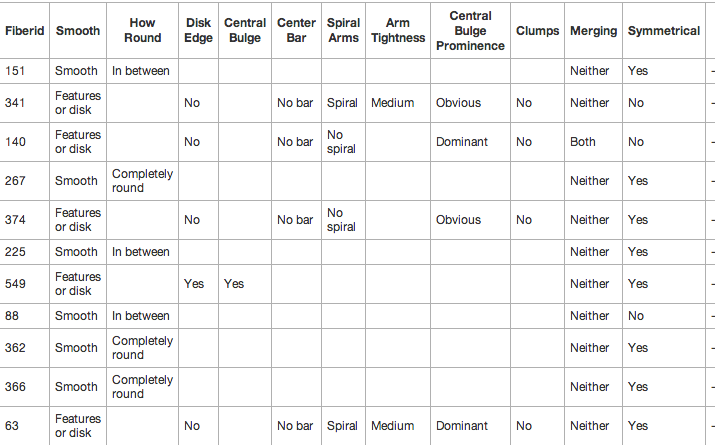
Example of the new GZ: Quench classification set in Tools
What does this mean for your analysis? Most of your old Dashboards and results should still work and remain valid results. For any work where you were analyzing morphological details (especially for spiral structure), though, we encourage you to revisit these and run them again on the new, filtered dataset. Please keep posting any questions you have on Talk, and we’ll answer them as soon as we can. Good luck!
And the winner is….. Arp 142 (The Penguin Galaxy)
Well it was a very close fought battle, but the winner of our fun vote to pick the cover image for the October A&G was:
Apr 142 (aka The Penguin Galaxy):
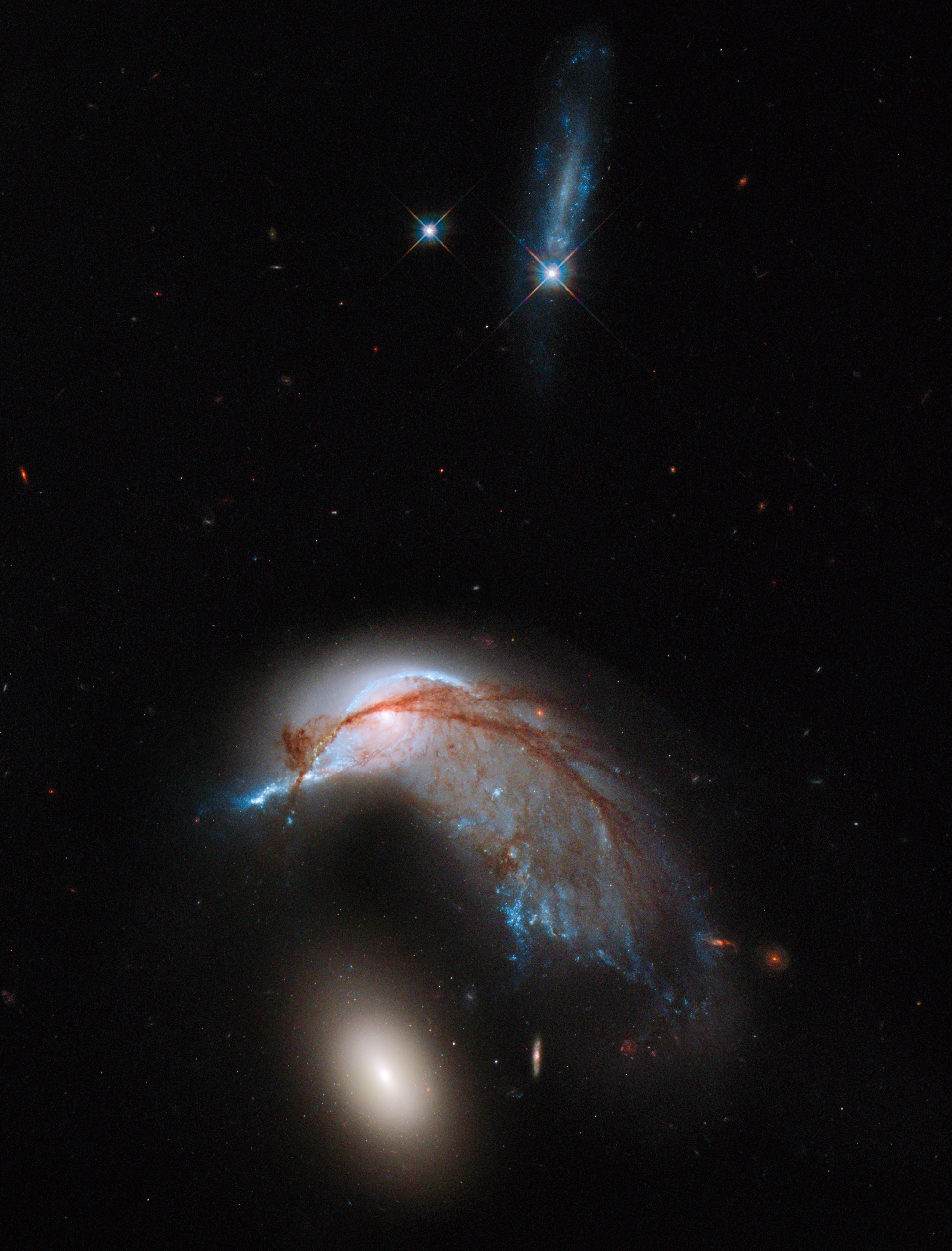
I include below a screen shot of the poll from today, which confirms that choice. We have now sent this choice to the cover editor, so we won’t count any more votes.

(Most) Galaxy Zoo Papers now Open Access
As announced on the Zooniverse blog, Oxford University Press have agreed that to make the Zooniverse papers published in Monthly Notices of the Royal Astronomical Society open access. While they’ve always been freely available on astro-ph, it’s nice that everyone who contributed can now get access – for free – via the main journal site.
GZ Quench: Classification Complete – Now the Real Fun Begins!
Congratulations all! We’ve completed Phase 1 of Galaxy Zoo Quench! Over 1600 people lent us their time and pattern-recognition skills to complete the needed 120,000 classifications. Thank you!
Now is when GZ Quench gets really fun, interesting, and totally different from past projects. We’re not stopping with classifications; we’re helping our volunteers to go all the way… from soup to nuts, as some like to say.
Phase 2 begins today and will run for the next few weeks*, with our science team supporting you, our esteemed Zooniverse volunteers, in the data analysis and discussion.

We’ll be using the results from our classifications of the 3002 post-quenched galaxies + 3002 control galaxies to address the following questions: What causes the star formation in these galaxies to be quenched? What role do galaxy mergers play in galaxy evolution? Join us in exploring these questions, being a part of the scientific process, and contributing to our understanding of this dynamic phase of galaxy evolution!
Luckily, we have great tools to help make this phase accessible to anyone, no matter your background.
- Quenchtalk.galaxyzoo.org – our discussion forum within which there are already really interesting and exciting conversations happening between Zooites and the science team. This forum allows us to share knowledge, pursue interesting results, collaboratively make sense of interesting plots, and determine which results to include in our article.
- Tools.zooniverse.org – our online data visualization environment, which helps you play with the data and look for trends. Click here for the blog post and to watch the GZ google hangout describing Tools and the Quench Tools tutorial.
- Authorea.com – the online article writing platform we’ll be using to collaboratively write the GZ Quench article, to be submitted to a professional journal. This is the same online environment that a group of over 100 CERN physicists are using to write their articles.
We can’t stress enough that you do not need prior background or knowledge to take part in this next phase. Each of you brings useful skills to the project – asking questions, communication, critical thinking, organization, leadership, consensus building, intuition, etc. Through Quench Talk, we’ll help you apply those skills in this context, and enable you to get your feet wet experiencing the full process of science.
Have questions about the project? Ask us on Twitter (@galaxyzoo), Facebook, or within Quench Talk.
*Science timelines often subject to a factor of two uncertainty. We’ll do our best to keep on track, at the same time expecting the unexpected (all part of the fun of doing science!).
Using Galaxy Zoo Classifications – a Casjobs Example
As Kyle posted yesterday, you can now download detailed classifications from Galaxy Zoo 2 for more than 300,000 galaxies via the Sloan Digital Sky Survey’s “CasJobs” – which is a flexible SQL-based interface to the databases. I thought it might be helpful to provide some example queries to the data base for selecting various samples from Galaxy Zoo.
This example will download what we call a volume limited sample of Galaxy Zoo 2. Basically what this means is that we attempt to select all galaxies down to a fixed brightness in a fixed volume of space. This avoids biases which can be introduced because we can see brighter galaxies at larger distances in a apparent brightness limited sample like Galaxy Zoo (which is complete to an r-band magnitude of 17 mag if anyone wants the gory details).
So here it is. To use this you need to go to CasJobs (make sure it’s the SDSS-III CasJobs and not the one for SDSS-I and SDSS-II which is a separate page and only includes SDSS data up to Data Release 7), sign up for a (free) account, and paste these code bits into the “Query” tab. I’ve included comments in the code which explain what each bit does.
 -- Select a volume limited sample from the Galaxy Zoo 2 data set (which is complete to r=17 mag).
 -- Also calculates an estimate of the stellar mass based on the g-r colours.
 -- Uses DR7 photometry for easier cross matching with the GZ2 sample which was selected from DR7.
 -- This bit of code tells casjobs what columns to download from what tables.
 -- It also renames the columns to be more user friendly and does some maths
 -- to calculate absolute magnitudes and stellar masses.
 -- For absolute magnitudes we use M = m - 5logcz - 15 + 5logh, with h=0.7.
 -- For stellar masses we use the Zibetti et al. (2009) estimate of
 -- M/L = -0.963+1.032*(g-i) for L in the i-band,
 -- and then convert to magnitude using a solar absolute magnitude of 4.52.
 select g.dr7objid, g.ra, g.dec,
 g.total_classifications as Nclass,
 g.t01_smooth_or_features_a01_smooth_debiased as psmooth,
 g.t01_smooth_or_features_a02_features_or_disk_debiased as pfeatures,
 g.t01_smooth_or_features_a03_star_or_artifact_debiased as pstar,
 s.z as redshift,
 s.dered_u as u, s.dered_g as g, s.dered_r as r, s.dered_i as i, s.dered_z as z, s.petromag_r,
 s.petromag_r - 5*log10(3e5*s.z) - 15.0 - 0.7745 as rAbs,
 s.dered_u-s.dered_r as ur, s.dered_g-s.dered_r as gr,
 (4.52-(s.petromag_i- 5*log10(3e5*s.z) - 15.0 - 0.7745))/2.5 + (-0.963 +1.032*(s.dered_g-s.dered_i)) as Mstar
-- This tells casjobs which tables to select from.
 from DR10.zoo2MainSpecz g, DR7.SpecPhotoAll s
-- This tells casjobs how to match the entries in the two tables
 where
 g.dr7objid = s.objid
 and
 -- This is the volume limit selection of 0.01<z<0.06 and Mr < -20.15
 s.z < 0.06 and s.z > 0.01
 and (s.petromag_r - 5*log10(3e5*s.z) - 15 - 0.7745) < -20.15
--This tells casjobs to put the output into a file in your MyDB called gz2volumelimit
 into MyDB.gz2volumelimit
Once you have this file in your MyDB, you can go into it and make plots right in the browser. Click on the file name, then the “plot” tab, and then pick what to plot. Colour-magnitude diagrams are interesting – to make one, you would plot “rabs” on the X-axis and “ur” (or “gr”) on the yaxis. There will be some extreme outliers in the colour, so put in limits (for u-r a range of 1-3 will work well). The resulting plot (which you will have to wait a couple of minutes to be able to download) should look something like this:

Or if you want to explore the GZ classifications, how about plotting “psmooth” (which is approximately the fraction of people viewing a galaxy who thought it was smooth) against the colour.
That plot would look something like this:
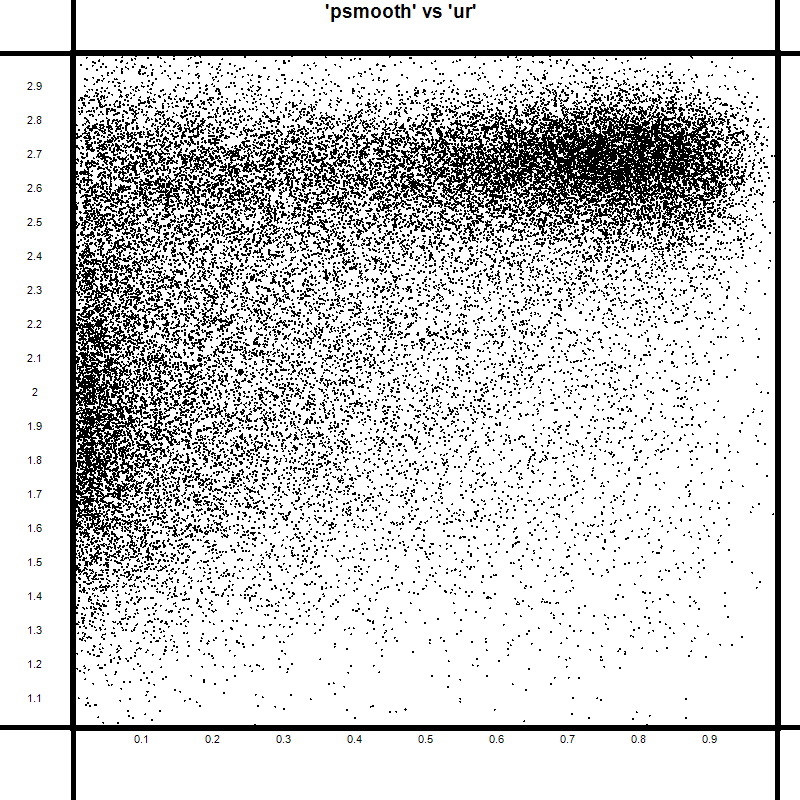
Which reveals the well known relationship between colour and morphology – that redder galaxies are much more likely to be ellipticals (or “smooth” in the GZ2 language) than blue ones.
You can learn more about SQL and the many things you could do with CasJobs at the Help Page (and then come back and tell me how simple my query example was!).
This example only downloads the very first answer from the GZ2 classification tree – there’s obviously a lot more in there to explore.
(Note that at the time of posting the DR10 server seemed to be struggling – perhaps over demand. I’m sure it will be fixed soon and this will then work.)
SDSS Data Release 10 and Galaxy Zoo 2
Since the original launch of the Sloan Digital Sky Survey (SDSS) in 2000, the data from the project has been released to the public on a timescale of every year or two. These Data Releases include both new observations from the telescope, as well as refinements to old data based on improving the processing and reduction routines.
Today, Sloan announced that Data Release 10 (DR10) is now available to both the general astronomy community and to the public. It contains the first release of spectra from the APOGEE experiment, which has been observing tens of thousands of red giant stars in the Milky Way. It also includes new data from BOSS, which has been measuring redshifts for distant galaxies in order to measure cosmological parameters and study structure formation.
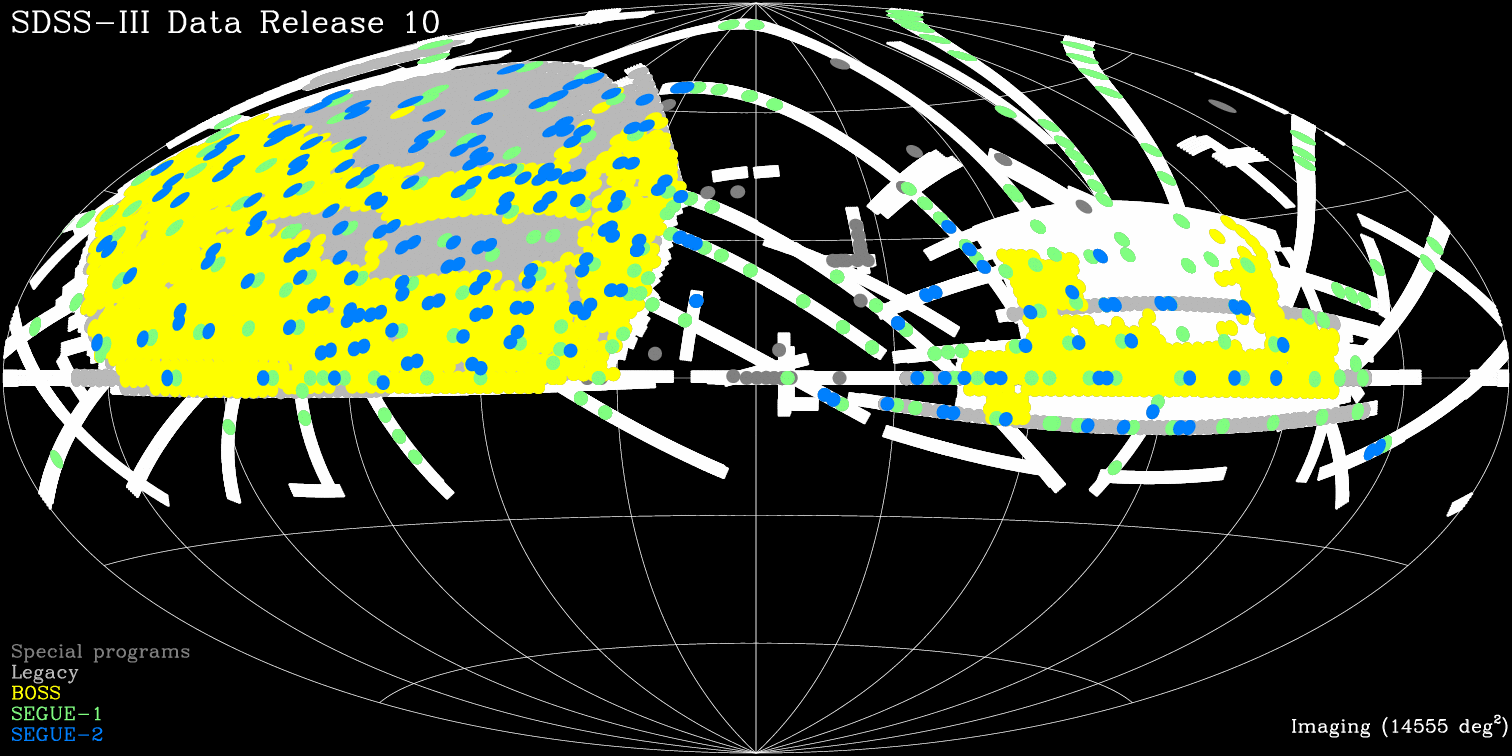
Sky coverage of the SDSS data contained in DR10
The original data from Galaxy Zoo was included in the SDSS Data Release 8. That’s quite important for a couple of reasons. It makes it much easier for scientists to use the GZ data, since SDSS uses this as the input for their own database, called CasJobs. This database enables matching of morphologies to other properties of the galaxies that SDSS measures, such as color or size. It also provides one of the main means of access to the data for people who aren’t members of the Galaxy Zoo team. Finally, it’s a validation that your GZ classifications have become a core data product of the survey, and something which is worth preserving and sharing as widely as possible.
In DR10, we’re happy to announce that data from Galaxy Zoo 2 is available for the first time. The reduction and description of the data is covered in a recent paper, which received a very favorable referee report a couple of weeks ago and will be resubmitted soon. We’ll share the paper as soon as it’s been formally accepted. The GZ2 data will also be hosted on our own site within Galaxy Zoo in the near future.

Galaxy Zoo 2 data is now on CasJobs!
Please check out DR10 if you’re interested in peeking at the GZ2 data – do acknowledge both Willett et al. (GZ2) and Ahn et al. (DR10) if you end up using it, though. Congratulations to the SDSS team on this new release!
Next GZ (Tools!) Hangout: Wednesday 24th July, 20:30 GMT

With the Quench project well underway and the start of the next phase of the project around the corner, it’s time for another hangout — this time with a focus on using the new Zoo Tools data analysis suite to work with Quench data!
We’ll start at 15:30 CDT (Chicago), which is 13:30 PDT, 16:30 EDT, 20:30 GMT, 21:30 BST, 22:30 CET, and 23:30 CAT. That’s getting a bit late for Europe and Africa, but if you can’t make the hangout on the day, don’t worry, we’ll post the recording of it as soon as possible.
Have questions? Post them here or tweet at us (@galaxyzoo). Just before the hangout starts, we’ll embed the video here so you can watch from the blog. And feel free to try out tools.zooniverse.org (and check out the Zooniverse blog post about it) beforehand!
The best way to send us a comment during the live hangout is to tweet at us, but you can also leave a comment on this blog post, or on Google Plus, Facebook or YouTube, which we’ll also try to keep an eye on. See you soon!
Note: if you’d prefer a text-based tutorial, check out this Zooniverse blog post.
Zoo Tools: A New Way to Analyze, View and Share Data
Your Galaxy Zoo data can be explored using our new Zoo Tools site. It’s currently in beta (meaning it’s not perfect!) but if you’re interested in plotting and sharing data, you should give it a try.

Since the very first days of Galaxy Zoo, our projects have seen amazing contributions from volunteers who have gone beyond the main classification tasks. Many of these examples have led to scientific publications, including Hanny’s Voorwerp, the ‘green pea’ galaxies, and the circumbinary planet PH1b.
One common thread that runs through the many positive experiences we’ve had with the volunteers is the way in which they’ve interacted more deeply with the data. In Galaxy Zoo, much of this has been enabled by linking to the Sloan SkyServer website, where you can find huge amounts of additional information about galaxies on the site (redshift, spectra, magnitudes, etc). We’ve put in similar links on other projects now, linking to the Kepler database on Planet Hunters, or data on the location and water conditions in Seafloor Explorer.
The second part of this that we think is really important, however, is providing…
View original post 1,026 more words

